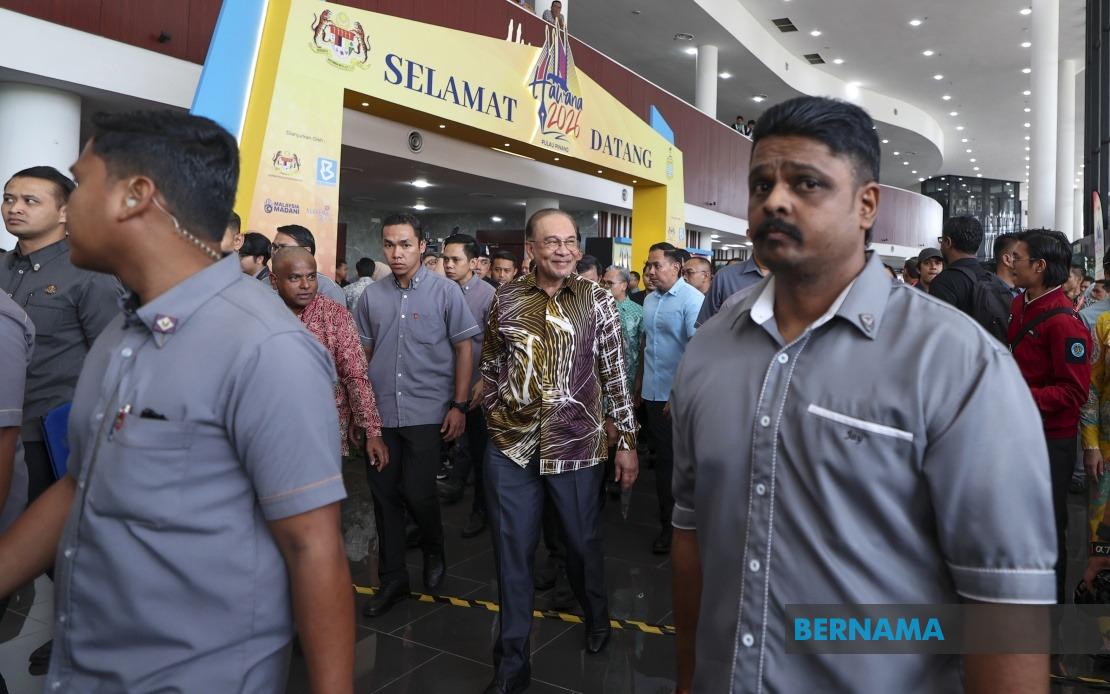
Prime Minister Datuk Seri Anwar Ibrahim officially opened the National Journalists' Day (HAWANA) 2026 celebration on June 20 at the PICCA Convention Centre @ Butterworth Arena, underscoring the government's commitment to recognising the role of media professionals in maintaining democratic discourse and public trust. Arriving at 2.40 pm, he was received by Penang Chief Minister Chow Kon Yeow, Communications Minister Datuk Fahmi Fadzil and Communications Ministry secretary-general Datuk Abdul Halim Hamzah, signalling the significance attached to the event both at federal and state level.
The Prime Minister took time to engage with the event's interactive elements, visiting exhibition booths and touring the HAWANA 2026 Photo Gallery displayed in the venue's foyer. This hands-on approach reflected the government's intention to demonstrate tangible support for the journalism community at a time when the industry faces mounting pressures from digital disruption and declining trust in traditional news sources. The exhibition space served as a showcase for media innovation and industry best practices, offering practitioners an opportunity to display their work and exchange ideas.
The gathering drew significant participation from Malaysia's media establishment and regional counterparts. Among those present were Malaysian National News Agency (Bernama) chairman Datuk Seri Wong Chun Wai, Bernama chief executive officer and HAWANA 2026 Working Committee chairman Datin Paduka Nur-ul Afida Kamaludin, and key editorial figures within the agency. The presence of senior government communicators alongside industry leadership underscored a collaborative approach to addressing contemporary challenges in news dissemination and public information delivery.
The event transcended national boundaries, attracting delegates from across Southeast Asia and beyond. Timor-Leste sent its Secretary of State for Social Communication Expedito Loro Dias Ximenes, while Cambodia's Ministry of Information was represented by Undersecretary of State Prak Thaveak Amida. Laos' Ministry of Technology and Communications contributed its Permanent Secretary of the Cabinet Office, Phuangpasert Keosouvanh. This regional participation reflected the shared challenges facing media institutions throughout Southeast Asia, where concerns about misinformation, resource constraints and changing consumption patterns affect newsrooms from Bangkok to Dili.
International news agencies and journalism organisations further broadened the event's scope. Delegates from Indonesia's Antara News Agency, Vietnam News Agency (VNA), and China's Xinhua News Agency attended alongside professional bodies including the Indonesian Journalists Association (PWI) and the Ikatan Setiakawan Wartawan Malaysia-Indonesia (ISWAMI). This convergence of regional and international media voices created a platform for cross-border dialogue on industry standards and contemporary reporting challenges, particularly relevant as economic integration and digital connectivity blur traditional geographic boundaries in news production.
Central to the ceremonial proceedings was the presentation of HAWANA Awards and Special HAWANA Awards to individuals demonstrating exceptional contributions to journalism and the advancement of public discourse. These accolades serve not merely as recognition but as endorsements of professional excellence, signalling to the broader journalism community the values and standards the government and media organisations collectively champion. Alongside awards, the Prime Minister distributed contributions from the Kasih@HAWANA Fund to media veterans, a gesture acknowledging the sector's historical contributors during an era when economic pressures increasingly squeeze traditional media revenue streams.
The event operated under the overarching theme of 'Media Integrity Strengthens Credibility', a statement of principle addressing fundamental concerns about public faith in news institutions. This thematic focus carries particular resonance in Malaysia and throughout the region, where political polarisation, social media misinformation and partisan news sources have fragmented the information landscape. By elevating integrity as a central concern, the gathering positioned ethical journalism as essential infrastructure for democratic functioning and informed citizenship.
With approximately 1,000 media practitioners assembled, HAWANA 2026 functioned as a strategic convening aimed at generating innovative thinking about journalism's future. The sheer attendance underscores continued industry vitality despite significant headwinds, while the concentration of professionals created a rare opportunity for sectoral introspection about emerging challenges and opportunities. These gatherings typically facilitate networking that translates into collaborative projects, knowledge transfer and collective efforts to address shared industry problems.
HAWANA, organised by the Ministry of Communications with Bernama serving as implementing agency, fulfils a specific institutional function within Malaysia's media ecosystem. As an annual observance, it provides formal recognition of journalism's societal role while simultaneously offering government opportunity to articulate its media policy priorities and values. The inclusion of regional delegates transformed what might otherwise be a domestic commemoration into a multilateral discussion forum, positioning Malaysia as a convener of Southeast Asian media dialogue.
The timing and scope of HAWANA 2026 reflects broader regional developments in journalism and digital communication. Southeast Asian newsrooms increasingly navigate questions about sustainability models, audience engagement across platforms, verification methodologies for user-generated content, and relationships between state institutions and independent media. By bringing together practitioners, policymakers and international colleagues, the event created space for examining these issues collectively rather than in institutional isolation.
Prime Minister Anwar's participation emphasised government acknowledgment of journalism's democratic function at a time when media institutions globally face existential questions about revenue sustainability, audience trust and competitive positioning relative to social platforms. His presence communicated that the Malaysian government recognises journalism as meriting policy attention and resource commitment, a positioning increasingly necessary as digital disruption reshapes the media landscape across developing economies.
Looking forward, the diverse participation and high attendance suggest that regional appetite remains strong for professional communities to convene, share experiences and collectively develop responses to industry transformation. For Malaysian journalists specifically, HAWANA 2026 offered both celebration of the profession's achievements and engagement with the evolving standards and practices that will shape journalism's role in an increasingly complex information environment.

