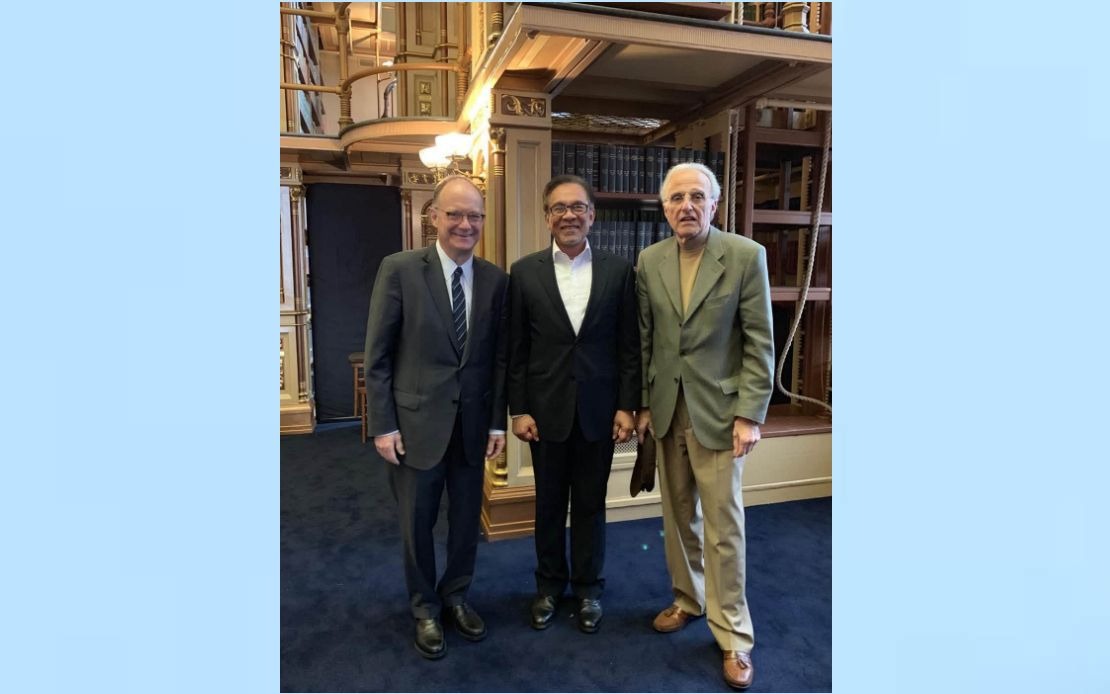
Prime Minister Datuk Seri Anwar Ibrahim has expressed profound grief over the death of Professor John L. Esposito, one of the world's most prominent and respected scholars specialising in Islamic studies. Through a Facebook post released on July 16, Anwar extended heartfelt condolences to Esposito's immediate family, including his wife Jean, as well as his professional colleagues and the many students whose lives were shaped by his decades of academic work. The Prime Minister's public tribute underscores the deep personal and intellectual bonds that existed between these two men across more than fifty years of acquaintance.
The relationship between Anwar and Esposito began in the early 1970s, a formative period for both the Malaysian leader and the American academic. Over the subsequent decades, their connection transcended the typical scholar-politician dynamic, evolving into a genuine friendship grounded in mutual respect and shared vision for interfaith understanding. Anwar's decision to publicly acknowledge this bond demonstrates the significance that Esposito held not merely as an intellectual figure but as a personal confidant and trusted advisor. This long association positioned Esposito as witness to Anwar's own intellectual and political evolution, providing a bridge between Malaysian and broader Western perspectives on Islam.
Esposito's scholarly legacy rests fundamentally on his unwavering commitment to fostering genuine dialogue between Muslim and Christian communities at a time when such endeavours were neither fashionable nor widely supported. As the founding director of Georgetown University's Centre for Muslim-Christian Understanding, Esposito institutionalised what many considered an undervalued academic pursuit, creating lasting structures and frameworks for serious, respectful engagement across religious boundaries. His role in establishing this centre cannot be overstated, as it provided institutional legitimacy and resources to research that challenged prevailing stereotypes and contributed to more nuanced understandings of Islamic thought and practice in the contemporary world.
Among Esposito's numerous scholarly contributions, his work as co-author of "Makers of Contemporary Islam" stands out as a significant attempt to document and analyse the intellectual movements and key figures shaping modern Islamic thought. This volume, alongside his other academic works, represented an effort to move beyond oversimplified narratives and present Islam as a dynamic, internally diverse, and continuously evolving civilisation. For Malaysian and Southeast Asian readers, such scholarship holds particular relevance given the region's own complex religious landscape and the ongoing negotiations between traditional Islamic values and contemporary globalisation.
Perhaps most significantly for the general reader, Esposito's more accessible publications democratised scholarly understanding of Islamic history and contemporary issues. Works such as "What Everyone Needs to Know About Islam" and "Who Speaks for Islam?" translated rigorous academic analysis into prose comprehensible to educated laypeople, a task of considerable importance especially in the period following the September 2001 attacks. During that tumultuous era, when misinformation about Islam proliferated and nuanced discussion proved increasingly difficult to sustain, Esposito's accessible writings provided an intellectual counterweight, offering factual foundations for public discourse at precisely the moment such grounding was desperately needed.
Anwar's characterisation of Esposito as someone who "built bridges where others were content to build civilisational barriers" captures the essence of the scholar's philosophical approach. Rather than accepting the "clash of civilisations" framework that gained prominence in some Western intellectual circles, Esposito invested his career in demonstrating the possibilities for understanding, cooperation, and mutual enrichment across religious and cultural divides. His example proved influential for scholars and policymakers throughout the Muslim world and beyond, including figures like Anwar who similarly championed interfaith dialogue as essential to global stability and mutual prosperity.
The Prime Minister's recollections of their private interactions reveal a dimension of Esposito's character that extended well beyond the public intellectual persona. Anwar noted that Esposito brought the same intellectual rigour to private conversation as he demonstrated in his published scholarship, suggesting a consistency of character and commitment that many find admirable in academic life. His willingness to stand by Anwar "through thick and thin" suggests Esposito understood friendship not as a casual association but as a fundamental commitment transcending professional convenience or political calculation. In Malaysian and Asian contexts, where personal relationships often carry significant weight in professional and diplomatic spheres, such loyalty would be particularly valued and remembered.
Esposito's passing represents a significant loss for interfaith scholarship and for the broader project of fostering mutual understanding between Islamic and Western societies. His death comes at a moment when the world continues to grapple with religious polarisation, geopolitical tensions intertwined with religious identity, and competing narratives about Islam's place in contemporary global affairs. The loss of such a prominent voice for nuanced, scholarly engagement leaves a notable void in public intellectual discourse, particularly for those seeking factually grounded analysis unburdened by ideological presupposition or sensationalism.
For Malaysia specifically, Esposito's intellectual contributions carry particular significance given the nation's position as a Muslim-majority democracy with substantial non-Muslim populations and significant involvement in regional and global affairs. His work provided frameworks for thinking about Islam not as monolithic or inherently opposed to Western values, but as internally diverse, historically developed, and capable of coexisting with secular governance and religious pluralism. These insights proved relevant for Malaysian policymakers and intellectuals navigating their own complex terrain of managing religious identity, national cohesion, and international relations.
Anwar's tribute concludes with hope that Esposito's scholarly legacy and the dialogical tradition he spent his life cultivating will continue to yield benefits for generations to come. This forward-looking dimension of the tribute acknowledges that the impact of major intellectual figures often extends long beyond their lifetime, influencing students, readers, and institutional structures in ways that cannot be immediately measured. By invoking Esposito's enduring relevance even after his passing, Anwar suggests that the principles and approaches the scholar championed remain essential for addressing contemporary global challenges. The Prime Minister's final characterisation of Esposito as "a true friend to the Muslim world" encapsulates the scholar's role not merely as an external observer or analyst of Islamic civilisation, but as a genuine ally committed to its flourishing and its just representation in global discourse.

