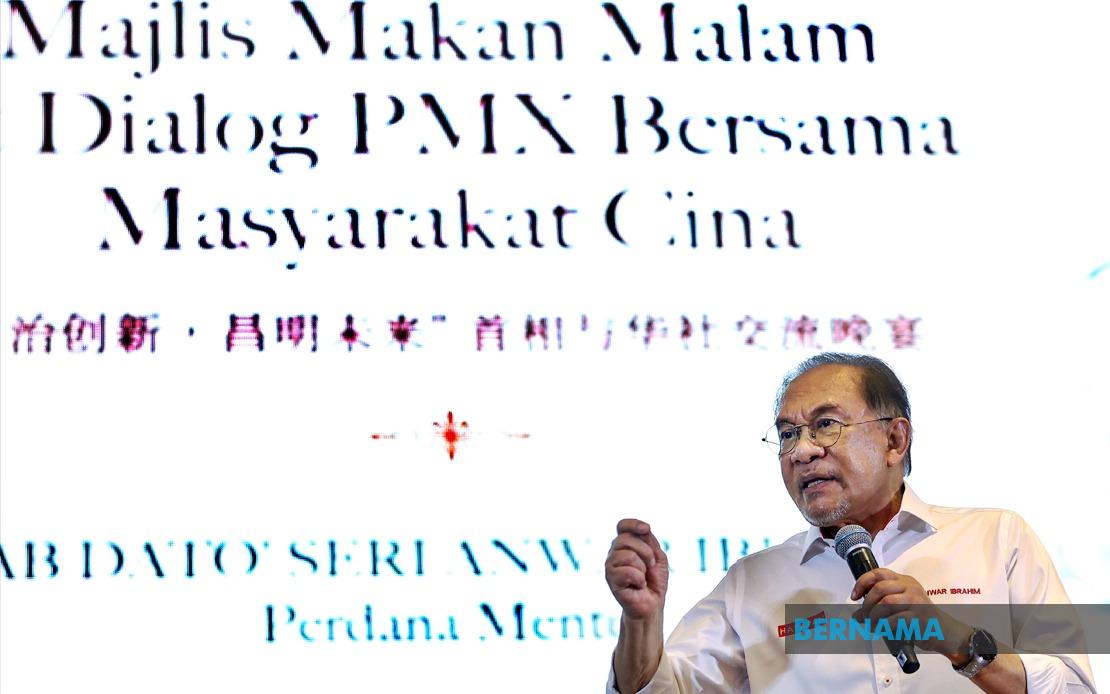
Prime Minister Datuk Seri Anwar Ibrahim has reaffirmed his determination to guide Malaysia towards becoming a prosperous and thriving nation, underscoring his vision for inclusive leadership that transcends ethnic and communal boundaries. Speaking at a gathering with members of the Chinese community in Johor Bahru, the Prime Minister articulated a vision rooted in accessibility and equity, positioning himself as a leader who actively engages with every sector of Malaysian society irrespective of background.
At this juncture in his political career, Anwar has identified the cultivation of a leadership legacy as his primary objective. Rather than pursuing grandiose policy initiatives or headline-grabbing reforms, the Prime Minister emphasizes the foundational importance of integrity, transparency, and equitable governance. His framing of these values reflects a deliberate strategic choice to ground his administration's identity in principles that resonate across Malaysia's diverse demographic landscape, particularly crucial in a multiethnic nation where perceptions of fairness remain deeply contested.
The Prime Minister's remarks carry particular significance given Malaysia's recent political turbulence and the erosion of public confidence in governmental institutions. By explicitly committing to fair and clean leadership, Anwar positions his administration as a corrective response to the governance failures and corruption scandals that plagued previous regimes. This messaging strategy seeks to rebuild institutional legitimacy by emphasizing procedural fairness and ethical conduct as foundational to his government's mandate.
Anwar's emphasis on serving "every single citizen" without distinction represents more than rhetorical flourish. It acknowledges the complex challenge of governing a nation where competition for resources and representation frequently aligns along communal lines. By highlighting his commitment to all communities, the Prime Minister attempts to transcend the zero-sum dynamics that characterize much of Malaysian political discourse, where gains for one group are frequently perceived as losses for another.
The invocation of personal legacy reveals important dimensions of Anwar's political psychology and strategic calculus. At an advanced stage of his career, having endured imprisonment, political exile, and repeated comebacks, Anwar frames his motivations in terms transcending personal power accumulation. Instead, he positions himself as seeking validation through popular affection and historical esteem, suggesting that the ultimate measure of his leadership lies in whether citizens remember him with warmth and reciprocal regard.
This emotional register—emphasizing love between leader and people—contrasts with more transactional or performance-based leadership narratives. Anwar's insistence that citizens will ultimately judge him based on whether he "loved the people" appeals to sentiments of care and genuine concern rather than technical competence or economic outcomes alone. For Malaysian voters historically conditioned by patronage networks and personal relationships in politics, this framing carries particular resonance.
The presence of Parti Keadilan Rakyat vice president and Selangor Menteri Besar Datuk Seri Amirudin Shari at the event underscores the formal nature of the gathering and signals continuity between federal and state-level governance priorities. The inclusion of PKR leadership alongside the Prime Minister reinforces party cohesion and presents a unified front regarding the administration's core values and strategic direction.
For Malaysian readers and regional observers, Anwar's articulation of leadership priorities offers insight into how the government intends to navigate persistent challenges around institutional trust, ethnic-religious tensions, and economic performance. By anchoring his administration's identity in principles of fairness and inclusivity rather than specific policy achievements, the Prime Minister may be hedging against the political vicissitudes that have characterized Malaysia's recent governance landscape.
The broader context reveals an administration conscious of its vulnerability to future political realignment. By emphasizing values rather than accomplishments, Anwar creates a more durable political narrative resistant to shifting coalitions or changing economic circumstances. This approach acknowledges that in Malaysia's fluid political environment, where alliances frequently reorganize and public sentiment shifts rapidly, anchoring legitimacy in ethical principles offers greater stability than dependence on concrete deliverables.
For Southeast Asia more broadly, Anwar's emphasis on cross-communal engagement and inclusive governance carries implications for regional stability and democratic norms. Malaysia's ability to maintain cohesion while managing deep social diversity influences regional perceptions of Southeast Asian democratic governance and intercommunal relations. Leaders throughout the region watching Anwar's approach to balancing unity with pluralism may calibrate their own governance strategies accordingly.
The gathering in Johor Bahru, a state with significant Chinese representation, served as an appropriate venue for articulating themes of communal inclusion. By engaging directly with Malaysian Chinese communities, Anwar demonstrated tangible commitment to the inclusive principles he articulated, moving beyond abstract rhetoric toward concrete relationship-building with specific constituencies. Such engagement becomes increasingly important as Malaysia navigates economic challenges and social fragmentation that threaten national cohesion.

