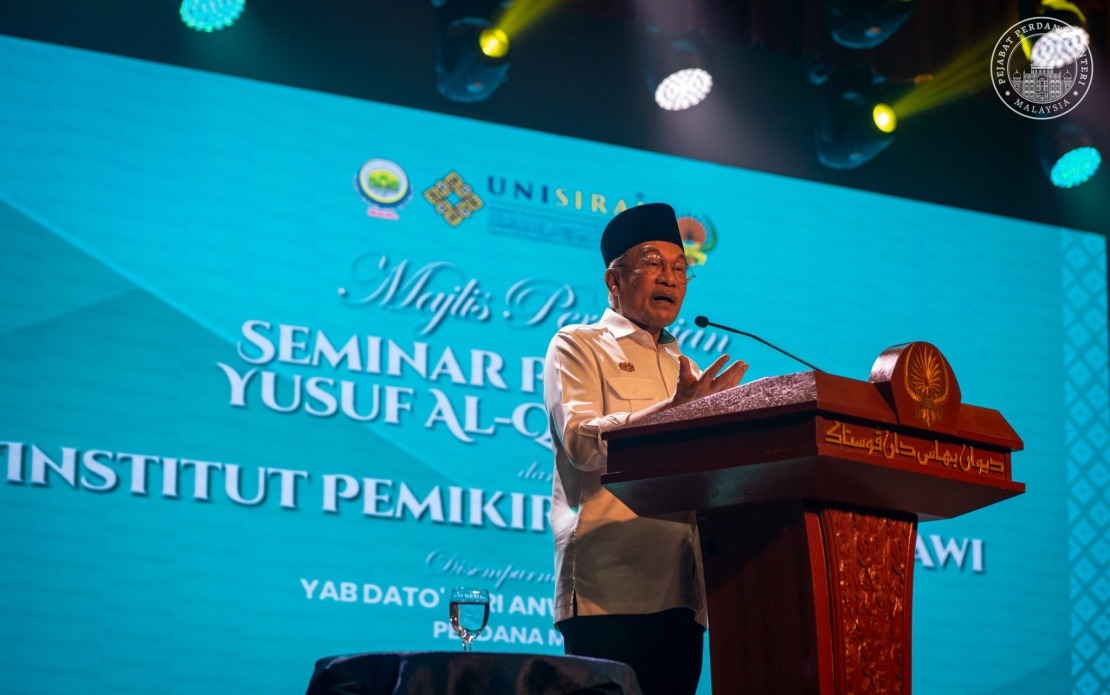
Prime Minister Datuk Seri Anwar Ibrahim has committed RM2 million in MADANI Government funding towards the Al-Qaradawi Thought Institute, signalling the administration's backing for research and scholarship honouring the late Islamic scholar Sheikh Dr Yusuf Al-Qaradawi. The announcement came during the opening of both the Yusuf Al-Qaradawi Thought Seminar and the institute itself at Wisma Dewan Bahasa dan Pustaka in Kuala Lumpur, underscoring the government's prioritisation of intellectual development within Islamic academia across the region.
Anwar's personal connection to Al-Qaradawi runs deep, forged through decades of intellectual exchange and shared philosophical convictions regarding the direction of Islamic thought in the modern world. The Prime Minister outlined his profound gratitude towards the scholar, acknowledging the formative influence that Al-Qaradawi's ideas, mentorship, and principled friendship had exerted on his own intellectual formation. Through a statement posted on X, Anwar expressed hope that such institutional endeavours would prove spiritually fruitful and contribute meaningfully to the enlightenment and wellbeing of the broader Muslim community.
The financial commitment reflects broader governmental interest in cementing Malaysia's role as a centre for progressive Islamic scholarship. By establishing a dedicated institute bearing Al-Qaradawi's name and supporting its operational and research functions, the government acknowledges the enduring relevance of his intellectual contributions at a time when Muslim-majority societies grapple with modernisation, governance, and the reconciliation of tradition with contemporary realities. The institute is positioned to become a hub for examining Al-Qaradawi's voluminous writings and his methodological approaches to Islamic jurisprudence.
Anwar's formative years with the Malaysian Islamic Youth Movement, or ABIM, proved instrumental in establishing his relationship with Al-Qaradawi during the pivotal 1980s. During this era of heightened Islamic resurgence across Southeast Asia and the broader Muslim world, Al-Qaradawi maintained sustained correspondence with emerging Islamic leaders, offering intellectual guidance and strategic counsel. His intervention in ABIM's developmental trajectory proved particularly consequential, as he counselled the movement's leadership to embrace intellectual flexibility and reject rigid ideological postures that might alienate potential constituencies or limit the movement's capacity to engage with pluralistic societies.
The principle of wasatiyyah, or Islamic moderation, emerged as the cornerstone of Al-Qaradawi's intervention in ABIM's intellectual direction during the early 1980s. At a moment when enthusiasm for Islamic renewal occasionally veered towards doctrinal rigidity and confrontational approaches, Al-Qaradawi's counsel advocated for an alternative vision rooted in balanced reasoning and openness to diverse perspectives. Anwar characterises this guidance as invaluable amid a climate where ideological fervour sometimes crowded out nuance and where receptivity to alternative viewpoints faced considerable headwinds from more doctrinaire constituencies within the broader Islamic movement.
Al-Qaradawi's significance extends beyond his influence on individual leaders like Anwar; he exemplified what the Prime Minister describes as an agent of change or zeitgeist—a figure whose intellectual output shaped the spirit of successive eras. His prolific scholarship, fatwa issuances, and public advocacy positioned him as a bridge-builder between classical Islamic jurisprudential traditions and the exigencies of contemporary Muslim societies navigating secularisation, technological transformation, and pluralistic coexistence. His insistence on reform undertaken from within Islamic frameworks rather than through wholesale capitulation to secularist paradigms resonated across generations of Islamic intellectuals and activists.
The establishment of the institute arrives at a moment when Southeast Asia confronts persistent questions regarding the compatibility of Islamic governance frameworks with democratic institutions and multicultural societies. Malaysia itself has long positioned itself as a laboratory for such experimentation, maintaining constitutional monarchical democracy alongside Islam's constitutional position. The Al-Qaradawi institute provides institutional infrastructure through which scholars can engage his methodologies and apply his intellectual toolkit to contemporary regional challenges spanning religious pluralism, economic justice, educational policy, and interfaith relations.
Government support for such intellectual institutions carries implications beyond academic circles. By channelling resources towards rigorous scholarship on Islamic thought rooted in moderation and adaptability, policymakers signal their preference for Islamic intellectual currents aligned with democratic governance, religious freedom, and pluralistic coexistence. This positioning differentiates Malaysia's approach from more restrictive or literalist interpretations gaining currency in certain other Muslim-majority contexts, potentially attracting scholars and students seeking environments conducive to serious engagement with Islam's intellectual traditions alongside democratic values.
The RM2 million allocation, while not monumental in absolute terms, carries symbolic weight beyond its numerical value. It demonstrates government willingness to invest in institutional infrastructure supporting Islamic scholarship of a particular philosophical orientation—one emphasising reasoned jurisprudence, engagement with contemporary challenges, and principled moderation. Such support may encourage additional donations from private foundations, religious organisations, and individual benefactors seeking to advance similar intellectual objectives, potentially generating a sustainable funding ecosystem for the institute's operations and research programmes.
Looking forward, the institute's success will depend substantially on its capacity to attract distinguished scholars, facilitate rigorous academic exchange, and produce research that resonates with contemporary audiences while maintaining intellectual integrity. The challenge lies in honouring Al-Qaradawi's intellectual legacy whilst avoiding hagiography or purely commemorative exercises that lack substantive scholarly engagement. If executed effectively, the institute could position Malaysia as a significant locus for progressive Islamic scholarship, potentially influencing intellectual currents across Southeast Asia and beyond.

