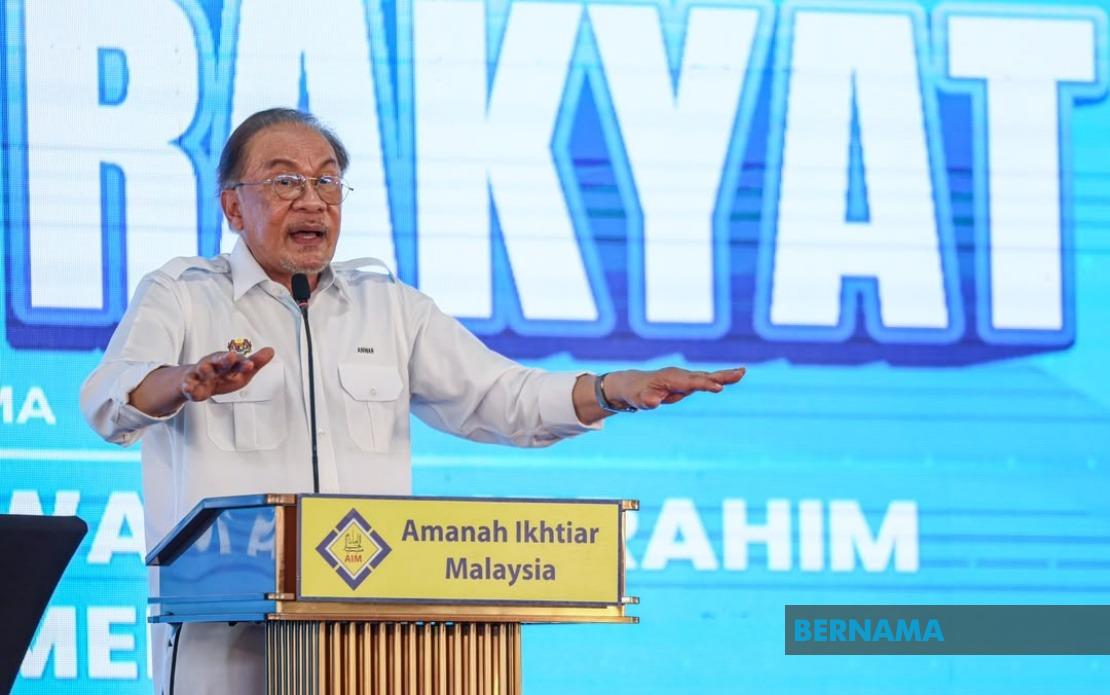
Prime Minister Datuk Seri Anwar Ibrahim has attributed mounting political opposition to his government's unwavering commitment to combating corruption and the abuse of power, claiming that multiple parties are coordinating efforts to destabilise his administration. Speaking at a campaign gathering in Batu Pahat during the Johor state election campaign, the Pakatan Harapan chairman contended that his MADANI Government's refusal to tolerate those who pilfer state funds or exploit their positions has created considerable discomfort among certain quarters in the political establishment.
The Prime Minister's remarks offer insight into the calculus behind the opposition's recent political manoeuvres. Anwar suggested that the convergence of various political entities against his leadership stems directly from their awareness of the administration's rigorous standards in public administration. By framing anti-corruption efforts as the source of political friction, he sought to position his government as a principled administration facing pressure from interests threatened by greater accountability. This framing carries particular significance in Malaysian politics, where governance standards and financial transparency remain contentious issues across the political spectrum.
Central to Anwar's message was his personal commitment to demonstrating integrity among elected officials. He emphasised that despite his numerous visits to Johor in his capacity as Prime Minister, he has consistently refrained from acquiring land, securing business projects, or accumulating shares in the state. This personal testimony, offered repeatedly throughout his remarks, served as a template for the behaviour he expects from political representatives at all levels. The emphasis on individual restraint from self-enrichment underscores a broader governance philosophy centred on institutional discipline and public trust.
The Prime Minister further articulated his vision for how state and federal governance should operate in alignment. Anwar called upon Johor voters to grant Pakatan Harapan the opportunity to govern the state, arguing that political coherence between state and federal authorities would enable more effective implementation of development initiatives and welfare programmes. This pitch resonates with longstanding debates in Malaysian federalism about coordination and policy consistency, particularly regarding resource allocation and infrastructure development.
Critically, Anwar acknowledged that despite billions of ringgit in development expenditure flowing into Johor, fundamental needs remain inadequately addressed. Housing affordability, road infrastructure, and religious facilities continue to be areas of concern for ordinary residents, a reality he attributed to insufficient state government effort. By highlighting this gap between aggregate investment and tangible improvements in living standards, he implicitly critiqued the previous state administration's priorities and resource management, positioning a Pakatan Harapan government as more responsive to grassroots concerns.
The socioeconomic dimension of Anwar's campaign message cannot be overlooked. His observation that substantial development spending exists alongside widespread housing unaffordability points to a persistent tension in Malaysian development—that major infrastructure projects and corporate investments may not translate into improved welfare for ordinary citizens. This theme carries particular weight in Johor, a state with significant economic output that nonetheless contains pockets of relative deprivation alongside concentrated wealth. Anwar's assertion that a small group should not become enriched while the majority remain disadvantaged reflects a populist economic argument designed to mobilise voters concerned about inclusive growth.
A secondary but significant element of Anwar's address involved defending Pakatan Harapan's coalition arrangement with the Democratic Action Party. He flatly stated that across his three-and-a-half-year tenure as Prime Minister, DAP representatives in the federal Cabinet have never opposed programmes benefiting Malays or Islam. This defence addresses a persistent criticism from Malay-Muslim constituencies that question the compatibility of a multiethnic, multireligious coalition with Muslim majority interests. By inviting scrutiny of the Cabinet record, Anwar attempted to disarm concerns about DAP's role in governance decisions affecting religious and communal matters.
The collaborative dynamics within the Pakatan Harapan coalition remain sensitive in the Malaysian political context, where concerns about religious and cultural governance often dominate electoral discourse. Anwar's explicit invitation to voters to verify his claims about DAP's voting record suggests confidence in the factual record of Cabinet decisions, while simultaneously acknowledging that such concerns sufficiently influence voter behaviour to warrant direct rebuttal. This defensive posture indicates that despite coalition stability at the federal level, questions about DAP's influence persist in certain constituencies.
Anwar's observation about the exceptional turnout and enthusiasm among supporters in Senggarang reflected broader electoral dynamics in the Johor campaign. The willingness of supporters to wait in intense heat, according to the Prime Minister, demonstrated genuine political engagement and commitment to Pakatan Harapan's message. This anecdotal evidence of grassroots support contrasted with his broader claims about political opposition, suggesting that while certain elite-level opposition exists, popular engagement with his administration's agenda remains substantial in specific constituencies.
The Johor state election itself represents a critical test of these competing claims about political support and the resonance of anti-corruption messaging. With 172 candidates contesting 56 state seats, and voting scheduled for July 11 following early voting on July 7, the election provides voters with a direct mechanism to express their views on governance quality and political direction. Anwar's campaign appeal explicitly sought to convert anti-corruption sentiment and governance concerns into electoral advantage for Pakatan Harapan, positioning state-level support as essential to continuing federal-level reform efforts.
The Prime Minister's campaign strategy in Johor reflects a broader calculation that anti-corruption and governance integrity can serve as effective electoral mobilisation tools among voters fatigued by previous instances of political malfeasance. By attributing opposition pressure to the regime's uncompromising standards, Anwar inverted the conventional political narrative, presenting his administration's strictness not as a source of authoritarian concern but as the basis for principled resistance. Whether this reframing successfully persuades Johor voters will become apparent as the election results emerge, providing data on whether governance quality and anti-corruption messages translate into decisive electoral support.

