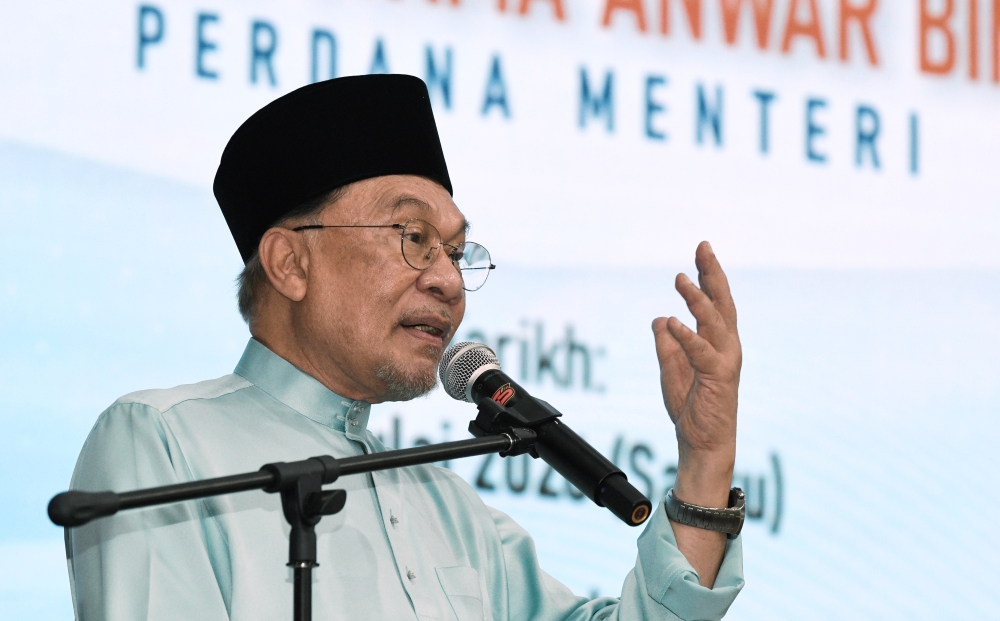
Prime Minister Datuk Seri Anwar Ibrahim has issued a stern rebuke of Kedah Menteri Besar Muhammad Sanusi Md Nor, condemning what he characterizes as inflammatory and divisive rhetoric that undermines national cohesion. Speaking in Seberang Perai on July 25, the Prime Minister expressed concern that such statements from high-ranking political figures risk exacerbating communal tensions and distracting from the government's agenda of economic recovery and social stability. The remarks represent an escalation in simmering tensions between the federal administration and the Perikatan Nasional-led state government, reflecting deepening fissures within Malaysia's political landscape.
Anwar's intervention underscores the Prime Minister's emerging role as guardian of political decorum and national unity, a position that carries particular weight given Malaysia's history of communal sensitivities. The criticism carries implicit warnings about the responsibilities that accompany high office, particularly when wielding state-level executive power. By speaking out publicly rather than through private channels, Anwar signals that the federal government takes such statements seriously enough to warrant direct presidential-style correction, elevating the dispute beyond routine inter-party disagreements.
The Kedah Menteri Besar, who represents a key component of the opposition Perikatan Nasional coalition, has emerged as an increasingly vocal critic of the federal government's policies. His comments, whatever their specific nature, apparently touched on issues sensitive to communal or religious sensibilities, prompting the Prime Minister's unusually strong and public response. Such sensitivity reflects Malaysian political reality, where statements touching on Islam, Bumiputera rights, or ethnic relations can rapidly escalate tensions if perceived as inflammatory or dismissive.
Anwar's call for unity represents a consistent rhetorical theme throughout his tenure as Prime Minister, one that contrasts with the confrontational approach favoured by some opposition figures. By framing the issue around leadership responsibility and national interest, the Prime Minister attempts to position his government as the mature, stabilizing force in Malaysian politics. This approach resonates particularly with moderate urban constituencies and international observers concerned about political volatility in Southeast Asia's largest economy.
The incident highlights the ongoing structural tensions within Malaysia's federal system, where opposition-controlled states maintain significant autonomy yet remain subject to federal oversight on matters of national concern. Kedah's Perikatan Nasional government, while nominally in opposition, retains real power within its territorial jurisdiction, creating frequent friction points with Putrajaya over policy implementation and political messaging. These conflicts often become proxy battlegrounds for broader national political struggles.
Anwar's intervention also reflects growing concern within the federal government about the narrative direction of opposition politics. By allowing unchecked divisive commentary, federal officials apparently fear that the opposition could gradually shift the boundaries of acceptable political discourse, potentially emboldening more extreme voices within Perikatan Nasional or other opposition parties. Proactive criticism serves as an attempt to maintain what the government views as responsible standards for public political speech.
The timing and venue of Anwar's remarks matter significantly. His address in Seberang Perai, a strategically important region that encompasses urban and rural constituencies, suggests that the federal government is actively contesting opposition political dominance in state-level politics. By directly challenging the Kedah Menteri Besar in a public forum, the Prime Minister sends a message to voters in neighbouring states and urban centres that federal authority remains engaged in local governance issues.
For Malaysia's business community and foreign investors, such political friction introduces uncertainty about the stability of policy frameworks and the reliability of government partnerships. While occasional political disputes are normal in democratic systems, their public and seemingly personal nature can raise concerns about the quality of institutional governance. The preference within investor circles for predictable, technocratic administration makes high-profile political conflicts problematic regardless of their ultimate resolution.
The broader context involves Anwar's continuing efforts to consolidate federal government authority while managing an increasingly fractious coalition. The Prime Minister's emphasis on unity serves multiple audiences: reassuring moderate Malaysians that political stability remains intact, signalling resolve to coalition partners about maintaining discipline, and attempting to distinguish his administration from the more confrontational opposition. Each audience interprets the message somewhat differently, reflecting Malaysia's complex multi-level political competition.
Sanusi's positions within Perikatan Nasional and as Kedah's chief executive provide him a platform for significant political influence, particularly given the state's industrial and agricultural significance. His willingness to make controversial statements suggests confidence in his political base or conviction about particular policy positions, neither of which typically yields to prime ministerial criticism. The exchange between Anwar and Sanusi therefore likely represents the beginning rather than the resolution of their political disagreement.
Moving forward, the intensity and public nature of this dispute may influence how other opposition figures calculate their own communications strategies. Some may interpret Anwar's response as overly sensitive and therefore opportunities to exploit the government's apparent anxiety about political messaging. Others may view it as warranted correction and adjust their approach accordingly. The outcome depends partly on how Malaysian voters and civil society interpret both leaders' actions.
Ultimately, Anwar's rebuke reflects deeper questions about Malaysian political maturity and the role of high-ranking officials in shaping public discourse. While criticism of government policies represents normal democratic practice, statements perceived as deliberately inflaming communal sensitivities occupy contested terrain. The Prime Minister's intervention attempts to preserve space for robust political competition while maintaining boundaries around divisive rhetoric, a balance that remains perpetually challenging in Malaysia's ethnically and religiously diverse context.

