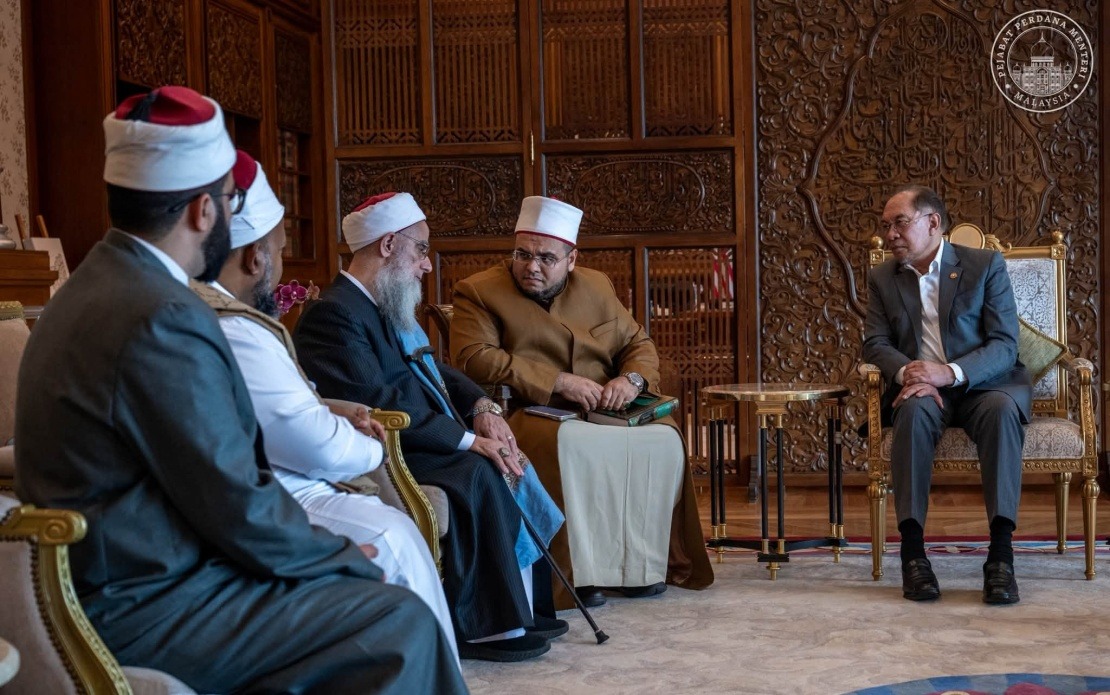
Prime Minister Datuk Seri Anwar Ibrahim hosted a meeting with Sheikh Dr Mustafa An-Nadwi Al-Hasani Mansurah, a prominent Egyptian Islamic scholar, at his Putrajaya office on July 20. The encounter underscores Malaysia's continued engagement with influential Islamic intellectuals from across the Muslim world, particularly those who champion traditional Islamic learning and ethical governance.
In remarks shared on social media, Anwar characterised Sheikh Dr Mustafa as a distinguished authority with deep expertise in hadith scholarship, the study of prophetic traditions that forms a cornerstone of Islamic jurisprudence. The Prime Minister highlighted the scholar's particular dedication to upholding moral principles and the pursuit of substantive knowledge—themes increasingly relevant as societies grapple with information overload and superficial engagement with complex issues.
Sheikh Dr Mustafa counts himself among the scholarly lineage of Sheikh Abul Hasan Ali al-Nadwi, the twentieth-century Islamic thinker whose works have profoundly shaped contemporary Islamic thought across South Asia, the Middle East, and Southeast Asia. This intellectual pedigree positions the visiting scholar within a tradition that bridges classical Islamic learning with modern engagement, a balance Anwar appeared keen to emphasise during their discussion.
Anwar's public remarks reveal a deliberate framing of the visit around questions of knowledge, wisdom and their role in national development. He articulated a philosophical position that positions substantive learning and contemplative thought against what he termed an era of "sensationalism." This messaging carries particular resonance in Malaysia, where political discourse has increasingly centred on questions of institutional integrity, inclusive governance and the relationship between religious authority and state responsibility.
The Prime Minister employed metaphorical language to describe knowledge and wisdom, comparing them to morning dew—gentle, quiet, yet life-sustaining. This poetic characterisation suggests Anwar's view that transformative understanding operates not through aggressive assertion but through quiet influence and gradual influence. Such framing may also signal the administration's broader philosophy of measured, consultative governance as it navigates Malaysia's complex religious and ethnic landscape.
During their meeting, the two figures discussed current affairs and international developments, though specific details remain undisclosed. Given the geopolitical significance of Egypt as a leading Arab nation and the broader regional dynamics affecting the Islamic world, these conversations likely touched on challenges confronting Muslim-majority countries and the role of intellectual leadership in addressing them.
Sheikh Dr Mustafa's visit to Malaysia this week extended beyond the Prime Minister's office, including knowledge-sharing sessions intended for broader audiences. This suggests an institutional interest in facilitating dialogue between Malaysian religious and intellectual circles and international Islamic scholars. Such exchanges strengthen Malaysia's positioning as a centre for Islamic learning and moderation in Southeast Asia, complementing the country's diplomatic and cultural initiatives.
Anwar's expression of gratitude for the scholar's prayers for Malaysia's unity and prosperity reflects the significance Malaysia places on religious legitimacy and spiritual endorsement from respected international Islamic figures. This dimension of statecraft—seeking validation and support from global Islamic authorities—carries particular weight in Muslim-majority democracies like Malaysia, where religious credibility can influence public confidence in governance.
The meeting also illustrates the Malaysian government's cultivation of relationships with Islamic intellectuals who emphasise wisdom, moderation and community guidance. By publicly associating with scholars committed to ethical learning and balanced interpretation of Islamic principles, Anwar signals the administration's commitment to an Islam-centred identity while rejecting extremism or literalist approaches that might undermine national cohesion.
For the broader Southeast Asian context, such high-level engagement between Malaysian leadership and respected international Islamic scholars demonstrates the region's continuing centrality to global Islamic discourse. Malaysia's multi-religious democracy positions it as a venue where diverse perspectives on faith, governance and modernisation can be meaningfully exchanged.
The visit also touches on questions of intellectual authority within Islam. Sheikh Dr Mustafa's work in hadith studies places him within a scholarly tradition dedicated to rigorous textual analysis and preservation of prophetic knowledge. In an age of democratised information access, such specialists maintain particular importance in Malaysia's Muslim communities, offering grounded, theologically coherent perspectives on contemporary challenges.
Anwar's public engagement with this visit suggests a strategic effort to reinforce the administration's intellectual and spiritual legitimacy. By demonstrating direct engagement with globally recognised Islamic authorities, the Prime Minister strengthens his positioning as a leader engaged with contemporary Islamic thought while remaining committed to governance values of inclusivity, wisdom and national harmony. Such symbolic acts of intellectual exchange carry measurable political value in reinforcing public perception of principled leadership.

