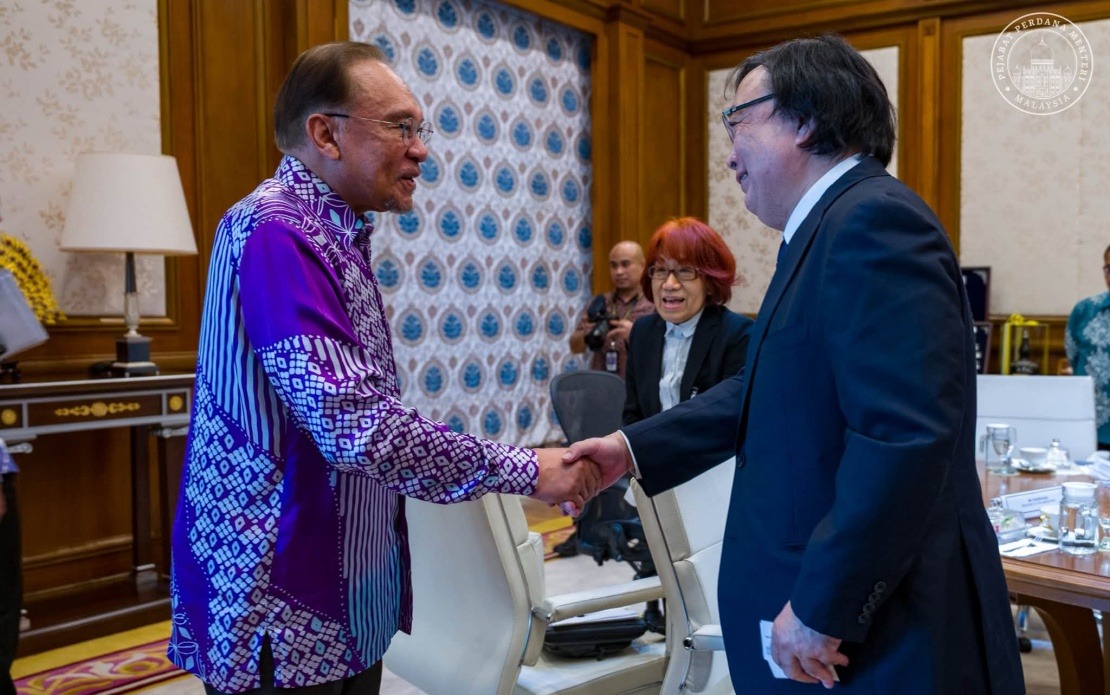
Prime Minister Datuk Seri Anwar Ibrahim received a courtesy call on July 23 from Yasushi Kudo, president of The Genron NPO, a respected Japan-based independent think tank. The meeting provided both leaders with an opportunity to explore ways of fortifying the Asia Leaders Roundtable, a platform designed to facilitate strategic dialogue among the region's policymakers as they grapple with interconnected regional and global challenges. Through their conversation, Anwar and Kudo reaffirmed their commitment to leveraging collaborative frameworks that can meaningfully contribute to peace, stability, and shared prosperity across Asia.
The discussion underscored Malaysia's enduring commitment to its relationship with Japan, which remains among the nation's most consequential strategic and economic partnerships. Anwar took the occasion to express Malaysia's profound appreciation for the reception and courtesy extended by the Japanese government during his official visit to Japan in June. This goodwill, he emphasised, reflects the depth of bilateral engagement and the mutual respect that characterises ties between Kuala Lumpur and Tokyo. The renewed emphasis on these bonds is particularly significant given the complex geopolitical environment facing Southeast Asia, where partnerships with major developed democracies provide essential anchors for regional stability.
Central to the conversation was the Comprehensive Strategic Partnership between Malaysia and Japan, a framework that extends beyond traditional diplomatic channels to encompass trade, technology, defence, and people-to-people exchanges. This partnership represents a deliberate effort by both nations to align their interests and capabilities in addressing transnational challenges such as maritime security, climate change, and economic resilience. For Malaysia, maintaining and deepening this relationship is crucial as the country navigates complex regional dynamics and seeks to diversify its strategic engagements beyond its immediate Southeast Asian neighbourhood.
Kudo extended an invitation to Prime Minister Anwar to participate in the Tokyo Conference 2027, a significant gathering that brings together leaders and thought leaders from across the Asian region. Additionally, Anwar expressed gratitude for the opportunity he had to deliver a video message at the 2026 iteration of the conference. These invitations reflect the high regard in which Malaysia's Prime Minister is held within influential Japanese policy circles and underscore the country's perceived importance in regional strategic discussions. The Tokyo Conferences serve as crucial platforms where emerging regional consensus can be built on critical issues affecting the continent's future.
The Asia Leaders Roundtable itself represents an innovative approach to multilateral dialogue, bringing together senior decision-makers in an informal setting conducive to candid and constructive conversations. Unlike formal international forums that are constrained by rigid protocols and national positioning, such roundtables allow leaders to explore nuanced perspectives on complex issues and build personal relationships that often translate into more effective cooperation at the governmental level. Malaysia's active participation in this initiative signals its commitment to being a substantive player in regional strategic discussions rather than a mere observer.
The meeting also reflects the broader strategic calculus that guides Malaysian foreign policy under Anwar's leadership. Despite the centrality of Asean to Malaysia's regional strategy, the country has consistently emphasised the importance of maintaining robust relationships with major powers and key strategic partners outside the bloc. Japan, as a technologically advanced, economically dynamic, and strategically important nation in the Indo-Pacific, occupies a special place in this architecture. The partnership with Tokyo provides Malaysia with access to technological innovation, economic opportunities, and strategic coordination that complements rather than competes with Malaysia's Asean commitments.
Both leaders' shared vision of continued strengthening of bilateral ties and cooperation through The Genron NPO suggests a mutual recognition that think tanks and civil society organisations play an increasingly vital role in shaping policy discourse and facilitating Track 1.5 diplomacy—a middle ground between official government channels and purely academic discussion. The Genron NPO, in particular, has emerged as an influential voice in Japanese foreign policy discussions, with its conferences and publications often reflecting the perspectives of Japan's strategic thinkers and policymakers. Malaysia's engagement with this institution therefore carries significance beyond the ceremonial aspects of diplomatic protocol.
The emphasis on shared prosperity and stability in their discussions is not merely rhetorical flourish but reflects genuine convergence of interests. Both Malaysia and Japan face challenges from regional tensions, economic uncertainties, and the need to maintain open sea lanes and stable trading relationships. Moreover, both nations are grappling with demographic changes and the need to harness technological innovation to maintain competitiveness in an increasingly knowledge-based global economy. The Asia Leaders Roundtable provides a venue where these shared concerns can be discussed in a regional context, potentially yielding collaborative solutions.
Looking forward, the trajectory of Malaysia-Japan relations appears set for continued deepening. Anwar's participation in the Tokyo Conferences and ongoing engagement with influential Japanese think tanks such as The Genron NPO signal that the Prime Minister places considerable value on maintaining Japan as a strategic pillar of Malaysia's external relations. For Malaysian policymakers and business leaders, this sustained diplomatic engagement opens doors to closer collaboration in areas ranging from advanced manufacturing to renewable energy and digital innovation. The Asia Leaders Roundtable, in turn, offers Malaysia a platform to project its voice and interests into broader Asian strategic conversations that will increasingly shape the region's trajectory in coming years.

