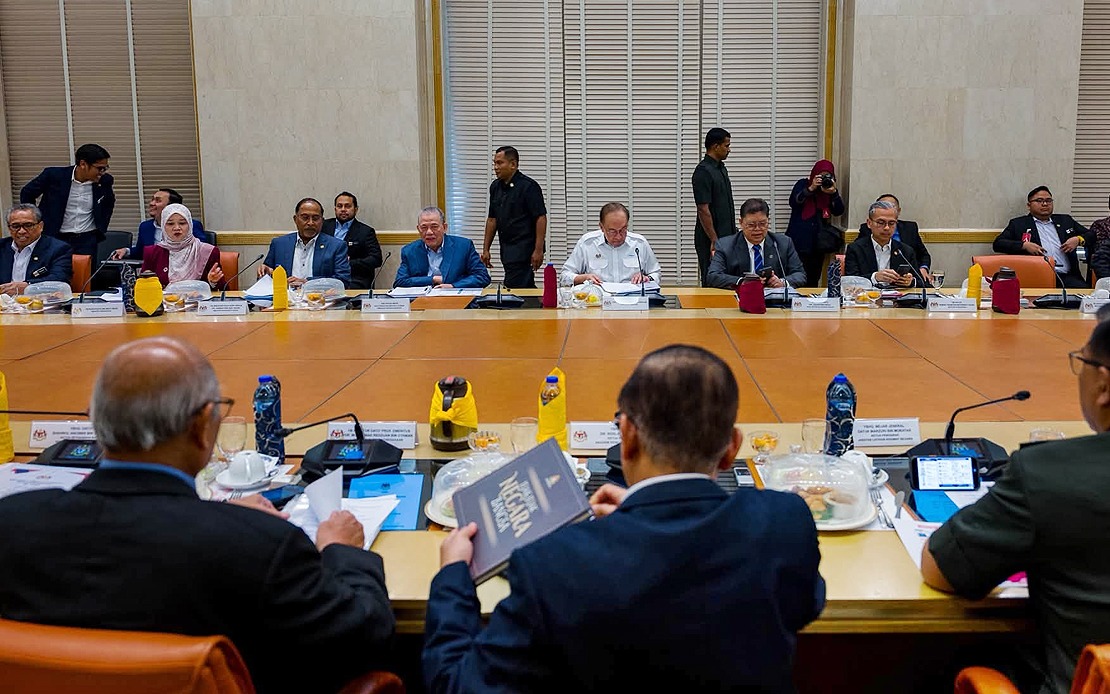
Prime Minister Datuk Seri Anwar Ibrahim has underscored the critical importance of systematically cultivating and reinforcing nationhood values as a cornerstone strategy for Malaysia's long-term development. Speaking following a Dewan Kenegaraan Board of Governance Meeting he chaired, Anwar articulated a vision where the nation's progress depends not merely on economic metrics or infrastructure projects, but fundamentally on the character and commitment of its citizens. The emphasis reflects growing recognition across government circles that sustainable nation-building requires deeper investment in the values and principles that bind Malaysians together across ethnic, religious and regional lines.
The Prime Minister's remarks highlight his belief that robust nationhood values create the foundation for a unified society capable of addressing contemporary challenges. By fostering strong national identity alongside personal integrity and ethical principles, Anwar suggests Malaysia can elevate its international standing and create citizens who prioritize collective welfare alongside individual aspirations. This framing positions nationhood values not as abstract ideals but as practical tools for social cohesion and national resilience in an increasingly complex world.
Central to this agenda is the National Service Training Programme (PLKN), which Anwar indicated has demonstrated tangible progress and garnered encouraging feedback from both participants and their families. The programme's role as an incubator for cultivating disciplined, resilient individuals with heightened national consciousness appears to have moved beyond theoretical justification to demonstrable results. By channeling young Malaysians through a structured immersive experience, PLKN serves as an institutional mechanism for transmitting nationhood values to the demographic most capable of shaping the country's future trajectory.
Anwar's advocacy for continued strengthening of PLKN reflects an understanding that passive awareness of national values proves insufficient. Active participation in shared national experiences, particularly during formative years, creates internalized commitment that survives into adulthood. The positive reception from families suggests PLKN has successfully bridged a potential gap between government messaging and household-level buy-in, indicating the programme resonates with ordinary Malaysians who recognize its value proposition.
The Prime Minister also emphasized the strategic function of the Nationhood Fellows initiative, which aggregates intellectual and political capital from respected figures spanning diverse backgrounds. This mechanism serves multiple objectives simultaneously: it legitimizes the nation-building agenda through endorsement from respected figures outside government, it ensures proposed approaches benefit from multifaceted perspectives rather than narrow institutional viewpoints, and it creates space for distinguished statesmen to contribute meaningfully during their later careers. By positioning the Nationhood Fellows as active contributors rather than ceremonial figures, the government signals genuine commitment to inclusive deliberation about national direction.
For Malaysian readers, Anwar's statements carry implications extending beyond rhetorical flourish about patriotism. In a nation managing competing communal identities and navigating significant socioeconomic disparities, deliberate cultivation of shared nationhood values represents a tested approach to maintaining social cohesion. Malaysia's relative stability despite regional instability suggests existing frameworks possess inherent strength, yet demographic change, digital connectivity, and evolving economic pressures require continuous recalibration of nation-building strategies. Anwar's emphasis suggests recognition that previous generation's unconscious nationalism, forged through independence struggle and early nation-building, cannot be assumed to transmit automatically to younger cohorts.
The policy direction also reflects broader Southeast Asian patterns, as regional governments increasingly recognize that economic development without corresponding civic engagement generates hollow societies vulnerable to fragmentation. Thailand's extended emphasis on monarchical values, Indonesia's Pancasila revival, and Vietnam's party-state integration all represent regional variations of similar imperatives. Malaysia's approach through PLKN and the Nationhood Fellows framework demonstrates a distinctly Malaysian model incorporating democratic deliberation alongside state-directed civic education.
Fundamentally, Anwar's advocacy positions nationhood values as competitive advantage in an era where technological disruption and globalization erode traditional sources of social glue. Nations with citizens genuinely invested in collective welfare rather than merely compliant subjects demonstrate superior adaptive capacity during crises, generate higher voluntary civic participation, and create internal environments attractive to talent retention. From this perspective, investment in nationhood values represents not sentimental nation-building but strategic infrastructure development with measurable returns.
The timing of these remarks, emerging from a formal governance board meeting rather than casual commentary, suggests the administration intends making values cultivation a centerpiece of its governing philosophy through the remainder of its term. This positioning establishes the framework through which other policies—from education reform to public service restructuring—can be assessed and aligned. Whether implementation matches rhetorical commitment will determine whether this initiative becomes a defining characteristic of the current administration's legacy or another example of well-intentioned messaging that fades under bureaucratic inertia.

