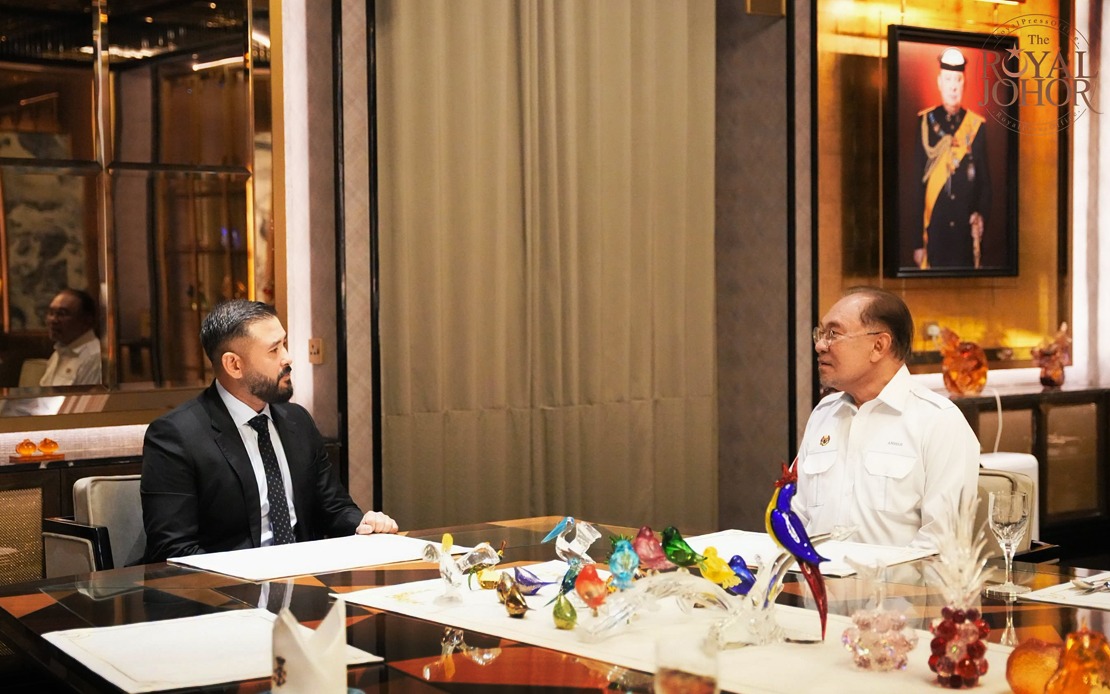
Prime Minister Datuk Seri Anwar Ibrahim has publicly expressed his appreciation to the Regent of Johor, Tunku Mahkota Ismail, for extending an audience to him in Kuala Lumpur, seizing the opportunity to make a pointed statement about the boundaries between political campaigning and the constitutional role of the monarchy. Speaking at the Pakatan Harapan candidate announcement for the 16th Johor state election at Padang Bukit Gambir Extreme Park on June 22, Anwar framed the courtesy meeting as a rebuttal to what he characterized as opportunistic political messaging from rivals.
The Prime Minister's comments reflect a broader tension in Malaysian politics concerning the proper relationship between elected officials and hereditary rulers. By publicly commending the Johor Regent's willingness to receive him, Anwar sought to demonstrate that maintaining respectful relations with state rulers transcends partisan considerations—a critical point in a federation where the Yang di-Pertuan Agong and state sultans occupy constitutionally protected positions that must remain insulated from day-to-day electoral competition. His emphasis on accepting the audience illustrated his administration's commitment to traditional governance protocols while simultaneously criticizing opponents for allegedly weaponizing royal symbolism to score political points.
Anwar took particular aim at what he described as cowardly political tactics, suggesting that some opposition figures invoke the monarchy's name while lacking the courage to engage in substantive political debate. The Prime Minister's sharp rhetoric underscored his frustration with what the government perceives as an inappropriate conflation of palace courtesy calls with partisan endorsement. He argued that his willingness to accept an audience from Tunku Mahkota Ismail serves as concrete evidence that the federal government operates with institutional respect for the rulers, rendering unnecessary any attempt by rivals to instrumentalize royal relationships for electoral advantage.
During his meeting with the Johor Regent, Anwar seized the platform to brief Tunku Mahkota Ismail on federal development initiatives benefiting Johor residents. This practical dimension of the audience reflects how Malaysian Prime Ministers traditionally leverage such occasions to present their administration's track record and policy achievements to influential state-level figures. By articulating these projects during a private audience, Anwar could demonstrate concrete governance outcomes while avoiding the appearance of deploying royal platforms for campaign messaging—a distinction he emphasized in his public remarks.
The Prime Minister elaborated on his administration's philosophy regarding engagement with Malaysia's hereditary rulers, a crucial constitutional force in the federation's system of governance. Anwar stressed that Pakatan Harapan, as the party leading the federal government, views maintaining constructive relations with all state sultans and the Yang di-Pertuan Agong as fundamental to effective administration. Rather than treating the monarchy as merely ceremonial, he characterized the relationship as genuinely consultative, involving genuine exchange of perspectives and mutual respect even when disagreements arise.
Anwar's description of his interactions with Sultan Ibrahim, the King of Malaysia, revealed an underlying governance principle: while the government presents its policy rationale to the ruler, and while disagreements may surface, both parties engage through formal consultation channels rather than public confrontation. The Prime Minister framed this approach not as capitulation but as institutional maturity—an acknowledgment that constitutional monarchs retain advisory authority and that government legitimacy depends partly on maintaining royal confidence. His reference to accepting the King's counsel even when counterviews exist demonstrated how he navigates the delicate balance between executive autonomy and deference to constitutional authority.
The attendance of senior Pakatan Harapan figures—including DAP secretary-general Anthony Loke Siew Fook and Amanah president Datuk Seri Mohamad Sabu—underscored the coalition's unity on this governance principle. By presenting a cohesive front on the proper relationship between electoral politics and royal institutions, PH signaled to both voters and the monarchy that the coalition's approach to federalism emphasizes respect for constitutional hierarchy and institutional boundaries. This positioning carries weight particularly in Johor, where the sultanate commands deep historical and cultural significance and where the state ruler's relationship with the federal government carries tangible political implications.
For Malaysian readers and regional observers, Anwar's comments illuminate a persistent challenge in post-colonial democracies attempting to reconcile democratic competition with hereditary institutions. Unlike purely republican systems where executive authority derives solely from popular election, Malaysia's constitutional framework vests certain protective powers in the monarchy—including the ability to withhold royal assent and to offer counsel that governments ignore at their political peril. The tension between modern electoral politics and these traditional prerogatives occasionally surfaces when opposition parties appear to invoke royal symbolism or when critics question government decisions by questioning royal guidance.
Anwar's framing of the Johor Regent's audience as a demonstration of institutional respect rather than political endorsement attempts to establish a clearer precedent for how such courtesies should be interpreted. In effect, he argued that accepting audiences from state rulers represents normal governance practice divorced from electoral calculation. This distinction matters because in Malaysian political culture, opposition parties have occasionally attempted to suggest that government ministers enjoy special royal favor, implying some form of behind-the-scenes palace influence favoring the governing coalition. By normalizing such meetings and emphasizing that proper governance requires ongoing consultation with rulers, Anwar sought to deflate such speculation.
The broader context of the 16th Johor state election adds urgency to these remarks. Johor remains economically and politically significant, and the state has experienced competitive electoral contests in recent years. Any perception that the federal government enjoys disproportionate royal backing could theoretically influence voter calculations, particularly among younger voters less attuned to traditional notions of proper royal-government relations. Conversely, any suggestion that the government fails to consult adequately with the Sultan could undermine public confidence in the administration's respect for constitutional norms. By publicly highlighting his consultation with Tunku Mahkota Ismail, Anwar attempted to occupy the middle ground—demonstrating respect for royal authority without claiming special favor.
Anwar's comments also reflect evolving Malaysian political discourse around institutional autonomy. During previous administrations, questions occasionally arose about whether the monarchy was being appropriately consulted on major decisions or whether executives were acting with insufficient regard for royal prerogatives. By explicitly endorsing the principle of regular consultation and genuine receptiveness to royal advice, the current Prime Minister positioned his administration as particularly attentive to constitutional governance even as it pursues substantive policy changes. This rhetorical posture serves to reassure both traditional constituencies concerned about institutional respect and more progressive voters favoring democratic accountability—a delicate balance Anwar consistently attempts to maintain.
For the regional audience, Malaysia's approach to managing the relationship between democratic governance and hereditary monarchy offers instructive contrast to other Southeast Asian systems. Thailand's highly centralized military institutions, Singapore's purely republican structure, and Indonesia's directly-elected presidency all represent different solutions to similar tensions. Malaysia's constitutional monarchy, combined with its federal structure and robust electoral competition, creates particular challenges when parties seek electoral advantage by invoking royal symbolism or questioning opponents' relationship with the throne. Anwar's insistence on institutional boundaries and regular consultation represents one approach to managing these tensions, though whether it will be broadly accepted or will face continued contestation during subsequent electoral cycles remains an open question.

