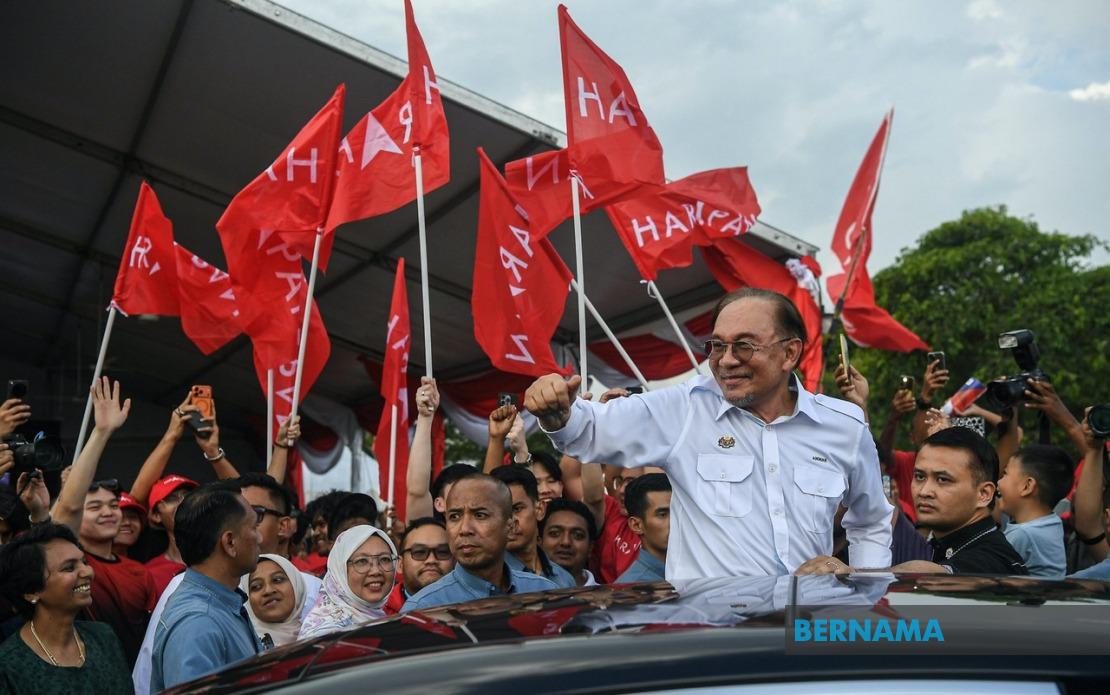
Prime Minister Datuk Seri Anwar Ibrahim's active participation in Pakatan Harapan's campaign machinery for the 16th Johor State Election has delivered a significant morale boost to the coalition's efforts, generating visible public enthusiasm across multiple constituencies. Communications Minister Datuk Fahmi Fadzil characterised the reception as extraordinary and encouraging, drawing on firsthand observations from recent campaign stops throughout the southern state.
Fahmi, who doubles as PH's Communications director, witnessed the grassroots response during two campaign programmes held in Senggarang and Semerah within the Batu Pahat district. The minister highlighted an anecdote illustrating the depth of public interest—an elderly resident arrived by trishaw with his wife solely to meet the Prime Minister—as emblematic of the broader sentiment he observed across the two locations. Such spontaneous engagement, from Fahmi's perspective, transcends typical election-year politicking and suggests authentic community receptiveness rather than obligatory attendance.
The intensity of Anwar's personal campaign involvement underscores the strategic importance Pakatan Harapan places on retaining and expanding influence in Johor, historically a significant political battleground. Across Saturday and Sunday in early July, the Prime Minister participated in 15 separate campaign events distributed across the state, effectively saturating the electoral landscape with his presence and messaging. This concentrated effort reflects calculations that Anwar's personal credibility and appeal could prove decisive in swaying undecided voters and consolidating support among coalition sympathisers.
Fahmi's interpretation of the public response suggests that community turnout at campaign events represents more than performative participation. He argued that observed reactions—encompassing spontaneous applause, deliberate efforts to attend specific programmes, and visible interest in coalition candidates—signal genuine acceptance of Pakatan Harapan's campaign narrative and policy positioning. Whether this enthusiasm translates into actual electoral support remains to be determined, but the minister indicated confidence that heightened interest and awareness would favour the coalition at the ballot box.
Pakatan Harapan's comprehensive candidate deployment demonstrates institutional commitment to the Johor contest. The coalition fielded aspirants across all 56 State Legislative Assembly seats, positioning itself for maximum territorial influence. Against a field of 172 total candidates competing for these positions, PH's presence in every constituency ensures the coalition can contest every electoral microcosm, even where victory prospects appear limited. This saturation strategy enables the coalition to capture protest votes, build organisational capacity, and establish platforms for future electoral cycles.
The timing of this campaign intensification, occurring mere days before the scheduled Saturday polling date, reflects standard electoral strategy—maximising visibility and voter contact during the final campaign window when voter attention concentrates most sharply on forthcoming decisions. The Prime Minister's personal involvement at this critical juncture signals urgency regarding the electoral stakes while simultaneously projecting confidence in PH's competitive position.
For Malaysian political observers, the apparent success of Anwar's campaign mobilisation carries implications extending beyond immediate Johor outcomes. The Prime Minister's capacity to generate public enthusiasm and grassroots engagement provides baseline evidence regarding his continuing political relevance and personal appeal following his appointment to the premiership. In a political landscape characterised by shifting coalitions and competing power centres, Anwar's demonstrated ability to draw crowds and generate positive reception strengthens his standing within both Pakatan Harapan and the broader national political framework.
The election itself represents one of the first significant electoral tests for the current federal government since assuming power. Results in Johor will provide crucial data regarding public sentiment toward Anwar's administration and Pakatan Harapan's broader political positioning. A strong performance could vindicate the coalition's electoral strategy and policy directions, while conversely, disappointing results might necessitate tactical recalibration heading into future contests at state and federal levels.
Early voting took place on the day Fahmi visited the Malaysian National News Agency's operations room, with the formal polling day scheduled for Saturday. This electoral timeline compressed the final campaign period, making intensive prime ministerial engagement particularly valuable for candidates seeking maximum publicity and voter connection during narrowed windows of opportunity.
The broader Southeast Asian context adds another analytical dimension. Electoral dynamics in Malaysian states frequently reflect regional trends and serve as testing grounds for policy approaches and political messaging strategies. Johor's economic significance and demographic diversity make it particularly influential as a bellwether for national political sentiment, with outcomes often foreshadowing larger electoral movements.

