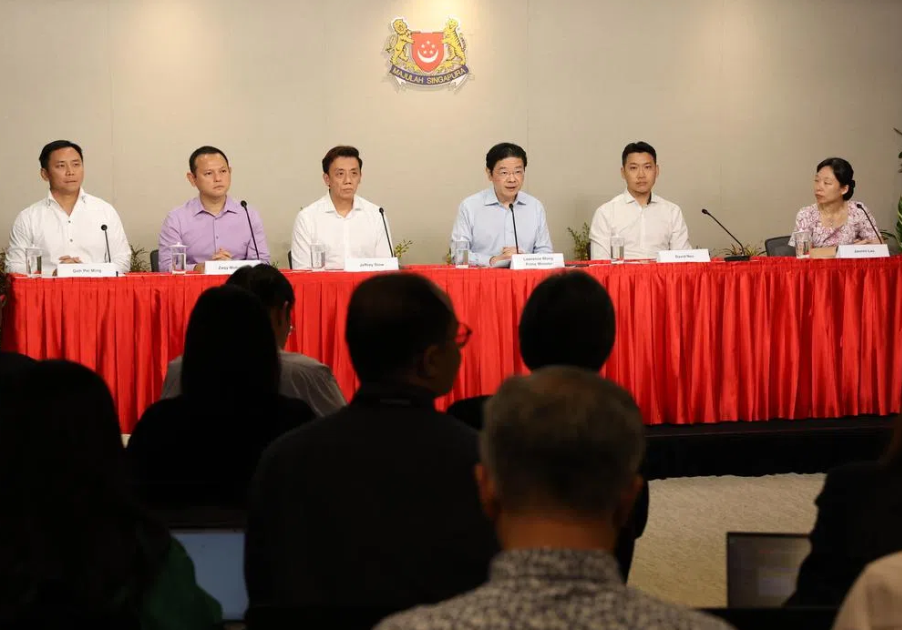
Prime Minister Lawrence Wong has unveiled a substantially reconfigured Singapore Cabinet that reflects the city-state's deliberate approach to leadership succession, promoting a cohort of first-term politicians into expanded responsibilities while retaining seasoned figures in advisory roles. The restructuring, announced on July 22, places newer generation office-holders on an accelerated pathway into senior positions, a strategic move designed to address both immediate governance demands and longer-term institutional continuity as the ruling party navigates its generational transition.
The promotion of Jeffrey Siow and David Neo to full ministerial rank represents the most significant elevation in the reshuffle. Both politicians, who first entered Parliament in the 2025 general election cycle, have been operating in acting capacities across their respective portfolios since May 2025—Siow in the Transport Ministry and Neo leading the Culture, Community and Youth portfolio. Their formal appointment signals confidence in their administrative capabilities and alignment with the Cabinet's strategic direction. The pair will retain their existing ministry assignments while assuming the additional authority and status that accompanies full ministerial designation, a structure that provides continuity in institutional knowledge whilst cementing their elevation within the political hierarchy.
Simultaneously, Sim Ann, another first-term legislator, has been named Second Minister for Foreign Affairs and Home Affairs, positioning her within Singapore's most sensitive policy domains. This dual appointment reflects the government's assessment of her readiness to handle complex diplomatic and internal security matters. The assignment carries particular significance given Singapore's strategic position in Southeast Asia and the interconnected nature of contemporary security challenges spanning cybersecurity, terrorism prevention, and transnational crime. Jasmin Lau, likewise a debut-term parliamentarian, has assumed the acting minister role at the Manpower Ministry following Tan See Leng's transition to the Ministry of Trade and Industry, focusing on energy and industry sectors.
The Cabinet changes have been precipitated, in part, by recent political departures that created both immediate vacancies and opportunities for structural rethinking. Acting Minister Faishal Ibrahim resigned on July 20 following what he characterized as a lapse in judgment concerning his interactions with a woman, prompting his departure from both his ministerial position and his role as Senior Minister of State for Home Affairs. Earlier in June, Koh Poh Koon, a senior minister of state, stepped down citing family considerations. These unexpected departures compelled the administration to reassess its ministerial architecture and accelerate aspects of its succession planning that might otherwise have proceeded more gradually.
PM Wong's decision to elevate Ng Chee Meng, the labour movement's chief representative, to Minister in the Prime Minister's Office reflects the government's recognition of political leverage across different constituencies. Ng's return to the Cabinet after previous service demonstrates the Singapore political system's practice of recycling senior figures into positions of renewed influence. Concurrently, K. Shanmugam has been promoted to Senior Minister, joining Senior Minister Lee Hsien Loong in the uppermost echelon of the Cabinet hierarchy. PM Wong specifically emphasized that these two seasoned practitioners, distinguished by their extensive experience, would increasingly assume mentoring responsibilities toward younger office-holders as the administration navigates its generational transition.
Two additional first-term backbench MPs—Foo Cexiang and Shawn Loh, both former senior civil servants—have been elevated to ministers of state positions. Their prior careers in the administrative service equip them with institutional knowledge and bureaucratic familiarity that can facilitate their integration into ministerial roles. Their appointment exemplifies the Singapore government's tendency to recruit or recycle experienced civil servants into elected office, leveraging their technical competence and alignment with state apparatus objectives.
The timing and rationale for the reshuffle reveal strategic considerations extending beyond mere portfolio allocation. PM Wong explained that whilst the Cabinet composition undergoes annual review as routine practice, the unexpected resignations necessitated more immediate recalibration. The reshuffle reflects the government's determination to maintain what it characterizes as a strong pipeline of political talent, extending beyond ministerial ranks to encompass capable backbenchers. The PM's public acknowledgment that succession planning remains unfinished work—particularly regarding his own ongoing tenure as finance minister since 2021—indicates that the current reshuffle represents an interim phase within a longer trajectory of organizational restructuring.
Notably, PM Wong declined to appoint a second deputy prime minister alongside Gan Kim Yong, stating that the existing structure provides adequate senior leadership. However, he signaled flexibility regarding this arrangement, noting that circumstances remain subject to ongoing review as renewal processes advance. The Cabinet's three coordinating ministers—Shanmugam as Coordinating Minister for National Security, together with Chan Chun Sing and Ong Ye Kung in coordinating capacities across other governmental domains—constitute a supplementary tier of seniority designed to provide strategic oversight.
The reshuffle's implications for Southeast Asian regional dynamics warrant attention from Malaysian policymakers and observers. Singapore's Cabinet restructuring typically signals broader strategic recalibrations affecting regional partnerships and engagement priorities. The elevation of officials handling foreign affairs and trade portfolios, combined with the retention of experienced security specialists, suggests continuity in Singapore's approach to regional architecture while enabling fresh perspectives on evolving challenges including economic integration, cybersecurity cooperation, and maritime security.
For Malaysian stakeholders monitoring Singapore's political trajectory, the reshuffle underscores the methodical pace at which developed city-states engineer leadership transitions within stable, institutional systems. The deliberate balancing of youth and experience, the retention of senior figures in advisory rather than purely executive capacity, and the measured acceleration of suitable candidates through expanded responsibilities represent governance practices distinguishing Singapore's political management. As both nations navigate post-pandemic economic recovery and regional realignment, Singapore's internal restructuring may presage shifts in bilateral relationships and multilateral positions.
PM Wong's characterization of the reshuffle as reflecting the Singapore way of continuous leadership renewal emphasizes institutional stability amid personnel change. The philosophy privileges gradual, managed transitions over abrupt generational substitution, accepting that different individuals develop at varying rates. The Cabinet changes taking effect progressively from July 27 onwards, with some modifications scheduled for later implementation, maintain this incrementalist approach. For regional observers assessing Singapore's governance capacity and medium-term strategic direction, the reshuffle suggests sustained administrative competence and the political system's capacity to absorb multiple simultaneous resignations without structural disruption.

