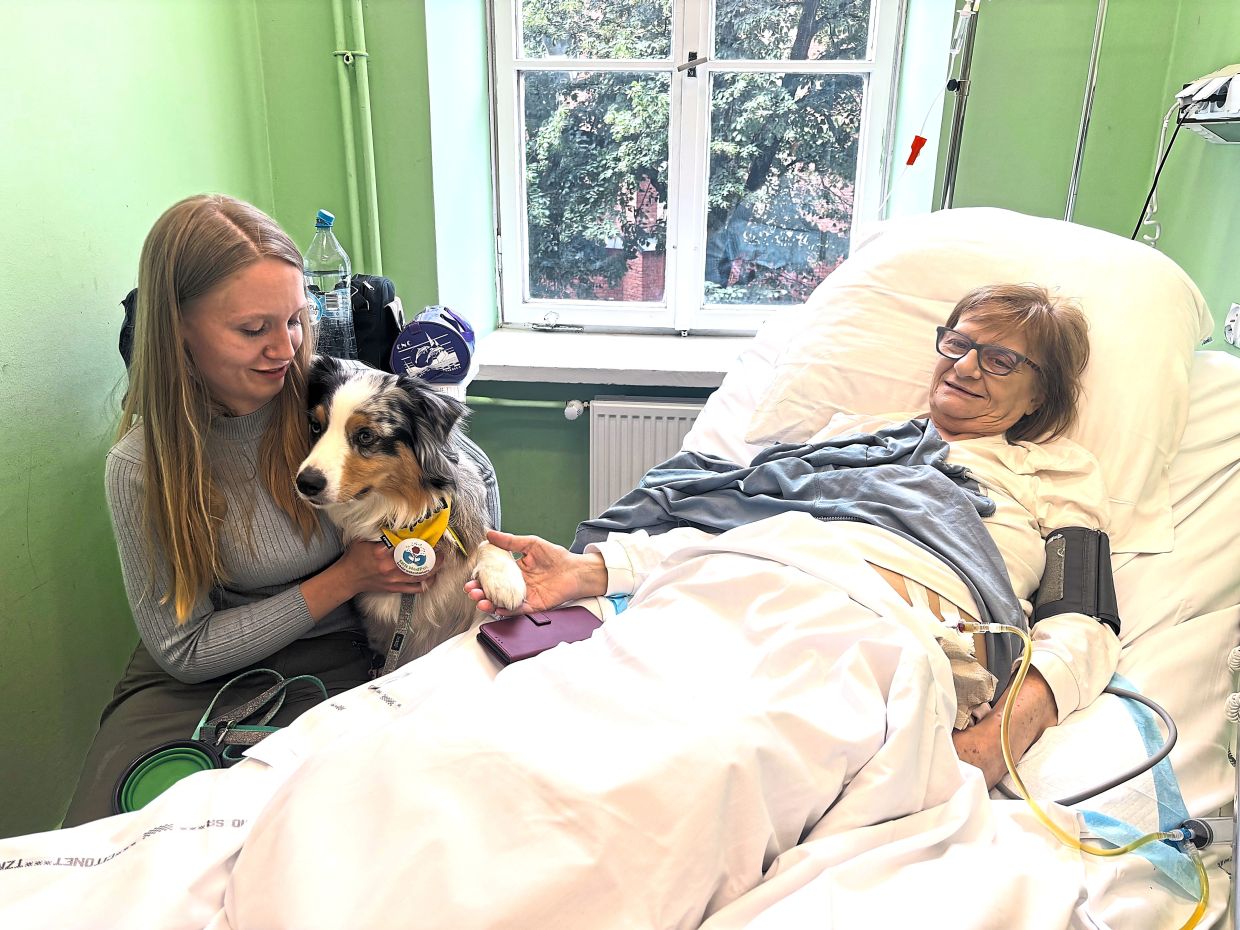
When Ewa Lutka-Krawczyk learned she had gallbladder cancer, her preoccupation was not with her own survival but with Gaja, a rescue dog she had sheltered for three years. She pressed her physician for reassurance that she would live long enough that her devoted companion would not face abandonment. The diagnosis proved devastating, and the 70-year-old has recently entered the palliative ward of a Warsaw hospital, separated from Gaja, who has stopped eating in her husband's care at home. "She is waiting for me," Lutka-Krawczyk remarked from her hospital bed, her abdomen marked by a drainage tube.
The separation between dying patients and their animal companions may soon become unnecessary across Poland. A new legislative proposal working through parliament would establish a legal entitlement for terminal patients to receive visits from their pets while in hospices and palliative care facilities. Although many Polish clinics already permit such visits on a discretionary basis, no comprehensive legal framework currently protects this right. The proposal was introduced by a lawmaker from Prime Minister Donald Tusk's centrist party and reflects growing recognition of the psychological and emotional value pets provide to those facing their final days.
Dr Tomasz Dzierzanowski, who directs the Palliative Medicine Clinic at the Medical University of Warsaw, has become the driving force behind this initiative. His clinic treats Lutka-Krawczyk, and Dzierzanowski has become convinced that allowing pet visitation represents a critical intervention in contemporary medical practice. He frames the issue within a broader social crisis: terminal patients increasingly face profound isolation at precisely the moment when human connection matters most. Society, he observes, is suffering from "an epidemic of loneliness" that extends to hospitals and end-of-life care facilities.
The motivation behind Dzierzanowski's crusade reveals itself in his understanding of the patient population he serves. Many terminal patients are elderly individuals who have outlived their social circles—friends, colleagues, and contemporaries who once provided companionship have preceded them in death. Simultaneously, younger patients admitted to palliative care units often lack the deep friendships that characterised earlier generations, their social networks fragmented by digital connection and virtual rather than tangible relationships. "We make sure that no patient dies alone," Dzierzanowski explained. "When someone is suffering, it is important that someone is there for them. Ideally, that should be another human being. Sometimes, however, there is no one."
The turning point in Dzierzanowski's mission came through a particular patient, Waldemar, a cancer sufferer whose primary anxiety centred not on his own mortality but on the fate of his two cats. When Dzierzanowski arranged for the animals to be brought into the ward, the emotional response proved transformative. Waldemar wept with joy at the reunion, and the cats displayed visible emotional responses to seeing their owner. The reaction from other patients and hospital staff who witnessed the encounter left a lasting impression on Dzierzanowski. "That made me realise that this issue finally needed to be addressed," he reflected.
Today, Dzierzanowski's clinic accommodates pet visitation when circumstances permit, meaning Lutka-Krawczyk will be able to see Gaja again—a prospect that lifted her spirits considerably when she learned of the possibility. The clinic also hosts therapy dogs, which provide additional comfort to patients. During a recent visit, Kluska, an Australian shepherd handled by medical student Malgorzata Brzozowska, circulated through the ward. Lutka-Krawczyk held the dog's paw and smiled—a moment of lightness in the heaviness of her condition. Another patient, 58-year-old Wojciech Zelik, admitted with a tumour, roused himself to watch Kluska perform tricks, finding solace in stroking her coat.
Therapy dog visitation extends its benefits beyond patients themselves. Hospital staff—nurses, cooks, cleaning personnel, and others who shoulder the emotional burden of caring for the dying—experience measurable stress relief from these interactions. Staff members were observed throughout the ward crouching to pet Kluska, their expressions lightening as they engaged with the animal. The cook even offered the dog slices of ham, a small gesture reflecting the humanising effect animals bring to institutional environments dedicated to end-of-life care.
However, the distinction between therapy dogs and a patient's own animal remains significant. Brzozowska, drawing on her medical training, emphasizes that the therapeutic impact intensifies dramatically when terminally ill individuals are visited by their own cherished pets rather than unfamiliar animals. The relationship established over years—built on daily routines, particular affections, and the mutual knowledge that accumulates between owner and animal—produces a calming effect that generic therapy animals cannot replicate. This benefit extends reciprocally: the patient finds comfort in familiar companionship; loved ones witness their relative's moment of joy; and the animal itself experiences reduced stress, as though it senses the disruption in its owner's presence and finds reassurance in the reunion.
Katarzyna Piekarska, the parliamentarian who introduced the legislation now under review by the health committee, emphasises that the legal framework simply formalises what already occurs informally in many hospitals. "In reality, animals in hospitals are already there anyway," she noted. "That's why it needs to be regulated in the law." Her point captures an important regulatory reality: without explicit legal protection, pet visitation depends on individual physician discretion and institutional policy, creating inconsistency and potential vulnerability to restriction during administrative transitions.
The Polish legislation represents a distinct approach to end-of-life care policy, one that acknowledges the profound non-medical dimensions of dying well. While most medical policy focuses on pain management, symptom control, and clinical interventions, this proposal recognises that psychological comfort, emotional connection, and the preservation of meaningful relationships constitute essential elements of quality palliative care. The framework implicitly rejects a purely biomedical model of terminal illness in favour of a more holistic understanding that incorporates the bonds between humans and animals as legitimate healthcare considerations.
For Malaysia and the broader Southeast Asian context, the Polish initiative offers instructive perspective as regional healthcare systems develop palliative care infrastructure and policies. As countries in this region establish or refine end-of-life care standards, the question of pet visitation rights presents an opportunity to move beyond purely clinical protocols toward frameworks that recognise patients' psychosocial needs. The rising prevalence of chronic disease, aging populations, and increasing urbanisation in Southeast Asian nations means growing numbers of terminal patients will navigate healthcare systems seeking meaning and connection in their final period. Integrating pet visitation into palliative care policy could represent a straightforward, low-cost intervention with measurable human benefit.

