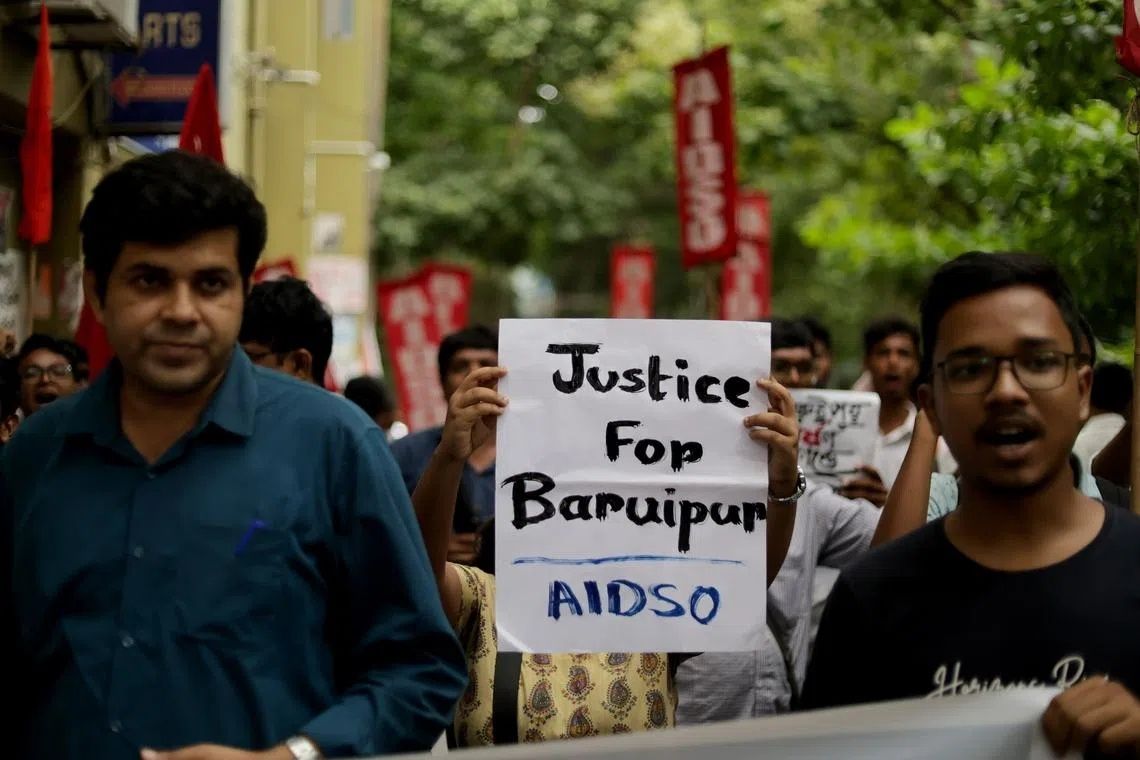
The discovery of an 11-year-old girl's body in a pond in West Bengal has ignited widespread civil unrest across the eastern Indian state, prompting authorities to respond with mass arrests and escalated force. Police in Baruipur, a city located roughly 30 kilometres south of Kolkata, confirmed on Friday that they have taken into custody 35 individuals suspected of participating in violent and destructive activities during the week-long demonstrations that erupted after the child's remains were recovered on July 5. The girl had disappeared the previous day, and her body's discovery transformed the case into a flashpoint for broader community anger about public safety and institutional accountability.
The scale of public outrage manifested itself through increasingly aggressive protest action. Demonstrators blocked major roads throughout the region and set fire to vehicles, effectively paralyzing normal commerce and movement in affected areas. The anger that mobilized thousands also produced darker consequences: reports indicate that one individual unconnected to the crime was beaten to death by enraged crowds in the chaos, raising troubling questions about mob justice and the risks posed when community rage spirals beyond organised protest. Senior state police official Arvind Kumar Anand told Reuters that authorities had identified 35 suspects through conventional investigation combined with digital evidence, noting that video footage circulating on social media platforms would help law enforcement identify additional participants in the violence.
In a development that underscores the volatile dynamics surrounding the case, police shot and killed Prabhas Mondal, one of four men arrested on suspicion of committing the rape and murder. According to police accounts, Mondal was fatally shot in the early morning hours of July 8 while allegedly attempting to flee custody. Officers had brought him to the crime scene as part of standard investigative procedures when the shooting occurred. The circumstances surrounding the killing have added another layer of controversy to the proceedings, with questions already emerging about police conduct and proportionality of force.
The response from Mondal's own family provides a striking illustration of the social rupture caused by such crimes. His mother stated publicly that she would not accept his body or arrange for his funeral rites, effectively disowning him even in death. In a television interview, she expressed acceptance of her son's fate, saying he had received appropriate punishment for his actions and that she bore no responsibility for bringing his remains into their home. Her statement reflects the cultural shame and ostracism that often befalls families of those accused or convicted of sexual violence in Indian society, where such crimes carry profound moral weight beyond their legal dimensions.
Complicating the narrative further, family members of at least one other detained suspect have contested the police case, asserting through media outlets that their relative was arrested in error and bears no connection to the crime. This claim of mistaken identity introduces an element of doubt into the investigative process and raises concerns about whether authorities may have pursued leads hastily in response to public pressure. The families of the remaining two suspects have not issued public statements, leaving significant aspects of their involvement unclear.
West Bengal's new state government, led by Chief Minister Suvendu Adhikari following the Bharatiya Janata Party's electoral victory in May, has seized on the incident as an opportunity to demonstrate its commitment to law enforcement and victim protection. Adhikari declared that his administration would show no tolerance for sexual violence or for citizens who take vigilante justice into their own hands, emphasizing that perpetrators would face prosecution to the fullest extent available under law. His statements, made via social media on July 9, attempt to position the state government as both tough on crime and protective of due process, even as questions linger about police conduct.
The tragic death of the 11-year-old girl must be understood within India's broader and deeply troubling pattern of violence against women and children. Despite legislative reforms implemented following the 2012 Delhi case—in which the gang rape and murder of a 22-year-old woman prompted massive national protests and eventually led to the execution of four convicts—sexual violence remains disturbingly prevalent across the country. That case prompted significant amendments to India's criminal code and renewed public discourse about women's safety, yet similar crimes continue to occur with alarming regularity, suggesting that legal reform alone has proved insufficient.
The West Bengal context adds particular significance to this incident. The state has already faced intense international scrutiny in 2024 following the rape and murder of a trainee doctor at Kolkata's prestigious RG Kar Medical College and Hospital, a case that ignited nationwide conversations about the vulnerability of women even in professional and institutional environments. That earlier tragedy mobilized medical professionals across India to demonstrate their concerns about workplace safety and systemic accountability. The current incident in Baruipur thus arrives in an environment already sensitized to questions about state capacity and willingness to protect its female population.
For Southeast Asian observers, the Indian case carries sobering implications. Sexual violence against children represents a challenge transcending national boundaries, and the tensions evident in West Bengal—between community demands for swift justice, police conduct standards, and systemic accountability—resonate throughout the region. Malaysia and neighbouring countries grapple with similar dynamics when high-profile crimes emerge, including questions about appropriate police response, media coverage of sensitive cases, and the balance between punitive impulses and principles of due process.
The protest movement itself reflects a broader phenomenon across India whereby citizens attempt to compel state action through collective mobilization. While such activism can serve important accountability functions, the descent into mob violence and the killing of an innocent person demonstrates the risks inherent when institutional mechanisms for justice fail to command public confidence. The challenge facing West Bengal's authorities involves not merely solving the immediate crime but rebuilding public faith in institutions sufficiently robust to deliver justice without requiring supplementary violence.
Looking forward, the case's trajectory will likely influence how subsequent investigations into sexual violence crimes proceed in the state and potentially across India more broadly. The visibility of this incident, combined with the controversial police shooting and questions about investigative accuracy, may prompt closer scrutiny of law enforcement practices. Civil society organizations focused on women's rights and criminal justice reform will probably monitor the case closely as it advances through courts, using it as a benchmark for assessing whether institutional responses to sexual violence crimes meet acceptable standards.

