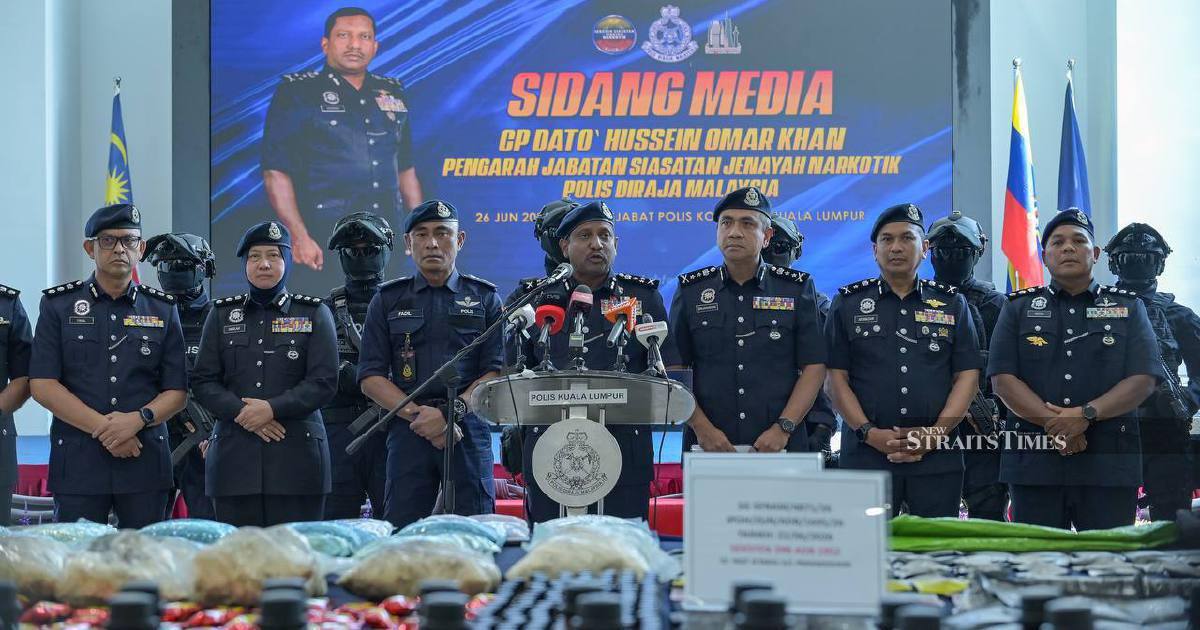
A major operation by Kuala Lumpur police has succeeded in intercepting what authorities describe as an attempt to flood the domestic market with illegal drugs. Three simultaneous raids conducted in the Cheras district on June 20 resulted in the confiscation of narcotics valued at approximately RM135.63 million and the apprehension of seven individuals suspected of involvement in large-scale trafficking operations.
The coordinated enforcement action represents one of the more substantial drug seizures in the federal capital in recent months and underscores the ongoing efforts by law enforcement to dismantle supply chains at critical junctures before contraband reaches street-level distribution networks. The convergence of multiple raids on a single day suggests that investigators had been tracking the suspects' activities over an extended period, allowing them to build sufficient intelligence for simultaneous action across multiple locations.
The specific composition of the seized drugs has not been disclosed in detail, though the substantial monetary valuation indicates the haul likely comprised high-value substances rather than smaller quantities of lower-grade materials. The sophistication required to accumulate such quantities points to an organised operation rather than casual trafficking, raising questions about the network's supply sources and intended distribution methods.
Cheras, a densely populated residential and commercial area in eastern Kuala Lumpur, has frequently featured in police reports as a location where drug-related activities are detected. The district's geography—with its mix of established housing, newer developments, and commercial properties—provides multiple locations where clandestine operations can be concealed. The concentration of enforcement activity in this zone suggests it may have served as either a storage hub, distribution point, or coordination centre for the wider trafficking network.
The arrest of seven suspects provides investigators with leads that may extend well beyond the three raid locations. In trafficking organisations of this scale, individuals in custody often possess knowledge of upstream suppliers, downstream distributors, and financial intermediaries crucial to the operation's functioning. Law enforcement authorities typically conduct extensive questioning during the initial remand period to map the broader criminal network and identify other locations requiring investigation.
The prevention of market flooding attempts carries particular significance for Malaysian drug policy. When traffickers attempt to saturate local markets with large supplies, the sudden availability typically drives down street prices, making drugs more accessible to occasional users and first-time consumers—a dynamic that public health authorities have linked to increased addiction rates and associated social problems. By interdicting supplies before they reach retail distribution points, police operations can maintain price equilibrium that acts as an economic barrier to casual consumption.
The June 20 operation contributes to a broader pattern of heightened enforcement that has characterised Malaysian police responses to trafficking in recent years. Training improvements, better inter-agency coordination, and investment in surveillance and intelligence-gathering capabilities have gradually increased the success rates of major busts. However, traffickers continue to adapt their methods, often routing supplies through neighbouring countries or employing increasingly sophisticated concealment techniques.
The monetary value assigned to confiscated drugs—typically calculated as street-level retail prices—can sometimes obscure the actual trafficking economics. The RM135.63 million figure represents what these substances would theoretically command if sold in small quantities at peak local prices. The actual cost to traffickers at source, likely a fraction of this sum, underscores the enormous profit margins that motivate continued criminal involvement in the trade despite enforcement risks.
Southeast Asia remains a significant transit zone for narcotics destined for regional markets and beyond. Malaysia's geographic position on major trafficking routes, combined with its developed infrastructure and relatively sophisticated financial systems, makes it an attractive operating environment for criminal organisations. Domestic consumption also provides a substantial market, creating demand that organised suppliers are eager to fulfil regardless of law enforcement obstacles.
The implications of the Cheras busts extend to questions about the sources of these substances and their intended destinations within Malaysia. If the drugs were destined purely for local markets, the operation represents a significant reduction in available supplies for a particular period. Alternatively, if this haul represented only one component of a larger importation or represented redistribution of materials for multiple geographic markets, the actual disruption to broader trafficking patterns may be more limited.
Police have indicated that investigations are continuing and the cases will be presented to the Public Prosecutor for charging decisions. The nature of charges laid will depend on factors including the specific substances involved, the quantities of each, and evidence of intent regarding whether the suspects were retailers, mid-level distributors, or higher-level traffickers. These distinctions carry significant implications for sentencing severity under Malaysia's drug trafficking legislation.
The success of this operation demonstrates that intelligence-led policing remains effective in disrupting criminal networks, even in an environment where trafficking organisations continually evolve their tactics. However, law enforcement officials acknowledge that supply reduction alone cannot address the underlying drivers of drug demand. Complementary public health, education, and social intervention strategies are required to create a comprehensive response to drug trafficking and consumption.

