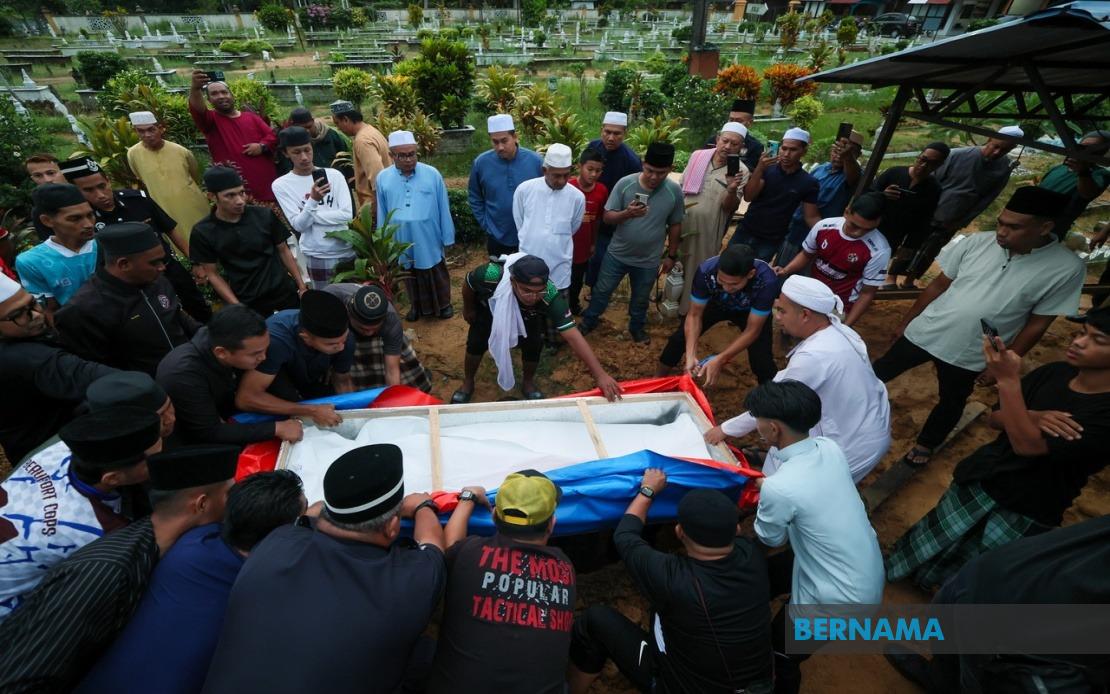
Corporal Mohamad Nur Hafiz Rahim, a 29-year-old police officer who died in an electrocution accident in Beaufort, Sabah, was laid to rest this morning at Kampung Pangkal Kuang Muslim Cemetery in Ketereh, Kelantan. The funeral ceremony took place after prayers were conducted at his family residence in Kampung Hutan Pasir, bringing to a close the funeral proceedings for one of three police personnel killed in the tragedy at Weston Police Station on Thursday evening.
The incident, which occurred at 5.50 pm outside the station near Sekolah Kebangsaan Weston, claimed the lives of Corporal Mohamad Nur Hafiz alongside two colleagues: Corporal Chiu Teck Siong, 40, originally from Sarawak, and Constable Muhammad Raimi Ismarubee, 26, from Terengganu. All three officers were fatally electrocuted while attempting to relocate a 29-foot metal pole typically used for harvesting coconuts. The tragic incident has raised serious questions about workplace safety protocols and equipment management within police stations across the country.
Nurlella Rahim, the deceased officer's eldest sister at 34 years old, expressed her family's deep gratitude to the Royal Malaysia Police for their compassionate assistance in arranging the transportation of her brother's remains from Sabah to their home state. She recounted to gathered media representatives that the vehicle carrying Mohamad Nur Hafiz's body arrived at their family home at 4.45 am, enabling them to conduct funeral arrangements according to Islamic rites and family tradition. The logistics of transporting remains across state lines proved to be a significant undertaking, and the family appreciated PDRM's coordination in facilitating this process during their time of grief.
The Rahim family, comprising five siblings, maintained exceptionally close bonds despite their geographic dispersion across Malaysia. Nurlella, who resides in Ipoh, Perak, described how the siblings engaged in daily video calls and maintained constant communication through a dedicated family WhatsApp group. This virtual closeness had become integral to their relationship, allowing them to remain connected across the considerable distances separating their respective locations in Perak, Kelantan, and Sabah. The family's tight-knit nature meant that Mohamad Nur Hafiz's absence would be keenly felt, as they had relied on these daily digital interactions to sustain their bond.
The last meaningful interaction between Mohamad Nur Hafiz and his mother occurred on Thursday afternoon through a video call, just hours before the fatal incident. Nurlella recalled that during this conversation, her brother appeared fatigued and somewhat withdrawn, offering only brief responses though he managed to smile at his mother. He indicated that he needed to end the call as he had work obligations to attend to, expressing his intention to reconnect later. Despite his apparent tiredness, he continued the family tradition of maintaining frequent contact, even during brief work breaks when he could snatch moments to reach out to his relatives.
Nurlella's final personal interaction with her late brother occurred on Sunday, when he shared video footage of himself, his wife Fatimah Shahira, and their young child enjoying time together at a local beach. These routine family moments, captured and shared digitally, had provided the siblings with regular touchpoints in their daily lives. The normalcy of this recent family outing made the sudden tragedy all the more shocking and incomprehensible for those left behind. The sudden loss has transformed what should have been an ordinary week into one marked by profound grief and unanswered questions about how such an accident could occur.
Prime Minister Datuk Seri Anwar Ibrahim has responded swiftly to the tragedy, issuing directives for a comprehensive, transparent, and expedited investigation into the circumstances surrounding the electrocution deaths. In a Facebook announcement, Anwar emphasized that such an investigation carries vital importance not merely for establishing the immediate cause of the fatal incident, but for identifying systemic gaps that may have contributed to the accident. His call for improved preventive measures reflects broader concerns about occupational safety standards within government agencies and the need for enhanced protocols to protect frontline personnel from hazardous workplace conditions.
The investigation ordered by the Prime Minister signals government commitment to preventing similar tragedies among law enforcement personnel. Understanding how three trained police officers could simultaneously come into contact with live electrical current will be crucial for determining whether the incident resulted from equipment failure, inadequate safety training, absent warning systems, or a combination of factors. The pole used for coconut harvesting—a somewhat unusual item to be stored at a police station—raises questions about whether proper safety procedures existed for handling and moving potentially dangerous equipment.
For Malaysia's law enforcement community, this incident represents a sobering reminder of the occupational hazards police officers face beyond their primary crime-fighting duties. Police stations, like all workplaces, must maintain rigorous safety standards to protect their personnel from preventable accidents. The tragedy underscores the importance of regular safety audits, proper equipment maintenance, and comprehensive training for handling potentially hazardous items within station compounds. The three officers who died were simply performing routine tasks when a terrible accident claimed their lives, highlighting how quickly circumstances can turn tragic.
The loss reverberates through multiple communities: the police force has lost three dedicated members, three families have been shattered, and the wider public is left questioning whether sufficient safeguards exist to protect those who serve the nation. Mohamad Nur Hafiz's family, Corporal Chiu Teck Siong's loved ones in Sarawak, and Constable Muhammad Raimi Ismarubee's family in Terengganu all face the profound challenge of coping with sudden, preventable deaths. As the investigation proceeds, these families and the broader police force will be watching closely to understand what went wrong and what measures will be implemented to prevent future incidents.
The funeral of Mohamad Nur Hafiz concluded his earthly journey, but the implications of his death will extend far beyond the cemetery in Kelantan. The investigation ordered by the Prime Minister must deliver substantive findings and actionable recommendations. For police personnel across the country, this tragedy serves as a grim confirmation that workplace safety cannot be taken for granted, and that even seemingly routine tasks must be approached with appropriate caution and proper protocols. The memory of the three officers who died in this incident should catalyze meaningful changes throughout Malaysia's police stations to ensure that their sacrifice was not entirely in vain.

