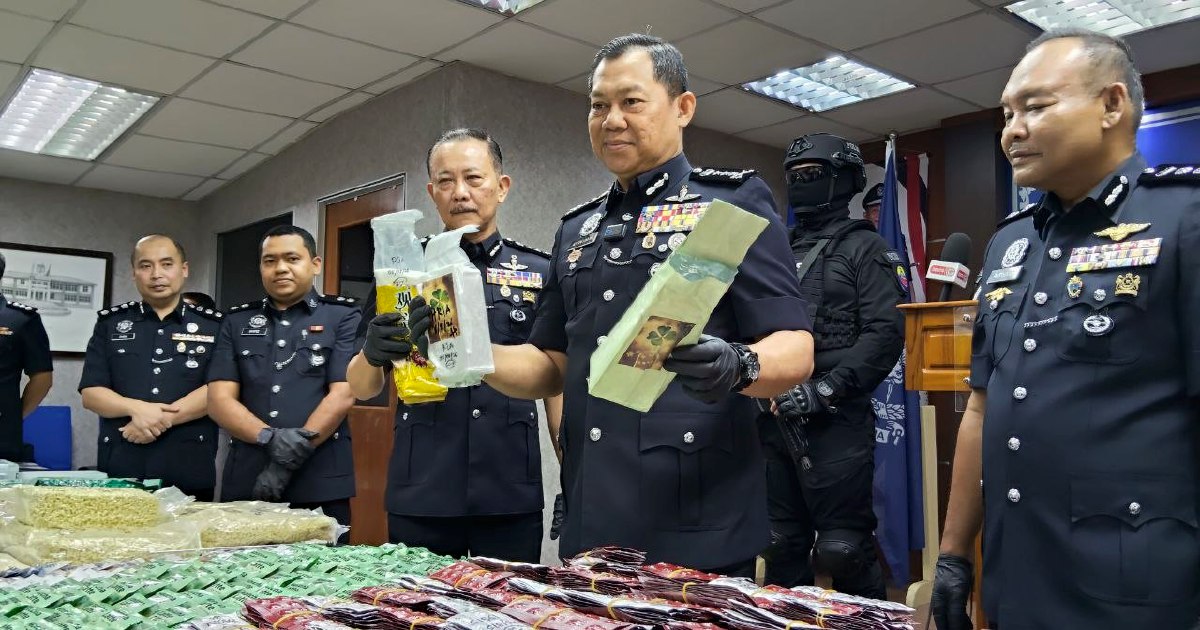
Johor Baru police have successfully disrupted a major drug trafficking operation after conducting a high-impact raid on a residential unit in Persiaran Senibong, Masai, resulting in the seizure of 96.76 kilogrammes of assorted narcotics valued at RM8.49 million. The coordinated enforcement action has led to the arrest of two suspects in connection with the scheme, which authorities allege operated the apartment primarily as a clandestine storage depot for narcotics destined for distribution across the region.
The discovery of such a substantial drug cache underscores the persistent challenge Malaysia faces in combating organised narcotics trafficking, particularly in industrial and residential areas near major transportation hubs. Masai, strategically located within Johor Baru's urban sprawl, has emerged as an increasingly common location for illicit drug operations owing to its accessibility and relative anonymity among the broader commercial landscape. The choice of a rented apartment as a storage facility reflects evolving tactics employed by trafficking syndicates seeking to conceal their activities from law enforcement detection.
The scale of this seizure places it among the more significant drug busts recorded in Johor in recent years, highlighting the volume of controlled substances flowing through the state's distribution networks. The variety of drugs recovered indicates the syndicate's capacity to handle multiple narcotic types, suggesting either a sophisticated operation with diverse client networks or a wholesale distribution point servicing multiple smaller dealers across Johor and potentially neighbouring states. Law enforcement experts frequently note that such wholesale operations represent critical pressure points where intervention can yield disproportionately high impact on downstream street-level drug availability.
The arrest of two individuals marks the beginning of what is typically an extensive investigative process. Authorities will seek to establish the organisational hierarchy of the syndicate, identify upstream suppliers, trace downstream distribution channels, and determine the duration of the operation's existence. These inquiries often reveal connections to larger criminal organisations and may uncover involvement of additional suspects who have yet to be apprehended. The apartment's rental details will likely prove crucial in establishing patterns of operation and identifying landlords or intermediaries who may have unknowingly facilitated or deliberately overlooked the illegal activity.
For Malaysian law enforcement, successful operations like this validate resource-intensive investigative methods and provide actionable intelligence for subsequent operations against the broader trafficking network. Police narcotics units employ intelligence fusion, surveillance, financial tracking, and informant networks to identify storage facilities and distribution hubs. The timing of this raid may indicate months of preparatory investigation, making the seizure the culmination of sustained operational effort rather than a chance discovery.
The RM8.49 million valuation reflects street-level pricing estimates, though the actual economic significance extends beyond the nominal figure. The removal of such quantities from circulation represents substantial disruption to local supply chains, potentially resulting in temporary price spikes and supply shortages that prompt users to seek treatment or reduce consumption. Conversely, it may accelerate competing syndicates' efforts to fill the market gap, intensifying inter-gang competition and associated violence.
Regionally, Johor's proximity to Singapore and its position as Malaysia's primary gateway for goods transit make it inherently vulnerable to drug trafficking operations leveraging legitimate commerce as cover. The state's network of roads, ports, and informal entry points facilitates movement of contraband across borders. This Masai bust exemplifies the ongoing struggle to maintain narcotics interdiction standards despite the volume and sophistication of trafficking methods employed by criminal networks operating across the Johor-Singapore corridor.
The investigation will likely examine financial transactions, telecommunications records, and surveillance footage to build a comprehensive understanding of the syndicate's operations. Modern drug trafficking increasingly relies on encrypted communications and cryptocurrency transactions, complicating law enforcement's ability to trace proceeds and identify associates. The physical seizure, while substantial, represents only the visible dimension of the criminal enterprise.
Beyond the immediate law enforcement achievement, this operation carries broader implications for drug demand reduction strategies. Each major disruption creates temporary windows of opportunity for public health interventions, rehabilitation programme expansion, and community awareness initiatives targeting high-risk populations. Malaysian authorities have increasingly recognised that enforcement alone cannot address the underlying demand dynamics driving trafficking networks, necessitating complementary investment in treatment infrastructure and prevention programmes.
The two arrested individuals now face the Malaysian criminal justice system, where drug trafficking convictions carry severe penalties including lengthy imprisonment and potential capital charges depending on the specific substances involved and quantity thresholds. Their cooperation or otherwise in subsequent investigations will significantly influence the scope of prosecutorial reach into the broader syndicate structure.
Looking forward, this seizure demonstrates that notwithstanding the scale of Malaysia's drug trafficking challenge, law enforcement capacity to identify and disrupt major operations remains robust when proper resources and coordination are deployed. Sustaining this enforcement momentum while simultaneously addressing demand-side vulnerabilities represents the dual challenge confronting policymakers and operational commanders across the region.

