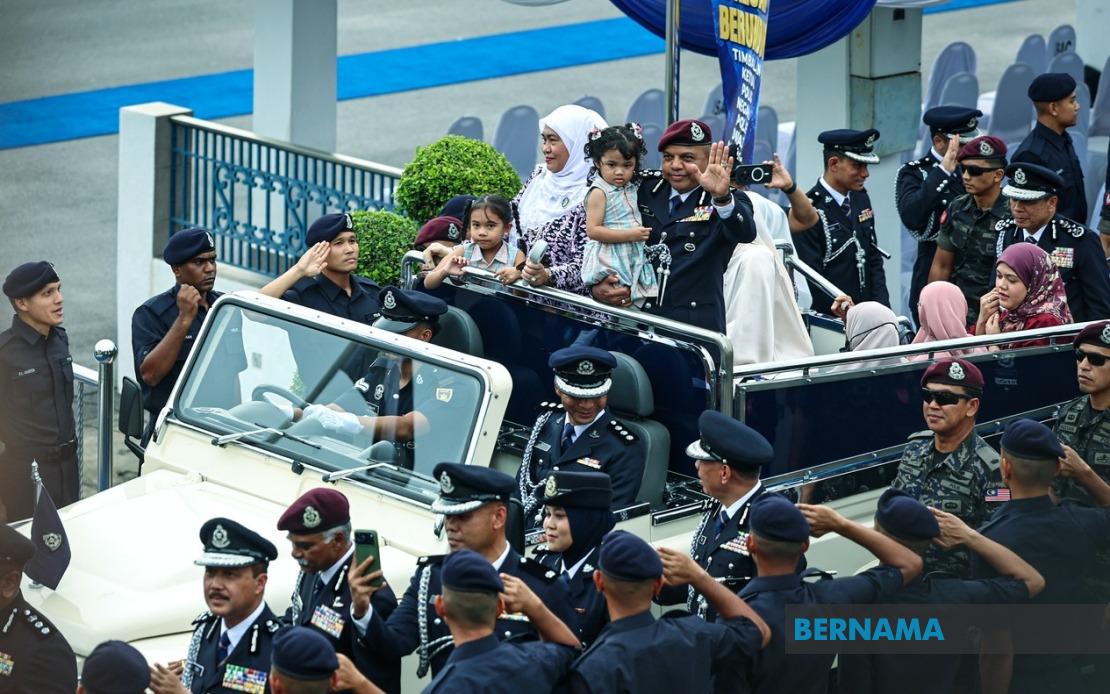
The Royal Malaysian Police can only aspire to world-class standards if it enforces the law with absolute impartiality, according to Tan Sri Ayob Khan Mydin Pitchay, the Deputy Inspector-General who is stepping down after nearly 35 years of service. Speaking at the handover ceremony at the Kuala Lumpur Police Training Centre, Ayob Khan emphasised that public respect for the force hinges on consistent, equitable application of the law across all segments of society, regardless of political affiliation or social standing.
Ayob Khan's remarks carry particular weight given Malaysia's ongoing struggles with public trust in institutions and occasional concerns about political interference in law enforcement. His assertion that the police must be granted operational independence to pursue cases wherever they lead—whether against government or opposition figures—sets a clear benchmark for institutional credibility. The incoming Acting Deputy Inspector-General, Datuk Seri Ibrahim Darus, who previously directed the Bukit Aman Special Branch, will inherit these expectations as he assumes the position.
The retiring senior officer rejected any suggestion that he has compromised investigative independence during his tenure, citing his track record when leading the Counter Terrorism Division in 2019. During that period, his division apprehended 14 to 15 individuals suspected of affiliation with the Liberation Tigers of Tamil Eelam, including two state assemblymen from the then-ruling coalition. Ayob Khan presented this instance as evidence that his division pursued cases on merit rather than political calculation, deliberately targeting individuals regardless of party membership to demonstrate consistent application of the law.
This example underscores a broader challenge facing Malaysian law enforcement: the need to demonstrate that investigations proceed according to evidence and legal principle rather than political convenience. For a regional audience, the significance extends beyond Malaysia itself, as public confidence in police forces shapes broader governance outcomes across Southeast Asia. Nations grappling with similar institutional pressures often find that perceived bias in law enforcement corrodes public trust more rapidly than any single scandal.
Ayob Khan also used his departure as an opportunity to clarify his future role, explicitly stating he harbours no intention of entering partisan politics after retirement. He drew a distinction between politicians, whom he characterised as focused on immediate electoral cycles, and statesmen, whom he described as thinking across longer timeframes. The separation of police leadership from political participation remains contentious in many democracies, and Ayob Khan's stance reflects international best practices emphasising institutional autonomy for security forces.
His 35-year career trajectory reflects the depth of experience now departing from the top leadership tier. Prior to his appointment as Deputy Inspector-General in June 2023, Ayob Khan held command roles spanning counterterrorism, narcotics investigation, criminal investigation, and state-level policing. This progression through diverse portfolios suggests exposure to the full spectrum of law enforcement challenges Malaysia faces, from organised crime to security threats. The concentration of such experience in a single departing officer highlights succession planning considerations for the force.
The timing of these remarks coincides with elevated scrutiny of police conduct across the region. Several Southeast Asian nations have undertaken police reforms aimed at reducing corruption and improving community relations. Ayob Khan's emphasis on firm, impartial enforcement without regard to political consequences aligns with international reform frameworks that prioritise institutional independence and accountability. For Malaysian observers, particularly those in civil society and governance watchdog organisations, the statement may be read as a template for evaluating future police leadership.
The question of political interference has shadowed Malaysian policing periodically throughout the past decade. Major investigations into high-profile cases occasionally generated public speculation about political influences, though many such concerns remained unsubstantiated. Ayob Khan's explicit rejection of interference and his willingness to cite specific cases where he pursued senior government figures suggests an attempt to establish a documented record of impartiality. However, institutional credibility extends beyond individual leader assertions; it requires sustained patterns of behaviour and transparent processes that publicly demonstrate consistent standards.
Looking forward, the handover to Ibrahim Darus signals continuity in expectations regarding institutional independence. The Special Branch, which Ibrahim previously directed, occupies a particularly sensitive position within the PDRM, handling counterintelligence and national security matters where political sensitivities frequently arise. His previous role suggests familiarity with balancing security imperatives against civil liberties concerns—a perennial challenge for intelligence-focused units worldwide. Whether the incoming leadership maintains Ayob Khan's emphasis on impartial enforcement will become evident through investigative patterns and public communications over coming months.
For Malaysia's broader development trajectory, police institutional quality matters significantly. Investor confidence, human rights ratings, and international standing all correlate with perceptions of law enforcement impartiality. Countries where police are perceived as politically captured often struggle with foreign direct investment and diplomatic standing. Ayob Khan's departure statement, framed as guidance for his successors, appears designed to reinforce expectations that merit-based, impartial law enforcement constitutes a national priority rather than an optional refinement.
The distinction Ayob Khan drew between the short-term electoral focus of politicians and the longer-term nation-building perspective of statesmen may also reflect implicit commentary on institutional autonomy more broadly. Security forces, military establishments, and investigative bodies in democratic societies function optimally when insulated from immediate political pressures. His retirement remarks essentially argue that allowing such institutions operational space, while maintaining ultimate democratic oversight, produces better outcomes than politicised decision-making. This perspective increasingly resonates across developed democracies, where institutional independence has become recognised as foundational to effective governance.
Ayob Khan's compulsory retirement, occurring the day after his remarks, marks the end of a significant chapter in recent Malaysian police history. His successor faces the dual challenge of maintaining the institutional standards he articulated while navigating the political complexities inherent in top law enforcement leadership. The degree to which Malaysia's police force achieves world-class status—in professionalism, impartiality, and public confidence—will depend substantially on whether successive leaders institutionalise the principles Ayob Khan outlined, ensuring they persist beyond any individual officer's tenure and become embedded within organisational culture.

