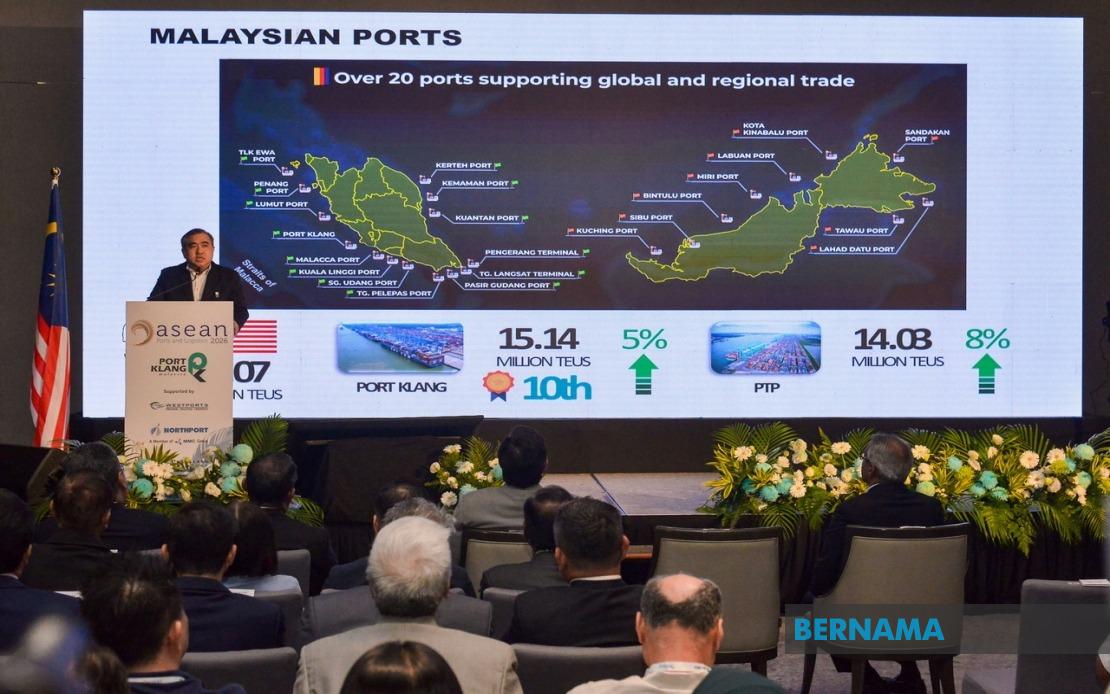
Malaysia is charting an ambitious course to cement its position as Southeast Asia's premier maritime hub through a transformative expansion of Port Klang that will span nearly two decades and fundamentally reshape the nation's logistics infrastructure. Transport Minister Anthony Loke articulated this strategic vision at the ASEAN Ports and Logistics Conference in Kuala Lumpur on July 8, framing the Third Terminal project on Carey Island as essential to Malaysia's economic competitiveness over the coming decades.
The scale of Malaysia's current maritime operations pales against regional rivals, a disparity that underpins the urgency of expansion plans. Port Klang currently processes approximately 20 million twenty-foot equivalent units annually, a figure dwarfed by Singapore's Tuas Port, which operates with three times the capacity at 60 million TEUs per year. This capacity gap represents a critical vulnerability for Malaysia's aspirations to capture greater shares of regional containerised trade and transshipment activity. The phased development programme is explicitly designed to transform Port Klang into a megaport capable of handling substantially larger cargo volumes, thereby addressing this competitive disadvantage that has constrained Malaysia's ability to compete effectively with established hubs across the region.
The project has already cleared important bureaucratic hurdles that position it for imminent advancement. The feasibility study, which commenced in 2018, has reached completion, and the Cabinet has granted in-principle approval to proceed under a public-private partnership model that will distribute implementation risks and capital requirements between government and private sector partners. However, administrative complexities still require resolution before construction can commence. Land acquisition and coordination issues with the Selangor state government remain outstanding matters that must be settled, though Loke indicated these obstacles are being actively addressed and should not substantially delay project commencement.
Beyond the immediate infrastructure imperative, Malaysia's strategic positioning within the global maritime landscape has been fundamentally altered by recent geopolitical developments in West Asia. While international shipping faces considerable uncertainty from regional conflicts, Malaysia's geographical location and political neutrality have paradoxically created competitive advantages. The nation's ports have proven resilient, with both Port Klang and Port of Tanjung Pelepas registering positive cargo growth during the first quarter of 2024, defying broader industry concerns. This performance reflects a deliberate recalibration of global shipping routes as operators prioritise safety and stability, with transshipment activities increasingly diverted to Malaysian and other ASEAN ports perceived as secure and geopolitically neutral havens.
The implications for Malaysia's maritime sector extend beyond commercial opportunity to questions of regional stability and international trade architecture. Loke emphasised that ASEAN member states must collectively safeguard the principles of neutrality and security throughout the Strait of Melaka, ensuring this critical international trade corridor remains insulated from geopolitical conflicts that threaten global commerce. Malaysia's role as a custodian of this vital shipping lane positions it uniquely to benefit from heightened international attention to maritime security, with shippers and logistics operators actively seeking alternative routing options that bypass conflict-affected regions. The Third Terminal project, therefore, represents more than domestic infrastructure development; it embodies Malaysia's commitment to providing stable, secure, and efficient maritime services during a period of unprecedented global uncertainty.
The phased implementation approach reflects realistic acknowledgment of the project's magnitude and the complexities involved in developing a world-class maritime facility. By distributing construction and commissioning across multiple stages over approximately 20 years, Malaysia can manage capital expenditure, monitor market conditions, and adjust capacity additions according to demand trajectories. This flexibility proves particularly valuable given the unpredictable nature of shipping cycles and the potential for technological disruption in maritime logistics. The staging approach also allows Malaysia to demonstrate project viability and operational competence with initial phases before committing to final expansions, providing assurance to private sector partners and international shipping lines that the investment will deliver promised outcomes.
For Malaysian policymakers, the Third Terminal project represents a strategic bet on Malaysia's enduring importance within global supply chains and maritime networks. Rather than accepting a secondary role as a transshipment hub dependent on external shipping patterns, the expansion programme signals Malaysia's intention to capture greater value from its geographical advantages and institutional stability. The project aligns with broader national ambitions to diversify the economy away from traditional manufacturing sectors and establish Malaysia as a regional financial and logistics centre of consequence. Success would position the nation to attract substantial foreign direct investment in port-related industries, warehousing, logistics services, and supply chain management operations, creating employment and economic dynamism across the Klang Valley and beyond.
The competitive dynamics between Malaysian and Singaporean ports inject additional strategic significance into the Third Terminal initiative. Singapore's dominance in regional container handling has historically constrained Malaysia's ability to capture high-value logistics activities and service higher-tier shipping lines. A substantially expanded Port Klang would provide Malaysian operators with competitive leverage to negotiate improved terminal handling agreements, attract new shipping alliances, and establish direct service relationships with major container lines currently routed primarily through Singapore. This competitive repositioning could gradually redistribute regional cargo flows and establish Malaysia as a genuine alternative to Singapore, reducing Malaysian shippers' dependence on Singapore's infrastructure and allowing domestic operators to capture greater margin within supply chains.
Looking forward, successful implementation of the Third Terminal project would represent a defining achievement for Malaysia's maritime sector and a vindication of the patient, phased approach to infrastructure development. The 20-year timeline, while lengthy, reflects realistic assessment of the engineering, environmental, regulatory, and commercial challenges inherent in developing a world-class container port facility. For Malaysian businesses, exporters, and logistics operators, the project promises enhanced capacity, improved service levels, and reduced transportation costs as competition increases between port operators and terminal facilities. For regional stakeholders, Malaysia's successful development of enhanced maritime infrastructure contributes to greater resilience, diversification, and stability across ASEAN shipping networks, ultimately benefiting regional trade and economic integration.

