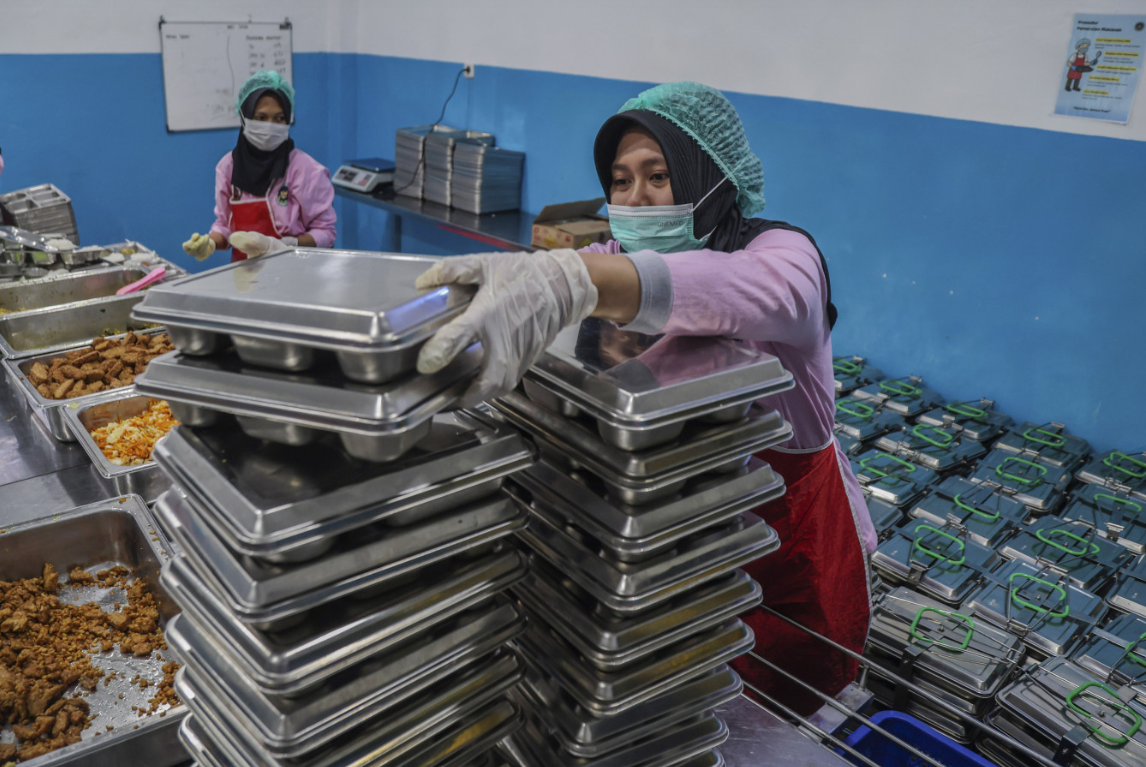
President Prabowo Subianto is directing his administration to conduct a comprehensive reassessment of two cornerstone social welfare initiatives, a move that signals potential structural changes to programmes that have become flashpoints for public controversy and political scrutiny. The decision, articulated during a four-hour closed-door session at the presidential palace on Wednesday with relevant cabinet ministers, reflects growing pressure on the government to address implementation challenges and public concerns regarding both the free nutritious meal scheme and the Red and White cooperative network.
The free meals initiative, which represents a centerpiece of Prabowo's social agenda, currently operates under a budget allocation of at least Rp 268 trillion for 2026 and aims to provide meals to approximately 83 million beneficiaries spanning schoolchildren, students in higher education, and pregnant women nationwide. The programme represents a significant fiscal commitment intended to combat malnutrition and stunting in childhood, persistent public health challenges across Indonesia's diverse regions. Yet despite its fundamental social objectives, the initiative has attracted considerable public disapproval, manifesting in street demonstrations last month advocating for temporary suspension of operations, intense media examination of its substantial financial footprint, documented cases of food poisoning affecting beneficiaries, and a criminal investigation into corruption allegations involving senior personnel from both the National Police and Indonesian Military establishments.
Bagn deputy chief Agustina Arumsari, speaking following the presidential meeting, outlined the specific directives Prabowo has communicated regarding programme recalibration. The National Nutrition Agency has received a one-month timeframe to conduct a meticulous evaluation of operational methods currently employed across school-based meal distribution networks. This reassessment will concentrate particularly on revisiting and potentially modifying eligibility criteria determining which population segments qualify for programme benefits, with preliminary government consideration being given to narrowing assistance to exclude higher-income households and evaluating implementation ramifications within educational institutions serving socioeconomically mixed student bodies.
The psychological and social dimensions of targeted assistance constitute a central concern animating the government's review process. Officials have emphasised avoiding scenarios where disparities in meal provision within single classrooms might generate stigma, embarrassment, or divisive dynamics among students of varying family financial circumstances. This sensitivity reflects understanding that poorly implemented targeting mechanisms can produce unintended social consequences extending beyond nutritional outcomes, potentially damaging the self-perception and peer relationships of vulnerable children.
Beyond revisions to eligibility frameworks, the government is actively exploring modified delivery methodologies for the programme. Current implementation relies substantially on dedicated free meal kitchen facilities, yet officials are investigating whether school canteen infrastructure might serve as an alternative or supplementary distribution channel. Such operational redesigns could potentially reduce administrative complexity, enhance local ownership of programme implementation, and integrate free meal provision more seamlessly into existing school food systems rather than maintaining parallel institutional structures.
The presidential directive represents a potential pivot toward more geographically and demographically concentrated targeting of resources directed toward Indonesia's economically most marginalised communities. This reorientation would move away from the current expansive universal model attempting to serve all 83 million designated beneficiaries toward a more deliberately focused approach concentrating finite resources on populations facing the most severe nutritional deprivation. Such recalibration reflects growing acknowledgment within policymaking circles that universal programmes, while politically attractive and administratively simpler to communicate, may generate efficiency losses and sustainability challenges when applied across such expansive beneficiary populations.
Parallel to the free meals reassessment, Coordinating Food Minister Zulhas Hasan announced modifications to the Red and White cooperative programme, which has similarly generated significant controversy and public backlash. The government has determined to substantially expand the cooperatives' institutional role within Indonesia's social assistance architecture, positioning them as the primary governmental mechanism through which various social welfare distributions and price-subsidised commodities reach rural populations. This expansion would vest the cooperative network with responsibility for administering multiple social protection schemes rather than concentrating on single narrow functions.
The cooperatives will additionally assume responsibility for agricultural product procurement, specifically purchasing rice and corn directly from farmers when prevailing market prices decline below government-established price floors. This intervention mechanism is designed to provide income stabilisation and market protection for agricultural producers, particularly small-scale farmers vulnerable to volatile commodity markets. By guaranteeing minimum purchase prices for staple crops, the government aims to enhance rural household income stability and discourage agricultural sector contraction during periods of commodity price weakness.
Yet the Red and White cooperative initiative has encountered its own significant implementation obstacles and public relations challenges. Military-style training programmes mandated for cooperative management personnel have resulted in at least four documented deaths, triggering substantial negative publicity, bereaved families' grievances, and civil society criticism regarding the appropriateness of militarised training methodologies for civilian economic cooperative administrators. These fatalities have substantially eroded public confidence in the programme's institutional design and operational practices, compelling government officials to acknowledge necessity for implementation review and potential structural modifications.
For Malaysian observers and Southeast Asian policymakers more broadly, Indonesia's experience with these large-scale social programmes offers instructive lessons regarding implementation challenges facing ambitious welfare expansion initiatives. The mounting controversies surrounding both the free meals scheme and the cooperative network illustrate tensions inherent in designing universal social programmes operating across vast, economically heterogeneous populations with divergent regional capacities for implementation. Resource scarcity, administrative capability limitations, and unintended social consequences frequently constrain the practical realisation of visionary social agendas, necessitating pragmatic policy adjustment based on implementation experience.
The Prabowo administration's willingness to conduct public reviews and acknowledge programme shortcomings, while politically costly in the short term, potentially positions Indonesia for more sustainable long-term social policy design. Rather than persisting with flagging initiatives despite mounting evidence of implementation dysfunction, systematic reassessment creates opportunities for evidence-based policy refinement, enhanced targeting efficiency, and recalibrated delivery mechanisms better calibrated to actual administrative capacities and beneficiary circumstances. The coming month will prove consequential in determining whether these review processes yield meaningful operational improvements or remain primarily symbolic gestures intended to manage public dissatisfaction without substantive policy modification.

