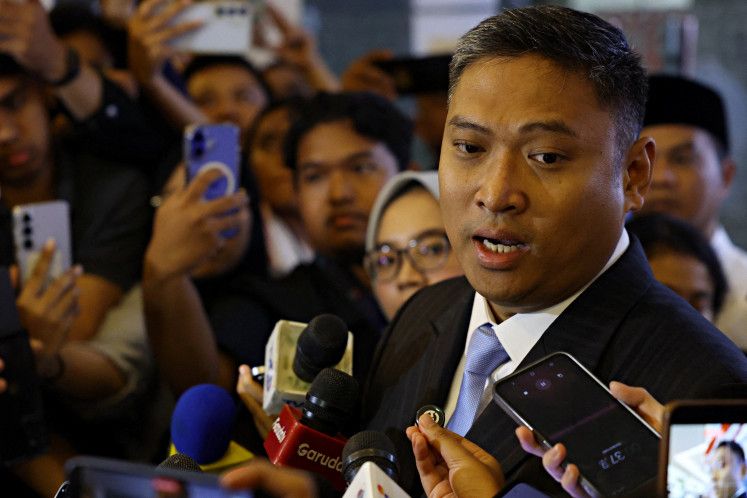
President Prabowo Subianto's flagship free nutritious meals programme encountered fresh institutional turbulence this week with the sudden departure of National Nutrition Agency (BGN) chief Nanik Sudaryati Deyang, who cited severe health complications as the reason for stepping down after less than two months in office. The resignation compounds a cascade of governance failures that have undermined public confidence in the sprawling initiative since its rollout earlier this year, exposing deep cracks in how Indonesia's government manages one of its most visible and costly social schemes.
Nanik's departure through a Facebook announcement on Wednesday revealed the extraordinary personal toll the role exacted. Days earlier, she had disclosed that doctors discovered a significant arterial blockage requiring urgent treatment overseas, a condition she directly attributed to the psychological strain of overseeing the programme's colossal budget allocation. In striking candour, she described the responsibility of managing public funds as standing precariously on a cliff edge, where miscalculation meant calamity. Her account painted a picture of institutional dysfunction so acute that even the appointed steward of the programme felt paralysed by fear of mismanagement, refusing to sign policies independently and subjecting every decision to agonised second-guessing.
The timing of this crisis compounds earlier damage to the agency's credibility. Nanik had been brought in just seven weeks earlier to restore institutional integrity following the June arrest of her predecessor, Dadan Hindayana, along with two deputies on corruption charges stemming from alleged procurement irregularities and financial misconduct within the multitrillion-rupiah scheme. Her role was explicitly rehabilitative—to demonstrate that leadership change could restore public and political faith. Instead, her exit under medical distress suggests that the underlying systemic problems generating such acute stress remain unresolved. Before her elevation to the top job, Nanik herself had functioned as Dadan's deputy, meaning she possessed intimate knowledge of the agency's operations while still proving unable to prevent her own breakdown.
Within hours of accepting Nanik's resignation at the State Palace in Jakarta, President Prabowo appointed Deputy Agriculture Minister Sudaryono as her successor. Sudaryono's profile differs markedly from his predecessor's—he carries explicit political credentials as a member of Prabowo's own Gerindra Party and served as the President's aide during the 2010s, marking him as a trusted political loyalist rather than a career bureaucrat or technocrat. This appointment signals a deliberate pivot toward injecting political loyalty and direct presidential alignment into an agency that has become a liability rather than an asset to Prabowo's political standing.
During his inauguration ceremony, Sudaryono acknowledged the governance catastrophe confronting him, pledging to demolish the opacity that has characterised BGN operations. He promised to eliminate manual processes through digitalisation and eliminate clandestine decision-making, positioning transparency as his core mandate. These commitments represented implicit admission that the agency had operated with insufficient oversight and inadequate documentation—precisely the conditions under which corruption had allegedly flourished under Dadan's stewardship. Whether Sudaryono's appointments as a political solution to an institutional problem can actually deliver technical improvements remained unclear.
State Secretary Prasetyo Hadi's comments underscored the political magnitude of the crisis engulfing what should be a flagship presidential achievement. He confirmed that Prabowo had ordered comprehensive administrative reforms across the entire agency in response to the corruption investigation, suggesting that problems extended far beyond individual misconduct to systemic weakness. Prasetyo justified Sudaryono's selection partly on the grounds that he had contributed to the programme's initial design, potentially offering continuity and institutional memory during a period of necessary overhaul. Yet this rationale also raised uncomfortable questions: if the programme's architects were present at its founding conception, how had such serious operational and governance defects emerged so rapidly?
The free meals initiative has encountered relentless criticism throughout its eighteen-month operational history. Recurring reports of food contamination have triggered multiple mass poisoning incidents across Indonesia, prompting quality investigations nationwide. In response, Nanik had imposed a moratorium on expanding kitchen facilities while reviewing approximately 28,000 existing sites for compliance. This defensive posture paradoxically generated fresh political friction, as thousands of prospective kitchen operators who had invested substantially in facilities now faced indefinite delays, spawning protests and resentment from constituencies the programme was meant to assist.
Recognising the accumulated weight of these criticisms, the BGN has fundamentally rescaled its ambitions. The agency announced Tuesday that it was slashing its provisional 2026 budget from the initially planned Rp268 trillion to Rp229 trillion (equivalent to US$12.8 billion), while simultaneously reducing the beneficiary target from 82.9 million to 62.7 million people. This retrenchment—cutting both spending and coverage simultaneously—effectively represents acknowledgement that the original vision proved operationally unachievable. Deputy BGN chief Agustina Arumsari reframed this retreat as a strategic pivot toward quality over quantity, stating that the agency would prioritise service excellence rather than chase numerical targets, at least for the immediate term.
The succession of crises engulfing the free meals programme reflects deeper institutional pathologies than any single leadership change can remedy. Political analyst Wasisto Raharjo Jati attributed the cascading problems to fundamental deficiencies in foundational planning, arguing that the initiative had been propelled forward primarily by presidential political ambition rather than rigorous technical preparation. Despite carrying supreme political priority as one of Prabowo's flagship campaign commitments, the programme's actual implementation revealed an institution driven more by political urgency than by the bureaucratic groundwork necessary for managing such vast expenditures across geographically dispersed operations. This diagnosis suggests that Sudaryono's appointment, regardless of his loyalties or digitalisation pledges, cannot overcome planning failures baked into the scheme's very conception.
For Malaysian observers, Indonesia's experience with the free meals programme offers sobering lessons about the risks of scaling ambitious social programmes without adequate institutional scaffolding. As Malaysia itself contemplates various assistance schemes and social safety net expansions, the Indonesian case demonstrates how rapid rollout combined with inadequate governance oversight can transform flagship initiatives into sources of public dissatisfaction and corruption vulnerability. The political costs of such failures extend beyond budgetary waste—they erode public trust in government capacity to deliver on promises, a particularly acute risk when programmes target vulnerable populations including schoolchildren and pregnant women, where quality lapses carry health implications.

