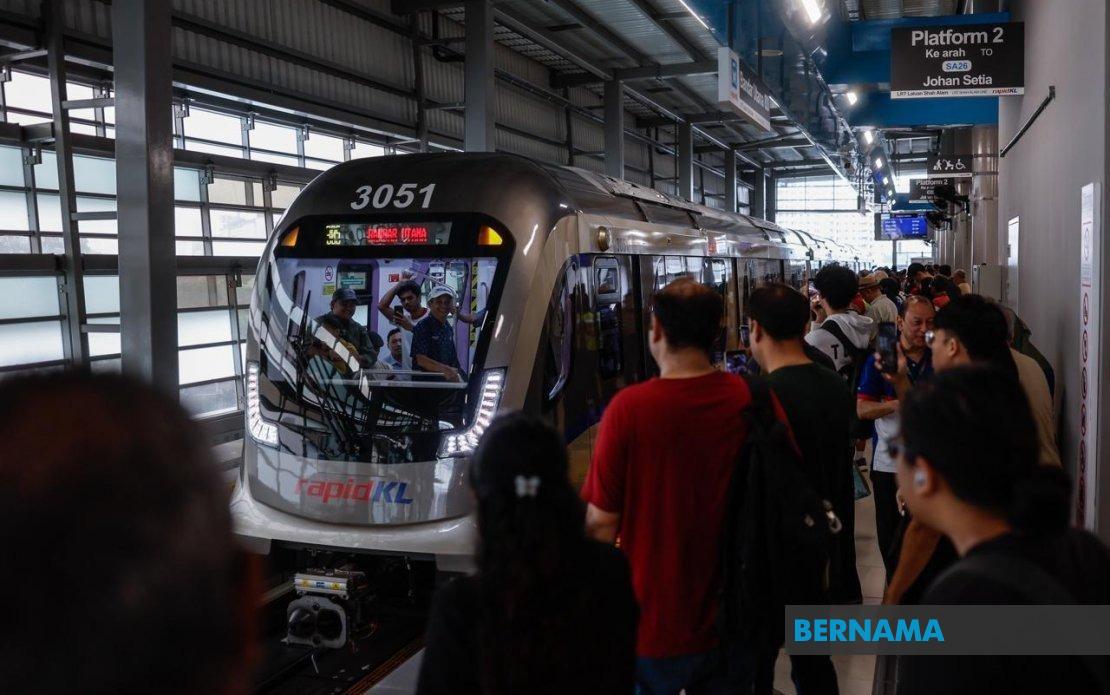
The Light Rail Transit 3 (LRT3) Shah Alam Line commenced operations today, marking another milestone in Malaysia's expanding public transport infrastructure. Prasarana Malaysia Berhad, the operator, projects cautious initial passenger numbers between 5,000 and 10,000 for the opening day, reflecting realistic expectations about how long it typically takes commuters to integrate a new rail service into their travel routines. Company president and chief executive Amir Hamdan indicated the ridership figure represents just the beginning of a gradual growth trajectory that should eventually reach 67,000 daily passengers within the first operational year, provided the transition occurs smoothly and without unexpected disruptions.
The enthusiasm surrounding today's launch was evident from early commuter responses, with multiple accounts of passengers eager to test the new line across its stations. Amir observed that early adopters were particularly drawn to the prospect of escaping traffic congestion during their morning commutes, with many already posting positive comments across social media platforms. These initial reactions underscore a broader regional shift towards accepting public transport as a viable alternative to private vehicles, a sentiment that aligns with ongoing efforts across Southeast Asia to reduce urban congestion and emissions. The willingness of early riders to embrace the service represents valuable momentum for Prasarana as it navigates the critical establishment phase.
Operations commenced at 6 am this morning, and Prasarana reports that services have proceeded without significant operational issues. Train intervals during peak hours are currently set at approximately eight minutes, a frequency considered manageable given the initial passenger volumes. The operator has deliberately adopted a measured approach to capacity management, preferring to observe actual ridership patterns before making adjustments to train frequency or introducing additional services. This data-driven methodology reflects lessons learned from previous mass rapid transit expansions across Malaysia, where premature capacity increases have sometimes resulted in underutilised resources.
Key interchange stations will receive particular attention during this monitoring phase. Glenmarie 2 station, which connects the new LRT3 line to the existing Kelana Jaya Line, and Bandar Utama, which links to the Kajang Line, are positioned as critical nodes where passenger flows will be carefully tracked. These interchanges are essential for the LRT3's viability, as they enable seamless transfers between the new line and established networks, expanding accessibility across the Klang Valley. The ability of these stations to handle transfer demand efficiently will significantly influence whether commuters adopt the LRT3 as part of regular multimodal journeys.
Prasarana's immediate operational focus extends beyond frequency management to encompassing the passenger experience itself. The operator is currently assessing how effectively the automatic gates, ticketing machines, and broader station layouts facilitate smooth passenger flows. These seemingly technical elements are actually critical to user satisfaction and retention, particularly during the window when commuters are forming habits around the new service. Any friction points—whether in payment systems, navigation, or physical accessibility—could discourage otherwise interested riders from making the switch from personal vehicles.
The operator has explicitly stated that no women-only coaches will be introduced during the initial phase, though this decision remains subject to revision. Prasarana indicated that future determinations regarding gender-segregated facilities will be driven by accumulated ridership data and feedback from actual users. This adaptive approach acknowledges that some public transport innovations, while potentially beneficial, require sufficient evidence before implementation, avoiding the introduction of features that may prove unnecessary or ineffective for this particular line's user base.
Prime Minister Datuk Seri Anwar Ibrahim's announcement of complimentary rides for one month—extending from today through July 31—represents a significant policy intervention intended to accelerate adoption during this critical launch window. The free ride scheme encompasses not merely the LRT3 line itself but also Prasarana's feeder bus services, creating an integrated incentive structure that encourages exploration of the entire transport ecosystem. This approach mirrors promotional strategies employed internationally, though the extended duration provides an unusually generous window for commuters to evaluate whether the service meets their mobility needs before any fare structure begins.
The introduction of the LRT3 Shah Alam Line carries implications extending beyond the immediate service area. The new line enhances connectivity within the Klang Valley, one of Malaysia's most economically productive regions, potentially reducing vehicular congestion on already strained road networks. For Shah Alam specifically, the transport upgrade may influence long-term urban development patterns and residential desirability, as areas with superior public transit access typically experience increased property values and commercial activity. The success or failure of this line will provide valuable evidence regarding whether current transport expansion strategies align with commuter preferences.
Amir Hamdan's remarks reflected a deliberate calibration of expectations, avoiding overly optimistic projections while nonetheless demonstrating confidence in the service's eventual success. The distinction between opening-day ridership and first-year targets acknowledges that establishing public transport behaviour requires time; commuters must work through initial curiosity, test the service against alternatives, and ultimately make deliberate decisions to modify their travel patterns. By setting the opening-day projection at a modest 5,000-10,000 passengers, Prasarana has essentially framed this as a validation and exploration phase rather than an immediate success indicator.
Looking ahead, the operator has clearly indicated its preparedness to scale operations responsively. If demand warrant, Prasarana can increase train frequency beyond the current eight-minute intervals or introduce additional rolling stock, including potentially positioning standby trains at strategic locations during peak periods. This flexibility suggests the operator has learned from experiences elsewhere, where rigid capacity planning occasionally constrained successful lines or left underutilised infrastructure in place at unsuccessful ones. The adaptive management approach should allow the LRT3 Shah Alam Line to evolve based on genuine demand rather than abstract projections.
The month-long free ride period serves a dual purpose beyond simple demand stimulation. It will generate operational data and passenger feedback that will inform Prasarana's decisions regarding future service modifications, facility enhancements, and potentially the introduction of features like gender-segregated coaching. This evidence-based approach to transport management reflects international best practices and contrasts with historical approaches where transport policy was sometimes determined through top-down planning without substantial reference to actual user preferences. The comprehensive monitoring during this establishment phase positions the operator well to make informed decisions throughout the LRT3's operational lifecycle.
For the broader Malaysian transport narrative, the LRT3 Shah Alam Line represents another test of the country's commitment to developing comprehensive public transport networks. The line's eventual success will depend fundamentally on whether it delivers reliable, convenient, and affordable mobility in competition with private vehicles—a challenge that extends beyond operational efficiency to encompass integration with urban development, pricing strategy, and consistent service quality. The months ahead will reveal whether commuters are sufficiently persuaded by the convenience and cost advantages of the new service to establish lasting behavioural change in this critical economic corridor.

