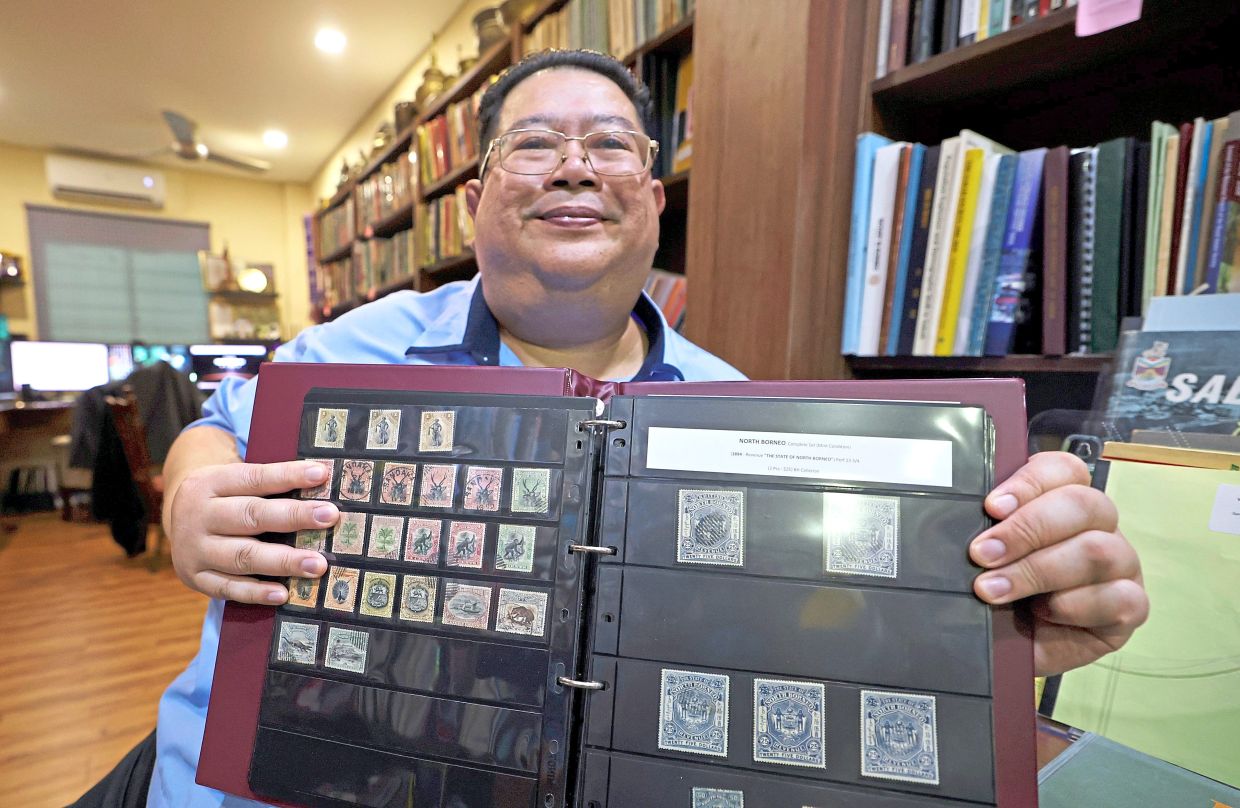
The fading interest in stamp collecting threatens to erase a crucial chapter of Sabah's documented history, as North Borneo's century-old postal artefacts become increasingly difficult to locate and preserve. Experts are sounding the alarm over dwindling enthusiasm for philately, warning that without concerted preservation efforts, these tangible records of the region's colonial and early independent periods could vanish from public consciousness and private collections alike.
Dr Shari Jeffri, 56, a leading authority on the subject and founder of the Borneo History Association, characterises the North Borneo stamps issued between 1883 and 1963 as a "living archive" deserving protection and transmission to future generations. His perspective carries weight earned through nearly four decades of dedicated collecting and research into the postal systems that served the territory. The stamps, he argues, transcend their original function as proof of postage—they constitute a visual and material record of Sabah's transformation across eight decades of significant political and social change.
The challenge facing collectors and historians today reflects broader generational shifts in how people engage with history and cultural artefacts. Where earlier cohorts embraced stamp collecting as both hobby and educational pursuit, contemporary youth have grown up in a digital age where physical correspondence has become largely obsolete. This cultural transition has resulted in a markedly smaller pool of active philatelists, particularly within Malaysia. Survey work conducted among antique dealers in Kota Kinabalu reveals that North Borneo stamps have become substantially harder to source, with market values reflecting their scarcity through fluctuations based on age, physical condition, and historical rarity.
The journey that transformed Shari into a leading voice on North Borneo philately began with inheritance rather than initial passion. His late grandfather, employed at the Recreation Club Jesselton during the 1920s, accumulated a stamp collection after witnessing British colonial officers engage in the hobby. This inherited collection introduced young Shari to philately at age seven, though his serious involvement as a collector did not commence until his secondary school years. Since then, he has devoted considerable energy to understanding the historical narratives embedded within stamp designs and their evolution across the territory's postal history.
Among Shari's most treasured possessions are two two-cent stamps from North Borneo's inaugural 1883 issue, featuring a brown sailing boat design and displaying complete postmarks. These pieces anchor his collection and illustrate the premium value philatelists assign to earliest issuances. For serious collectors, acquiring examples from the foundational 1883 series represents a milestone in developing a comprehensive North Borneo holding. The significance extends beyond monetary worth—each stamp functions as a discrete historical document, preserving information about the territory's identity presentation during the early years of the British North Borneo Chartered Company's administration.
The postal stamps issued by the British North Borneo Chartered Company from 1883 onwards reveal deliberately curated messaging about the territory's character and potential. Initial designs prominently featured symbolic imagery including lions, boats, and tigers, alongside the Latin inscription Pergo et Perago—translating to "I undertake and I achieve"—elements intended to present North Borneo favourably to international audiences and trading partners. This design philosophy reflected broader imperial marketing strategies of the era, wherein stamps functioned as miniature ambassadors projecting power, civility, and commercial viability.
Design evolution accelerated significantly during the 1930s, when the 1935 series introduced imagery more explicitly rooted in Sabah's distinctive environment and indigenous cultures. These stamps, circulating in denominations ranging from two cents to one dollar, departed from the earlier emphasis on symbolic grandeur and instead showcased Borneo's native flora, fauna, and wildlife. From 1894 onwards, this reorientation towards natural history iconography became increasingly pronounced, transforming the stamps into a visual encyclopaedia of the region's biodiversity as understood and appreciated by colonial administrators and European audiences.
The practical demands of preservation present substantial obstacles to philatelic stewardship. Shari emphasises that maintaining North Borneo stamps in optimal condition requires storing them in acid-free albums—materials that shield against chemical degradation and colour fading that would otherwise occur over decades. The paper composition and adhesive formulations of nineteenth and early twentieth-century stamps introduce particular vulnerabilities, as these materials were not designed with preservation timescales of over a century in mind. Additionally, the presence of complete postal cancellations—markings indicating the date, location, and time of mailing—significantly enhances both the historical and monetary value of individual stamps, as these details provide granular documentation of the postal infrastructure's operation across the territory.
Authenticity verification and value assessment in philately require specialised knowledge that Shari has systematically acquired through mentorship and rigorous study. His instruction under recognised Singaporean philatelic experts Voon Kyam Foh and Tan Chun Lim provided formal grounding in the field, complemented by extensive consultation of authoritative reference works such as the Commonwealth & British Empire Stamps catalogue. This expertise permits him to evaluate the subtle indicators of authenticity—including paper type, adhesive properties, and printing variations—that distinguish genuine issues from later reproductions or forgeries.
The broader implications of North Borneo stamp preservation extend beyond individual collectors' personal satisfaction or investment portfolios. These artefacts represent an irreplaceable material record of how a particular colonial territory was administered, promoted, and perceived during a transformative historical period. Each denomination, design change, and circulation pattern illuminates aspects of administrative priorities, economic development, and cultural representation that might otherwise remain obscured. As Malaysia approaches the third decade of the twenty-first century, revisiting this postal archive offers contemporary perspectives on colonial-era governance and the foundations upon which modern Sabah developed.
The urgent challenge confronting stakeholders involves reversing declining participation in philately whilst simultaneously ensuring that existing collections—particularly rare North Borneo examples—receive appropriate institutional care. Private collections scattered across homes and antique dealers face attrition through neglect, disposal, or loss. Without coordinated preservation initiatives, possibly including digitisation projects, exhibition programmes at museums, and education initiatives targeting younger audiences, a significant portion of this material heritage risks permanent disappearance. The window for securing these artefacts remains open, but narrows with each passing generation that proves less engaged with physical correspondence and its cultural resonance.

