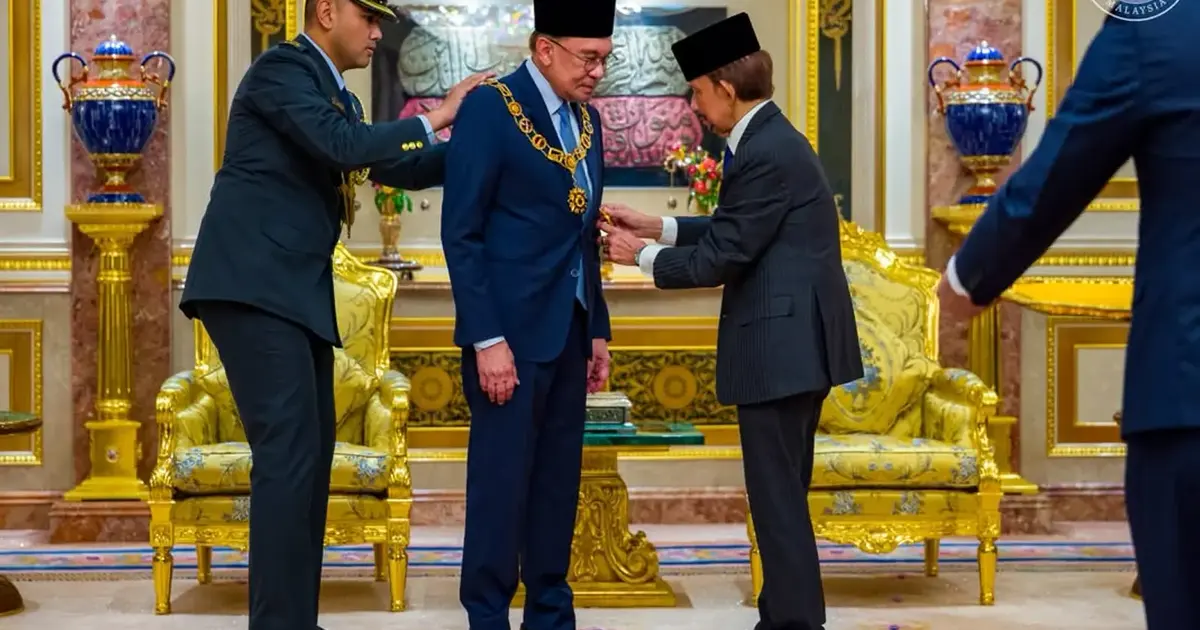
Prime Minister Anwar Ibrahim has been conferred with the Darjah Kerabat Laila Utama Yang Amat Dihormati (D.K.), one of Brunei's most distinguished royal honours, by Sultan Hassanal Bolkiah. The decoration represents a formal recognition by the Brunei ruler of Anwar's role in strengthening bilateral relations between the two neighbouring nations and underscores the significance Malaysia places in its partnership with the oil-rich sultanate.
The bestowal of this honour follows a tradition of diplomatic courtesy between Southeast Asian monarchies and senior political leaders. Such decorations serve multiple purposes in the regional diplomatic framework, functioning both as symbols of personal esteem and as public affirmations of interstate goodwill. For Anwar, the recognition comes at a time when Malaysia has been actively reasserting its regional engagement across ASEAN and beyond, with Brunei occupying a strategic position within this broader diplomatic canvas.
The Darjah Kerabat Laila Utama represents the upper echelon of Brunei's honours system, typically reserved for individuals of significant standing. By extending this honour to the Malaysian prime minister, Sultan Hassanal Bolkiah has signalled Brunei's commitment to deepening ties with its neighbour. Such ceremonial gestures often precede or accompany substantive discussions on trade, security cooperation, and regional initiatives, making the honour's timing particularly relevant to understanding the trajectory of Malaysia-Brunei relations.
Malaysia and Brunei share historical and cultural connections that run deep, from their common Islamic heritage to their participation in ASEAN and various regional economic frameworks. The two countries have collaborated on maritime issues, particularly regarding the South China Sea, where both have strategic interests. Educational exchanges and tourism between the nations have also grown, with Malaysian professionals and students maintaining a presence in Brunei's economy and institutions.
For the Brunei government, honouring Malaysia's prime minister reflects a calculated approach to maintaining stable relationships within ASEAN. As the bloc navigates challenges ranging from geopolitical tensions to economic integration pressures, bilateral partnerships between member states gain prominence. Brunei, despite its small size, punches above its weight in regional forums, and its strategic positioning alongside Malaysia enhances both nations' capacity to influence regional discourse.
Anwar's tenure as prime minister has emphasised the importance of regional cooperation and economic partnership. His administration has sought to position Malaysia as a credible and active player in ASEAN deliberations, and recognition from fellow regional leaders validates this diplomatic positioning. The honour from Sultan Hassanal Bolkiah may facilitate smoother negotiations on outstanding bilateral issues, including border demarcation, maritime cooperation, and joint development projects.
The diplomatic recognition also carries implications for Malaysia's standing among ASEAN's more conservative monarchies. Both Malaysia and Brunei maintain strong Islamic identities within their governance structures, and both have emphasised stability and development as core policy objectives. The convergence of these values creates a natural basis for cooperation that transcends mere ceremonial exchanges, though such honours remain important signifiers of goodwill and commitment.
From a broader regional perspective, the decoration highlights how Southeast Asian nations continue to employ traditional diplomatic protocols to strengthen contemporary relationships. Even as the region faces pressures from external powers and internal economic competition, the symbolic language of honours and formal recognition remains a cornerstone of how ASEAN members interact with one another. This continuity suggests that despite modernisation pressures, Southeast Asian diplomacy retains elements of protocol and ceremony that many Western observers might consider anachronistic but which remain deeply embedded in regional political culture.
The gesture may also be interpreted as Brunei's response to Malaysia's consistent diplomatic outreach. Under Anwar's leadership, Malaysia has pursued an inclusive approach to regional engagement, avoiding the more combative rhetoric that characterised earlier administrations. This shift has been welcomed by neighbours, including Brunei, which has traditionally favoured low-key but substantive bilateral relationships rather than high-profile diplomatic campaigns.
Looking ahead, the honour provides a foundation for expanded cooperation between the two countries. Areas of potential collaboration include deeper integration in ASEAN economic frameworks, enhanced security cooperation in maritime domains, and cultural exchanges that benefit both populations. Such ceremonial recognition often serves as a springboard for pragmatic negotiations on issues that require sustained commitment and goodwill.
The reception of this honour by Anwar also signals confidence in Malaysia's current political direction from a key regional partner. Given Malaysia's history of internal political volatility, recognition from established figures like Sultan Hassanal Bolkiah carries particular weight, suggesting that Brunei views the current Malaysian administration as stable and suitable for long-term partnership development. This external validation may bolster Anwar's standing domestically, particularly in contexts where regional respect is valued as a measure of effective governance and statecraft.

