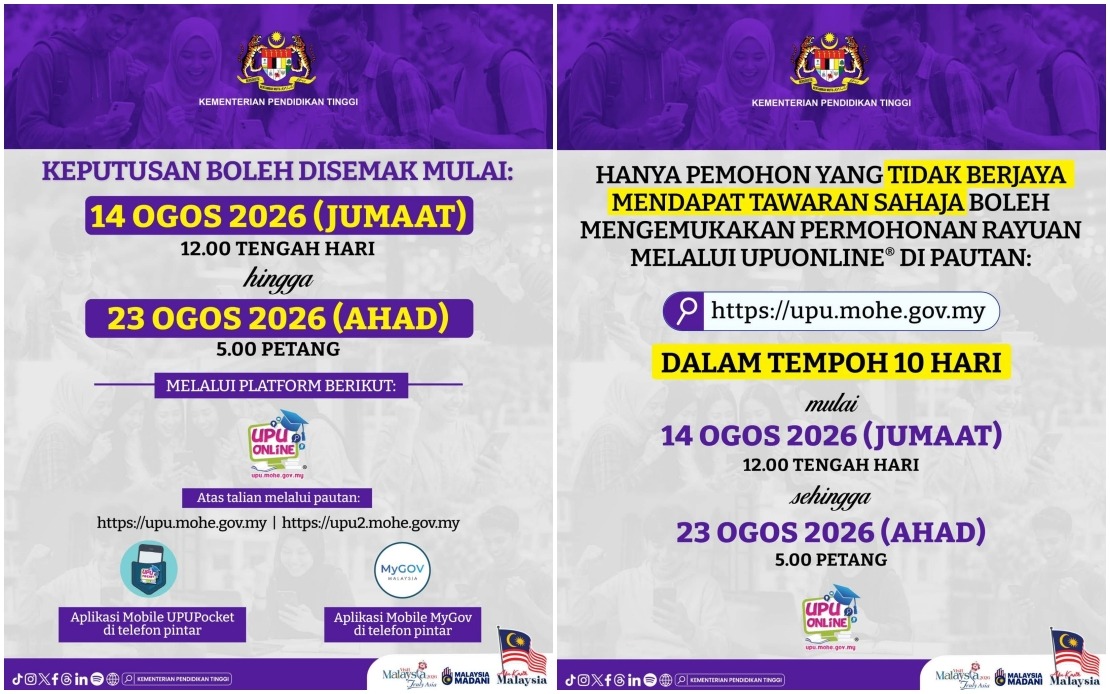
The Ministry of Higher Education has set August 14 as the official announcement date for admission results to Malaysia's public universities for students who have completed their STPM or equivalent examinations and wish to pursue bachelor's degree programmes in the 2026/2027 academic session. This milestone marks a crucial point in the university placement journey for thousands of secondary school graduates across the country.
Applicants will be able to access their results starting at noon on August 14 through multiple digital platforms designed to ensure wide accessibility. The main portal at https://upu.mohe.gov.my and the backup site https://upu2.mohe.gov.my will both be operational during the announcement period. In recognition of Malaysia's increasing smartphone penetration and digital-first approach among younger demographics, the ministry has also enabled result checking via the UPUPocket mobile application and the MyGov smartphone application, allowing candidates to view their outcomes conveniently from anywhere.
The window for checking results extends through August 23 at 5 pm, providing a full nine days for applicants to review their placement status and plan their next steps accordingly. This extended timeframe acknowledges that students and their families may need time to discuss their options, particularly those who received offers requiring geographical relocation or those whose results differed from initial expectations. The staggered timeline also allows the public university system to manage the technical load across these platforms without overwhelming servers.
Once results are published, the process of formally accepting or declining offers begins almost immediately. Successful candidates have from August 15 to August 23 to confirm their acceptance or rejection through the respective university websites where they have received offers. This confirmation period is critical because it determines which students will ultimately enroll and allows universities to manage their intake numbers effectively across different programmes and faculties. The swift confirmation window ensures that universities can complete their new student registration processes promptly and prepare for the commencement of the academic session.
Official offer letters will be issued by individual universities to candidates who confirm their acceptance of a place, commencing on August 15. These formal documents serve as binding agreements between the institution and the student, outlining the specific programme, academic requirements, and other essential conditions of admission. The issuance of physical or digital offer letters provides candidates with tangible documentation needed for dormitory applications, financial aid processing, and other administrative preparations for university life.
For the approximately 10-15 percent of applicants nationally who do not receive an initial offer, the ministry has established an appeal mechanism to provide a second opportunity for placement. Unsuccessful candidates may submit appeals through the UPUOnline system between August 14 and August 23, a window that aligns with the main confirmation period. These appeals will be considered for vacancies that emerge after new student registration is finalized, meaning that places freed up by students who decline offers or withdraw will be redistributed to appealing applicants based on academic merit and programme availability.
A significant policy clarification issued by the Ministry of Education emphasizes that placements offered through the initial selection round are final and non-negotiable in terms of programme or institution changes. This means that once an offer is made for a specific degree programme at a particular university, applicants cannot request to be considered for a different programme or institution within the same selection cycle. This policy maintains institutional planning integrity and prevents the logistical complications that would arise from large-scale post-offer programme switching. Applicants dissatisfied with their initial placement must therefore pursue the appeal route or consider alternatives outside the public university system.
The appeal selection process operates under a specific constraint: new placements can only be made if vacant positions exist following the completion of new student registration at all public universities. This mechanism ensures that the total student intake across the system remains aligned with institutional capacity, infrastructure, and resource availability. Once registration closes and all confirmed students have enrolled, any remaining vacancies in specific programmes can be filled through the appeal process. This approach balances the desire to accommodate as many qualified applicants as possible with the practical limitations of university infrastructure and faculty capacity.
For Malaysian students and their families, this announcement cycle represents a pivotal juncture in educational trajectories. Unlike international university applications where results may trickle in over several months, Malaysia's centralized UPU system delivers results simultaneously for all applicants, creating a single day of decision-making across the nation. The psychological and logistical impact on students is substantial, as those who succeed move immediately into preparation mode while those who miss out must quickly pivot to alternative pathways such as private universities, overseas applications, or vocational training programmes. The compressed timeline reflects Malaysia's efficient but demanding higher education admission structure.
From a systemic perspective, this admission round will distribute approximately 40,000 STPM and equivalent candidates across Malaysia's twenty public universities, each with distinct strengths in engineering, medicine, commerce, education, and other fields. The efficiency of the online UPU system and the clear procedural guidelines help ensure that this massive logistical operation proceeds smoothly. However, the stakes remain high for individual students, making it essential that applicants fully understand the confirmation procedures, appeal timelines, and policy restrictions to make informed decisions about their university placements and futures.

