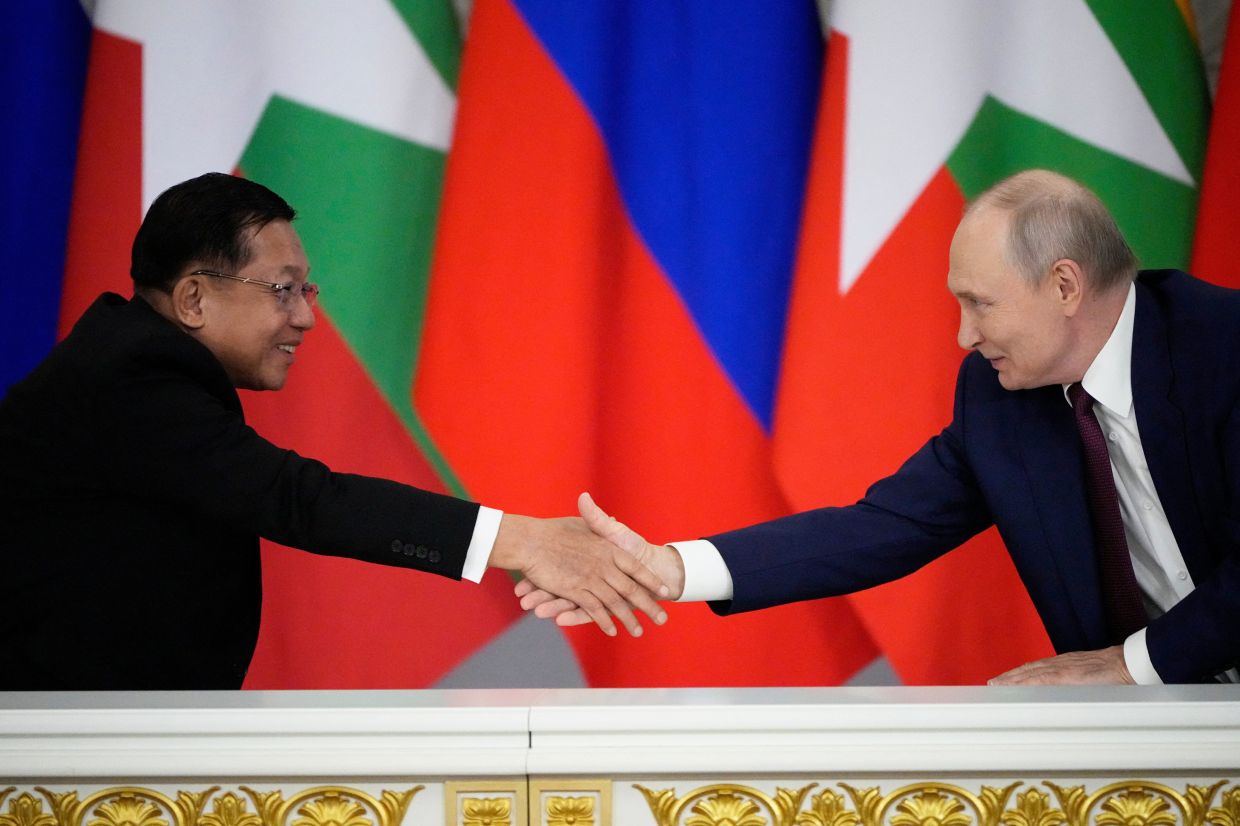
Vladimir Putin has characterised relations with Myanmar as "especially trusting" during a Kremlin meeting with the country's leader Min Aung Hlaing, underscoring Russia's strategic commitment to maintaining close ties with one of its few major allies in Southeast Asia. The Tuesday talks, attended by high-ranking officials from Moscow's foreign policy, defence, financial and energy sectors, signal Russia's determination to deepen cooperation across multiple domains even as Myanmar faces international isolation following its disputed 2023 election.
The geopolitical calculus underpinning these ties reflects the broader realignment following Russia's invasion of Ukraine. While Western governments and multilateral institutions have largely shunned Myanmar's military-led administration, Moscow has remained conspicuously engaged, providing both political cover and material support. This positions Russia as a crucial counterweight to international pressure on Min Aung Hlaing's junta-backed government, which has faced widespread criticism over the legitimacy of the election that formally installed him as president after initially seizing power in a February 2021 coup.
Energy infrastructure represents the centrepiece of Russia's Myanmar engagement strategy. Putin outlined plans to construct a power plant and an oil refinery in southern Myanmar, with Russian companies also seeking involvement in geological exploration and hydrocarbon extraction. These projects would substantially deepen Myanmar's economic dependence on Moscow while providing Russia with long-term revenue streams and strategic positioning in a region increasingly contested between major powers. The emphasis on liquefied natural gas exports additionally suggests Moscow views Myanmar as a potential transit route or market for Russian energy exports, particularly valuable given Western restrictions on Russian oil and gas following sanctions imposed after the Ukraine invasion.
Military and defence cooperation constitutes the second pillar of this relationship. Putin explicitly cited "close military and military-technical cooperation" between the nations, reflecting a partnership that predates the recent geopolitical upheaval. According to a United Nations report from May 2023, Russia has supplied Myanmar's military with advanced weaponry worth more than US$400 million since the 2021 coup, establishing Moscow as a critical source of military hardware for the junta. This dependency creates structural incentives for Myanmar to maintain alignment with Russia regardless of international pressure, as disruption of arms supplies could undermine the military's capacity to consolidate control.
Nuclear technology cooperation represents a particularly significant dimension of the bilateral relationship. Myanmar is collaborating with Russia's Rosatom State Corporation on developing a small nuclear power plant, an undertaking that extends far beyond conventional energy generation. Such projects create institutional linkages and technical dependencies that bind the two nations together while positioning Russia as instrumental to Myanmar's long-term developmental ambitions across health, agriculture and industrial sectors. This type of deep technological partnership typically generates sustained engagement regardless of political fluctuations, making it a cornerstone of Russia's influence strategy.
Min Aung Hlaing's visit follows a carefully orchestrated diplomatic campaign to legitimise his government internationally following the military-backed election. His recent travels to China, India, Laos and Thailand, combined with efforts to improve relations with the United States and the Association of Southeast Asian Nations, suggest a leader simultaneously seeking acceptance from multiple quarters while maintaining core alliances with authoritarian partners. The Moscow visit, coupled with attempts to engage ASEAN and Washington, reflects a sophisticated balancing act designed to prevent total international isolation while firmly rejecting calls to release ousted civilian leader Aung San Suu Kyi.
The composition of Min Aung Hlaing's delegation underscores the breadth of intended cooperation. Including multiple cabinet ministers and the head of Myanmar's space agency, the visiting contingent engaged not merely at the presidential level but across governmental structures, facilitating coordination on technical matters and establishing working relationships between bureaucratic counterparts. The presence of the space agency chief particularly suggests Russia views Myanmar as a partner in broader technological domains beyond conventional energy and defence sectors, potentially encompassing satellite technology and space capabilities.
This Moscow engagement also demonstrates Russia's strategic prioritisation of Myanmar within its broader Asian policies at a time when Moscow faces considerable isolation in Europe and the West. Maintaining and expanding ties with sympathetic regimes in Asia offers Russia both diplomatic legitimacy and practical support. Myanmar's geographic position along major shipping routes and its resource wealth make it particularly valuable, while Min Aung Hlaing's vulnerability to international criticism creates opportunities for Russia to position itself as a reliable partner willing to engage despite Western disapproval.
For Malaysia and other ASEAN member states, Russia's deepening embrace of Myanmar carries significant implications. Enhanced Russian military presence and influence in Myanmar could alter regional security dynamics, particularly if such involvement translates into increased military capabilities or emboldened assertiveness by the junta. Additionally, Russia's energy infrastructure investments may create competing economic interests and spheres of influence within Southeast Asia, complicating efforts by ASEAN to maintain strategic autonomy and non-alignment amid great power competition.
The Putin-Min Aung Hlaing relationship exemplifies how geopolitical polarisation reshapes regional partnerships. Russia's willingness to maintain close engagement with Myanmar despite international disapproval reflects Moscow's broader strategy of cultivating relationships with governments facing Western pressure, creating alternative power structures and dependencies that reduce reliance on Western institutions and capital. This dynamic ultimately contributes to a more fractured international order where regional powers must navigate competing spheres of influence rather than operating within a unified international system.

