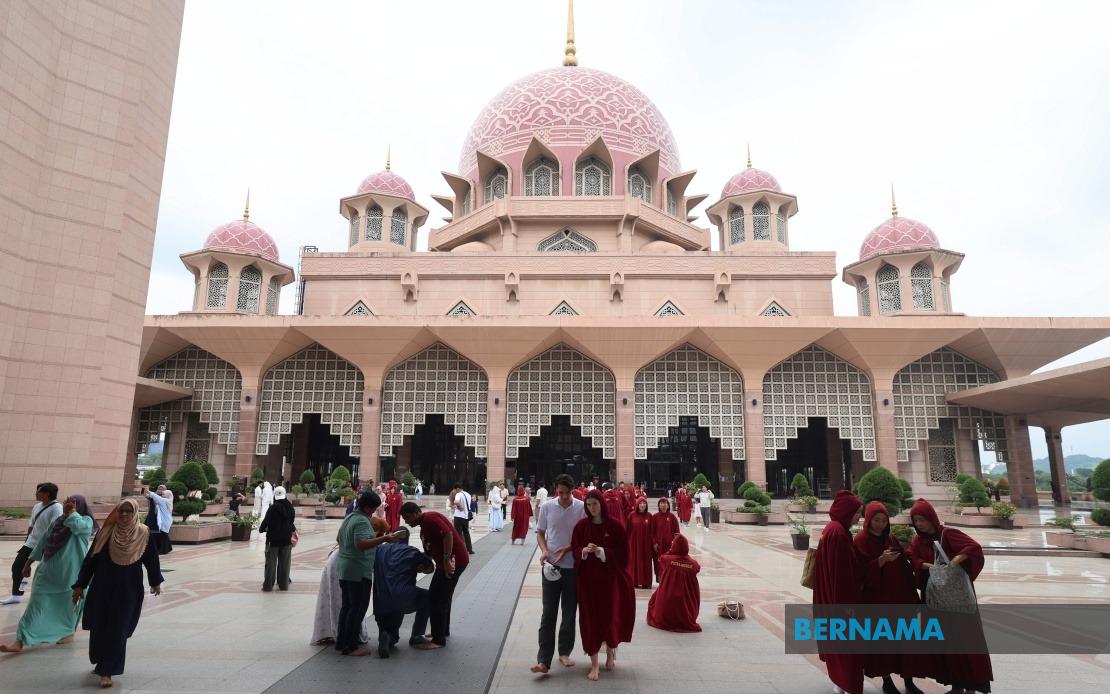
Putrajaya's iconic Putra Mosque is set to become the focal point of Malaysia's National Maal Hijrah 1448H/2026M celebration, drawing together approximately 5,000 local and international guests for a ceremony that underscores the nation's commitment to Islamic observance and cultural commemoration. The event, scheduled for June 17, carries particular significance as it brings together prominent political figures, religious scholars, and international representatives under one roof to honour the Islamic calendar's renewal and the spiritual message of migration and positive transformation that Maal Hijrah represents.
Sultan Nazrin Shah, the Sultan of Perak, will serve as the principal dignitary, officiating the proceedings and delivering a royal address that is anticipated to set the tone for the celebration. His presence reflects the traditional involvement of Malaysia's constitutional monarchs in major national and religious occasions, reinforcing the intertwined relationship between the institution of the Sultans and Islamic affairs within the Malaysian governance framework. The attendance of Deputy Prime Ministers Datuk Seri Ahmad Zahid Hamidi and Datuk Seri Fadillah Yusof, alongside various Cabinet ministers, government department heads, and senior officials, underscores the government's institutional commitment to marking this significant Islamic milestone.
The international dimension of the gathering carries particular weight for Malaysia's diplomatic positioning in the Muslim world. By hosting foreign representatives at this celebration, Malaysia reinforces its role as a bridge between diverse Islamic communities and demonstrates its capacity to organise inclusive religious and cultural events that resonate across geographical and sectarian boundaries. This approach aligns with Malaysia's broader foreign policy objectives of promoting interfaith dialogue and positioning itself as a progressive Islamic nation on the global stage.
Among the event's most significant components is the presentation of the National and International Tokoh Maal Hijrah Awards, a recognition programme that honours individuals demonstrating exceptional contributions to Islamic advancement. The award criteria reflect a comprehensive assessment framework encompassing profound knowledge within respective disciplines, exemplary personal conduct, and demonstrated impact on Islamic civilisation's progress both within Malaysia and internationally. These awards serve not merely as ceremonial honours but as instruments for identifying and celebrating Islamic intellectual leadership, thereby encouraging broader participation in Islamic knowledge production and practice.
The Department of Islamic Development Malaysia (JAKIM) has chosen this year's thematic framework specifically to reconnect contemporary Muslims with the historical significance of Prophet Muhammad SAW's Hijrah—an event that catalysed the development of Islamic civilisation itself. By framing Maal Hijrah as an opportunity for reflection on personal and collective transformation, JAKIM encourages Muslim communities to view the calendar's renewal as more than ceremonial observance; rather, it becomes a moment for purposeful evaluation of one's relationship with Islamic principles and commitment to positive societal change.
A notable innovation within this year's programme is the Tausiyyah @ Maal Hijrah initiative, which was conducted at Putra Mosque on the day preceding the main celebration. This supplementary programme moves beyond conventional sermonising by incorporating structured Quranic reflection (tadabbur) sessions, enabling participants to engage deeply with selected verses through recitations by accomplished qari while simultaneously accessing contextual guidance on the theological and practical implications embedded within the scriptural passages. This methodology transforms passive listening into active intellectual engagement, encouraging Muslims to internalise Quranic wisdom and translate its messages into concrete life choices.
The participatory architecture of Tausiyyah @ Maal Hijrah demonstrates a shift toward more sophisticated Islamic educational programming within Malaysia's official religious institutions. Rather than treating religious observance as a passive reception of transmitted knowledge, the programme structures opportunities for Muslims to contemplate how classical Islamic teachings address contemporary challenges and personal circumstances. This approach acknowledges that meaningful religious engagement requires intellectual participation rather than mere ceremonial attendance, a principle increasingly recognised across Malaysian Islamic education and community engagement sectors.
Extending the celebration's impact beyond the main gathering, JAKIM has scheduled the National and International Tokoh Maal Hijrah Lecture 1448H/2026M for the following day at Putrajaya Islamic Complex Auditorium beginning at 9 am. This continuation programme provides award recipients with a platform to present their knowledge, research findings, and practical experiences to broader audiences of scholars, students, and religious professionals. By creating this secondary venue for intellectual exchange, the organisers acknowledge that the celebration's most enduring value emerges not from ceremonial pageantry but from the substantive sharing of ideas and expertise that can advance Islamic thought and practice throughout the region.
For Malaysian Muslims, this multi-layered celebration offers multiple entry points for engagement. Whether participating in the formal ceremony, attending the Tausiyyah sessions, or engaging with the subsequent lectures, individuals encounter opportunities to reflect on their personal spiritual trajectories within the broader context of Islamic historical consciousness and contemporary Muslim leadership. The inclusion of international guests and award recipients transforms what might otherwise remain a domestic religious observance into a demonstration of Malaysia's intellectual contributions to global Islamic discourse.
The significance of hosting 5,000 guests at a single venue for this celebration reflects Malaysia's infrastructure capacity and its institutional commitment to treating Maal Hijrah as a matter of national importance. Beyond the logistical achievement, this scale of gathering sends a clear message about the government's prioritisation of Islamic observance and community mobilisation around shared religious values. For Southeast Asian Muslims observing from neighbouring countries, Malaysia's celebration model—combining governmental endorsement, intellectual engagement, and international participation—offers a template for how Islamic occasions might be commemorated in contemporary plural societies.
The Putra Mosque celebration ultimately serves multiple functions simultaneously: it honours an essential moment in Islamic history, recognises contemporary Muslim excellence, provides educational opportunities for spiritual reflection, and demonstrates Malaysia's role in advancing Islamic civilisation during the twenty-first century. Through careful programming that balances ceremonial significance with substantive intellectual engagement, the event positions itself not as merely nostalgic commemoration but as an active investment in the ongoing development of Islamic thought and practice relevant to modern Muslim communities throughout Malaysia and the broader region.