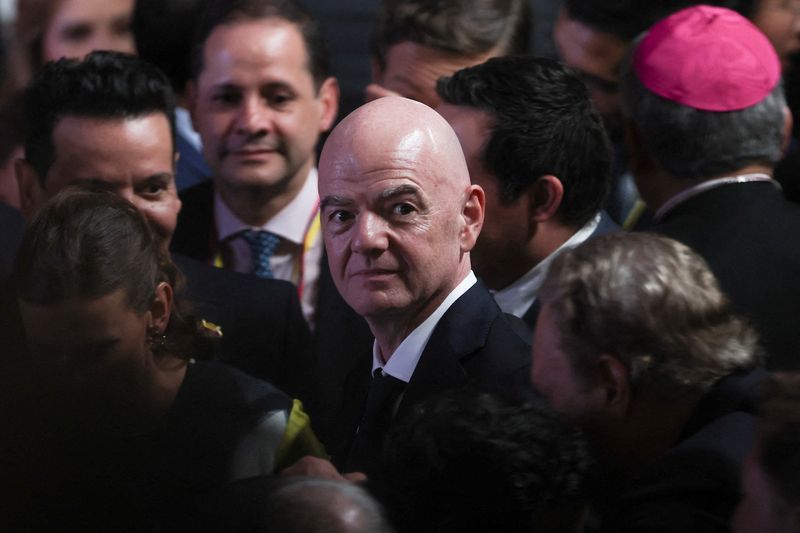
A significant fault line has emerged within Asian football as Qatar moves to undermine the Asian Football Confederation's coordinated assault on FIFA President Gianni Infantino, exposing deep divisions among the region's governing bodies at a pivotal moment in world soccer politics. The rupture comes as three continental confederations—UEFA, the AFC and CONCACAF—attempt to mount an unprecedented unified challenge to Infantino's leadership, with the FIFA chief facing calls to resign over his controversial bid to privatise World Cup commercial rights.
Qatar Football Association President Hamad bin Khalifa Al-Thani has formally objected to the AFC's participation in Monday's open letter, asserting in correspondence to AFC President Sheikh Salman bin Ibrahim Al Khalifa that neither he nor the QFA received any prior notification of the statement. The Qatari official, who sits on both the AFC Executive Committee and FIFA Council, emphasised that no consultation occurred—formal or otherwise—before the three confederations jointly denounced Infantino's conduct and called for his removal from office. This intervention signals that consensus among AFC members is far more fragile than the confederation's public pronouncements suggest.
Al-Thani's challenge to the AFC's legitimacy strikes at the heart of international football governance. He questioned the fundamental process by which the confederation claimed to represent a collective position of its 47 member associations, arguing that a unified stance cannot simply be declared into existence without proper consultation. The Qatari leader demanded the AFC explain what consultation had actually taken place and on what legal or procedural basis it considered itself authorised to speak on behalf of all members. The AFC, when approached for comment, declined to respond to these allegations, leaving questions about its decision-making processes unanswered.
The timing of Qatar's intervention is particularly significant given the broader context of FIFA's internal crisis. Infantino has faced mounting pressure following his aborted proposal to carve out commercial rights to the World Cup and sell a 20 percent stake to private investors—a scheme designed to raise approximately $4.2 billion before fierce backlash forced a reversal. The proposal triggered the rare spectacle of multiple continental confederations acting in concert to challenge the sitting FIFA president, normally a fractious and competitive body more inclined toward regional rivalry than unified action.
Yet just days before the AFC's public assault, a coalition of six Arab national football association heads—encompassing Qatar, 2030 World Cup co-hosts Morocco, Egypt, Mauritania and others—published their own statement backing Infantino and praising his efforts to expand opportunities across all regions and strengthen football's unifying role. Four of these six signatories, including Al-Thani and Egypt's Hany Abo Rida, hold positions on the FIFA Council, giving them considerable influence within world football's power structure. Their public endorsement of the embattled president underscores the fractured nature of the broader global soccer community.
The peculiar position of Qatar within this conflict deserves attention from a Malaysian perspective. As the nation that hosted the 2018 AFC U-19 Championship and maintains significant influence within Asian football networks, Qatar's willingness to publicly challenge the AFC demonstrates that regional solidarity cannot be assumed in high-stakes FIFA politics. This mirrors similar patterns observed in Southeast Asian sports governance, where larger or more economically influential nations often resist collective decisions they perceive as constraining their interests or contrary to their preferred outcomes.
The dispute also illuminates broader tensions about governance transparency and procedural legitimacy in international sports organisations. Al-Thani's insistence that collective views must be ascertained rather than presumed reflects fundamental questions about democratic decision-making that resonate beyond football. In a region where Malaysia itself has navigated complex multilateral coordination challenges, the AFC's apparent failure to engage all stakeholders before issuing the open letter raises concerns about how continental bodies actually function in practice versus how they present themselves publicly.
Infantino's reelection bid next year will occur against this backdrop of fragmented support and conflicting interests across the football world. The AFC's letter represented an unusual moment of unified continental opposition, yet it now appears that this unity was more apparent than real. The intervention from Qatar and the earlier Arab football heads' statement suggest that Infantino retains meaningful backing within strategic constituencies, even as UEFA and other powerful voices call for his removal. This fractured landscape will likely characterise the politics surrounding his candidacy as voting approaches.
The implications for Asian football governance extend beyond Infantino's immediate future. If the AFC cannot maintain a unified position among its member associations on a matter it has publicly endorsed, questions arise about the confederation's effectiveness and authority. Malaysian football administrators and other Southeast Asian stakeholders will watch closely to see whether the AFC can recover coherence or whether it will continue to be undermined by member states pursuing independent agendas. The episode suggests that continental confederations, despite their bureaucratic structures and formal authority, remain dependent on consensus among members who retain significant leverage through their FIFA Council seats and voting power.
The coming months will test whether the AFC's attempt to jointly challenge FIFA leadership can survive internal dissent, or whether divisive power plays at the confederation level will ultimately weaken the coordinated pressure on Infantino. Qatar's public challenge has already damaged the narrative of unified regional opposition, even as the other confederations maintain their stated positions. The resulting uncertainty over world football's direction—and over who will wield influence within FIFA's governance—creates a fluid situation where regional players may attempt to parlay their strategic leverage into advantageous positions within reformed or restructured FIFA arrangements.

