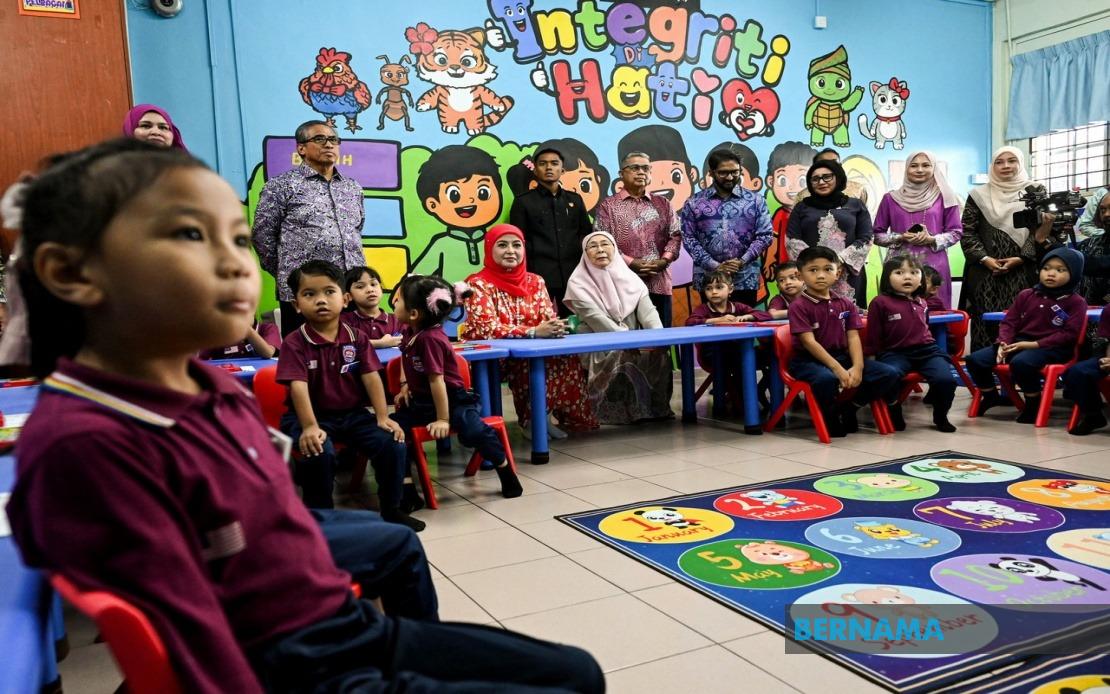
Queen Raja Zarith Sofiah officially inaugurated the Children's Integrity Module (MIKa) on August 27, marking a significant step in Malaysia's efforts to cultivate ethical consciousness from the earliest stages of childhood development. The launch ceremony took place at Tabika Perpaduan Taman Bukit Cheras in Kuala Lumpur, with the Queen's presence underscoring the national importance attributed to this educational initiative.
The Queen arrived at 9.45 am to receive a formal welcome from National Unity Minister Datuk Aaron Ago Dagang, Chief Secretary to the Government Tan Sri Shamsul Azri Abu Bakar, and Bandar Tun Razak Member of Parliament Datuk Seri Dr Wan Azizah Wan Ismail. Following the ceremonial launch, Raja Zarith Sofiah visited classrooms to observe the module's practical application firsthand, engaging directly with pupils participating in MIKa learning simulations. This hands-on engagement demonstrated the Crown's personal investment in understanding how the programme operates within educational settings.
Developed under the auspices of the Malaysian Institute of Integrity (IIM), which is chaired by Tan Sri Shamsul Azri, the MIKa module represents two years of collaborative research and curriculum design. The initiative involved 35 early childhood education specialists who contributed expertise in child development, pedagogical methodology, and values education. This extensive stakeholder engagement included support from multiple government ministries, government agencies, tertiary institutions, and organisations working within the early childhood education landscape, reflecting a whole-of-system approach to implementation.
The programme's scope is deliberately ambitious, targeting children between two and six years old—a critical developmental window when foundational habits, attitudes, and values begin forming. By establishing integrity as a core learning objective during this period, Malaysian policymakers aim to normalise ethical behaviour before children encounter more complex social situations. The underlying pedagogical philosophy recognises that character education must begin before formal schooling, during the formative years when children's neural pathways and behavioural patterns are most malleable.
Tan Sri Shamsul Azri articulated the strategic vision during his address, outlining plans for nationwide expansion that would make MIKa available across more than 31,000 childcare centres, kindergartens, and preschools by 2030. This projection encompasses virtually Malaysia's entire early childhood education infrastructure, representing a transformative commitment to integrating integrity education throughout the sector rather than restricting it to a handful of pilot institutions. Such comprehensive coverage would ensure that generational cohorts progress through their formative years with consistent exposure to integrity principles, regardless of their socioeconomic background or geographic location.
The Chief Secretary emphasised that integrity cannot be externally imposed through legal mechanisms or regulatory enforcement alone. Rather, sustainable ethical behaviour requires internalisation during early childhood, when foundational dispositions are still being established. This philosophical grounding distinguishes MIKa from compliance-based approaches, instead focusing on cultivating intrinsic motivation toward honest behaviour, trustworthiness, and responsible action. The expectation is that children who experience integrity-focused learning during early childhood will develop these values as habitual responses rather than rule-following compliance.
Parental involvement features prominently within the MIKa framework, as the programme recognises that home environments profoundly influence children's values formation. By engaging families and positioning parents as primary role models, the module acknowledges that early childhood education occurs within multiple overlapping environments—school, home, and community. This ecological approach to values education assumes that children internalise ethical principles most effectively when consistent messages permeate all their significant relationships and settings.
The launch reflects broader Malaysian governance concerns about ensuring future generations possess the integrity and trustworthiness necessary for national development. Recent public discourse regarding corruption, institutional accountability, and political ethics has heightened awareness that preventive measures targeting childhood development may yield greater long-term benefits than reactive enforcement mechanisms applied to adults. By normalising integrity during early childhood, Malaysia seeks to reduce future vulnerabilities to corrupt practices while fostering civic virtues essential for robust democratic institutions.
For Southeast Asian educators and policymakers, MIKa presents a noteworthy model of systematic values education grounded in developmental psychology rather than rote moral instruction. The programme's emphasis on making ethical behaviour habitual rather than imposed offers lessons for neighbouring countries wrestling with similar challenges regarding institutional integrity and civic virtue. The scale of Malaysia's ambition—reaching 31,000 institutions—suggests confidence that early childhood education represents a practical delivery mechanism for values-based curriculum at national scale.
The timeline extending to 2030 provides realistic implementation runway, allowing institutions to adapt existing curricula, provide educator training, and develop contextually appropriate pedagogical materials. This phased approach avoids the disruption that would accompany sudden system-wide curriculum changes while maintaining momentum toward the ambitious goal. Success will depend significantly on adequate resourcing, consistent policy support across electoral cycles, and educator capacity-building to ensure consistent delivery of integrity-focused learning experiences across diverse institutional contexts.
Implementation challenges will inevitably arise as the programme scales beyond pilot settings into the diverse ecosystem of Malaysia's early childhood sector, which encompasses government centres, private facilities, religious institutions, and community-based programmes operating under varying regulatory frameworks. Maintaining pedagogical consistency while respecting institutional autonomy and cultural diversity will require sophisticated programme management and professional development infrastructure. The IIM's coordinating role will prove critical in establishing quality standards without imposing rigid uniformity that contradicts the contextual flexibility necessary for diverse communities.
The Queen's ceremonial presence and personal engagement with the programme conveyed powerful symbolic messaging about national priorities and institutional commitment to integrity values. Royal patronage lends legitimacy and visibility to educational initiatives in ways that administrative announcements alone cannot achieve. This visible endorsement signals that values education ranks among Malaysia's strategic national concerns, potentially influencing institutional leaders' allocation of resources and attention to implement MIKa effectively within their facilities.
As Malaysia pursues this comprehensive early childhood integrity initiative, neighbouring Southeast Asian nations will likely monitor outcomes and implementation effectiveness. Should MIKa demonstrate measurable impacts on children's ethical reasoning and behaviour, the model could inspire comparable regional initiatives addressing widespread concerns about corruption, institutional accountability, and civic virtue. The programme's success or challenges will offer valuable evidence about whether systematically targeting early childhood provides a viable pathway toward building more ethically resilient societies within the region.

