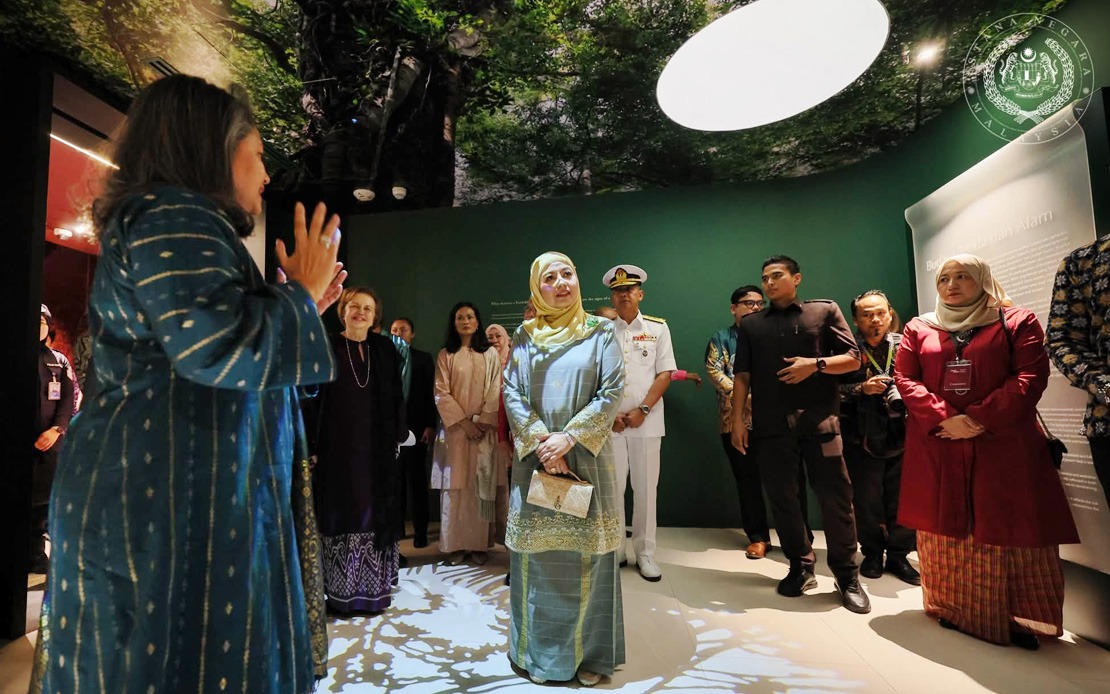
Her Majesty Queen Zarith Sofiah formally opened the Merdeka Textile Museum on Wednesday at the Menara Merdeka Maybank compound in Kuala Lumpur, marking a significant milestone in Malaysia's efforts to safeguard its rich textile traditions. The ceremonial launch underscores the constitutional monarchy's active role in promoting national cultural institutions at a time when traditional crafts face mounting pressure from globalisation and changing consumer habits.
Established by PNB Merdeka Ventures Sdn Bhd, a subsidiary of the state-owned Permodalan Nasional Berhad investment fund, the museum represents a substantial institutional commitment to textile preservation. Rather than serving merely as a passive repository of artefacts, the facility has been conceived as a dynamic learning environment that combines archival work with community engagement and interactive cultural programming. This approach reflects a broader international shift towards heritage institutions that actively interpret their collections through contemporary lenses, making historical material accessible and meaningful to diverse audiences.
During the inauguration, the Queen emphasised the universal imperative for nations to recognise, safeguard, and transmit their cultural inheritances to succeeding generations. Her comments positioned textile conservation within a wider discourse about national identity, suggesting that material culture—particularly handcrafted fabrics and traditional dress—embodies the distinctive values and social structures that define Malaysian society. This framing carries particular resonance in a multicultural context where heritage preservation can reinforce communal pride whilst promoting intercultural understanding through shared appreciation of diverse textile traditions.
The monarch further expressed her conviction that the museum will function as a vital knowledge institution for Malaysians from all backgrounds, whilst simultaneously inspiring contemporary women to engage with and champion their cultural inheritance. By explicitly directing her remarks towards younger generations and women in particular, the Queen acknowledged that cultural transmission depends not merely on institutional infrastructure but on active participation by those most likely to shape future trends in fashion, design, and craft education. This intergenerational emphasis has practical implications for textile education programmes and the commercial viability of traditional craftsmanship industries.
The museum's core collection derives from the personal assemblage accumulated by Sharifah Azah Syed Mohammed Alsagoff, widow of the late Prof Diraja Ungku Abdul Aziz Abdul Hamid and mother of former Bank Negara Malaysia governor Tan Sri Dr Ungku Zeti Akhtar Aziz. This provenance carries significance beyond mere historical curiosity—the collection bridges multiple generations of Malaysia's elite intellectual and financial circles, suggesting that textile appreciation has deep roots among custodians of national institutions. The family's decision to donate the materials to a public museum rather than preserve them as private holdings reflects a generous commitment to collective memory and scholarly access.
Comprehensively, the donated materials total 240 garments and 69 pieces of traditional jewellery spanning multiple textile traditions, including intricate songket sarongs, the elaborately embroidered Limar Baju Kurung style, and textiles featuring Tekat Emas gold thread embroidery. Each category represents distinct regional and technical traditions—songket demands complex silk and gold thread weaving techniques, whilst tekat represents a labour-intensive embroidery methodology particular to certain Malay communities. By showcasing these diverse forms within a single institutional framework, the museum enables visitors to trace both the technical sophistication and cultural specificity of Malaysian textile practices.
The physical infrastructure of the Merdeka Textile Museum extends considerably beyond exhibition galleries. Eight distinct thematic spaces provide different entry points for visitor engagement, whilst complementary facilities address the scholarly and practical dimensions of textile studies. The integrated conservation laboratory represents an essential component, as proper care of historic fabrics requires specialist environmental control, chemical treatment capabilities, and expert handling protocols. The fabric library and textile knowledge centre establish the museum as a research destination for designers, artisans, students, and academics seeking to understand historical techniques and contemporary applications of traditional methods.
This investment in research infrastructure carries implications for Malaysia's broader creative industries. As fashion design, interior decoration, and luxury goods sectors increasingly draw upon authentic cultural references, access to historically accurate materials and technical knowledge becomes commercially valuable. Museums functioning as innovation hubs—connecting traditional craftspeople with contemporary designers—can help revitalise artisanal sectors whilst generating sustainable economic activity in communities where textile skills remain embedded in cultural practice. The Merdeka Textile Museum's scholarly resources position it to facilitate such productive encounters between heritage and commerce.
Higher-ranking government figures present at the ceremony included Hannah Yeoh, Minister in the Prime Minister's Department with portfolio responsibility for Federal Territories, signalling the venue's importance within the capital's cultural infrastructure. The Chief Secretary to the Government Tan Sri Shamsul Azri Abu Bakar and PNB group chairman Raja Tan Sri Arshad Raja Tun Uda underscored the coordination between civil service leadership and state-sector financial institutions in advancing cultural preservation objectives. Such attendance patterns indicate that textile heritage has secured institutional backing across multiple spheres of governance and administration.
The opening occurs amidst broader regional developments in museum culture and heritage preservation across Southeast Asia. Thailand, Indonesia, and Vietnam have each invested substantially in textile museums and craft conservation centres, recognising both the intrinsic cultural value and the economic potential of heritage tourism. Malaysia's museum thus participates within a competitive landscape where nations vie to position their textile traditions as distinctive cultural assets worthy of scholarly attention and international recognition. The quality and comprehensiveness of the Merdeka Textile Museum's facilities positions it competitively within this regional context.
Looking forward, the museum's success will depend substantially on educational programming, community engagement, and integration with Malaysia's formal and informal learning sectors. School groups, university departments of fashion, design, and anthropology, and practitioners of traditional crafts represent key audiences whose sustained engagement will determine whether the institution truly functions as a vital repository of knowledge or becomes relegated to occasional tourist attraction status. The royal imprimatur and institutional backing established at this opening provide encouraging foundations for such ambitions.

