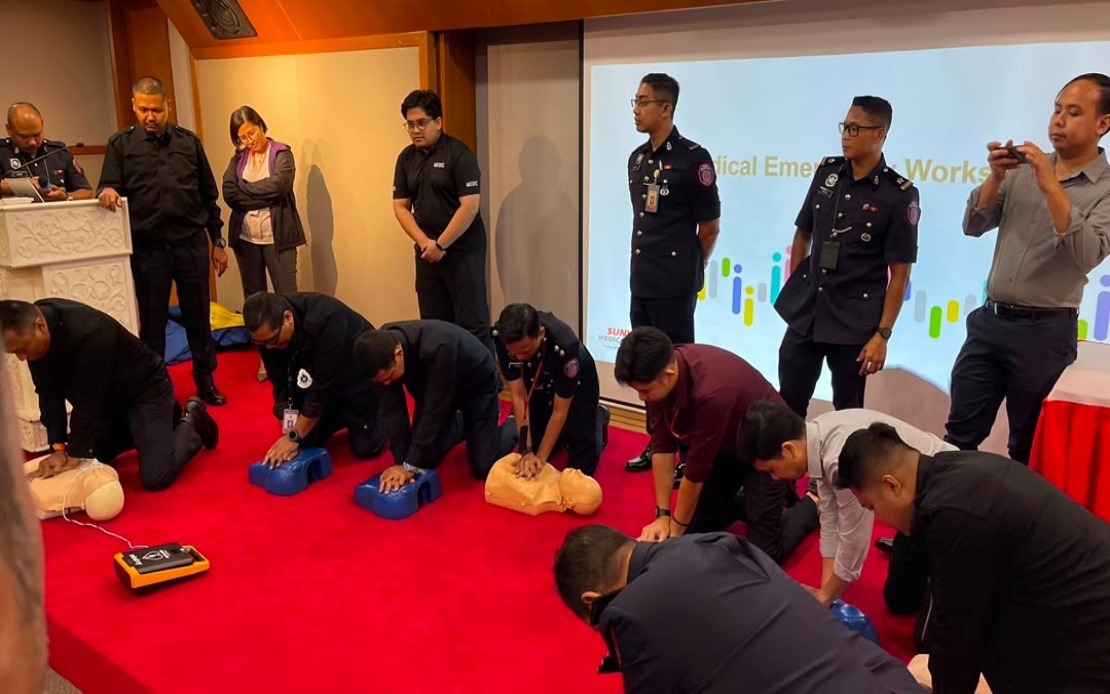
Sudden cardiac arrest remains one of Malaysia's most silent killers, striking without warning and demanding intervention within minutes. Yet survival rates languish at just 0.5 to 8.5 per cent, a figure that reflects not a shortage of medical expertise but rather the cruel arithmetic of emergency medicine: every minute without cardiopulmonary resuscitation (CPR) dramatically reduces a victim's chances of recovery. After eight to ten minutes, the odds shift irreversibly toward tragedy. This gap between the onset of cardiac crisis and access to life-saving intervention has prompted Sunway Medical Centre Velocity (SMCV) to undertake a systematic expansion of automated external defibrillators (AEDs) throughout Kuala Lumpur, supported by intensive public training that recognises the role ordinary citizens must play when seconds determine survival.
The initiative, unveiled as part of SMCV's corporate social responsibility agenda, extends the hospital's earlier "Save A Number, Save A Life" campaign by embedding AED units at strategically chosen public locations where cardiac emergencies are statistically more likely to occur. These sites represent the geography of urban Malaysia: the Tun Razak Exchange, Bukit Bintang, Ampang Park and Muzium Negara MRT stations, alongside commercial landmarks including Aquaria KLCC, Menara Public Bank and Menara Public Bank 2. The expansion will eventually encompass the National Heritage Building at Stadium Merdeka within the Merdeka 118 Precinct and Public Bank's IT and Training Centre, creating a distributed network of emergency response capability across the capital's busiest thoroughfares and gathering points.
Dr Wee Tong Ming, SMCV's Medical Director and Consultant Emergency Physician, articulates the philosophy underpinning this deployment with clinical precision: lives are not lost due to absence of help, but due to delays in response and the inaccessibility of equipment that makes the difference between survival and death. This reframing is crucial for understanding why infrastructure alone proves insufficient. The placement of AED units addresses only half the equation. Each device will be accompanied by a clearly visible standee designed for immediate recognition and use by bystanders, and every standee will carry QR code stickers linking to emergency medical guidance and training resources. These design choices reflect an understanding that in a crisis, confusion kills as surely as inaction.
The public health significance of this programme extends beyond Kuala Lumpur's borders, offering lessons for other Malaysian cities wrestling with infrastructure gaps in emergency response. Urban density and foot traffic at MRT stations and commercial hubs create both the necessity and opportunity for this intervention. A commuter experiencing cardiac arrest at Tun Razak Exchange during peak hours previously faced a race against time dependent entirely on whether paramedics could arrive within the critical window. With AEDs now positioned at these high-traffic nodes, trained bystanders can initiate defibrillation immediately, potentially extending the window of opportunity for successful resuscitation by several crucial minutes.
Susan Cheow, SMCV's Chief Executive Officer, emphasises that equipment without knowledge remains useless metal and plastic in moments demanding split-second action. The hospital has therefore coupled its AED deployment with on-site training sessions and Accident and Emergency awareness talks designed to equip the public with basic life support skills. This includes recognition of cardiac arrest symptoms, proper CPR technique, and safe operation of AED devices. The distinction between merely installing defibrillators and creating genuine emergency preparedness lies in this educational dimension. A person standing alongside a collapsed colleague may glimpse an AED standee, but without prior knowledge or confidence in its use, paralysis often prevails over intervention.
The programme's architects recognise that emergency preparedness functions best when embedded into everyday thinking rather than treated as an occasional concern. By distributing training across various public spaces and partnering with general practitioner clinics to display emergency guidance materials, SMCV aims to normalise knowledge of life-saving techniques. This approach aligns with international evidence suggesting that communities with higher public awareness of CPR and AED use experience measurably better cardiac arrest survival outcomes. Malaysia's current figures suggest room for substantial improvement through relatively straightforward interventions.
The choice of locations reveals strategic thinking about where cardiac emergencies concentrate. MRT stations serve millions of commuters annually, many of whom are older or potentially carrying undiagnosed cardiac risk factors. Commercial buildings house populations during working hours when stress-induced events may occur. Heritage sites and public attractions draw diverse crowds, including visitors unfamiliar with local medical infrastructure. By positioning AEDs at these junctures between transit, commerce, and civic life, SMCV has identified nodes where emergency response capability promises maximum impact. The stadium precinct addition signals recognition that sports venues and large gathering spaces present particular cardiac event risk.
Dr Wee underscores that installation represents merely the foundation of improved emergency response capacity. The real work involves ensuring that knowledge, technique, and confidence converge when crisis strikes. Through structured training programmes, the hospital aims to build a distributed network of informed bystanders capable of initiating appropriate interventions. This represents a democratisation of emergency medicine, shifting responsibility from institutions alone toward empowered citizens. It acknowledges what healthcare systems worldwide have discovered: survival in sudden cardiac arrest depends as much on lay response as on professional intervention.
The programme carries particular significance for Southeast Asia more broadly, where similar gaps between cardiac arrest incidence and emergency response capability exist across the region. Malaysia's willingness to address this through strategic infrastructure deployment coupled with public education offers a replicable model. The QR code linking system, for instance, provides scalable technology for connecting physical emergency resources to digital guidance and training resources. Other nations grappling with sudden cardiac arrest mortality could adapt these mechanisms to local contexts and healthcare systems.
From a public health perspective, this initiative demonstrates how corporate healthcare providers can contribute meaningfully to population-level health outcomes through infrastructure partnerships and educational programmes. Rather than treating cardiac arrest as an individual tragedy requiring only clinical response after the fact, SMCV's approach inverts the paradigm to ask how public spaces themselves can be engineered and educated to prevent death. This represents a shift from reactive medicine toward proactive community health intervention. The success of this model will likely be measured not only in improved survival statistics but in cultural change around emergency preparedness.
The broader implication concerns Malaysia's readiness as an urban society to prioritise collective safety over passive acceptance of preventable mortality. Sudden cardiac arrest carries no social distinctions; it strikes executives in office towers and passengers in transit stations with equal indifference. Yet access to emergency response capability has historically depended on geography and circumstance. By strategically deploying AEDs and training, SMCV works toward a future where every second truly counts because the necessary tools and knowledge stand ready in the spaces where Malaysians spend their daily lives.

