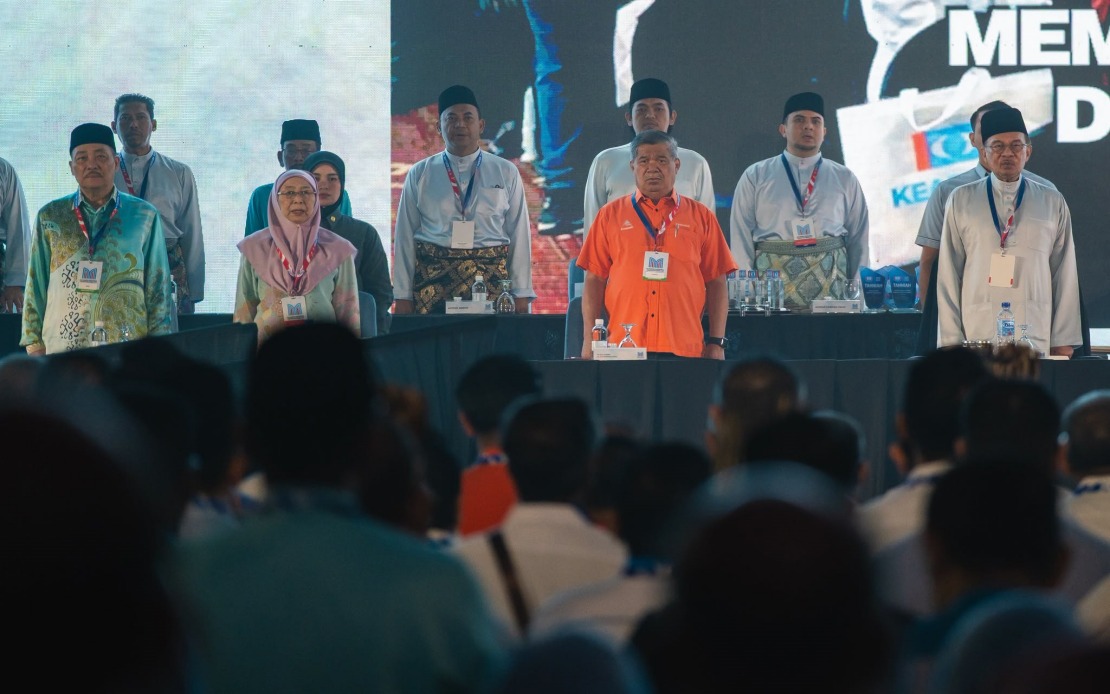
Parti Amanah Negara president Datuk Seri Mohamad Sabu has underscored the necessity of sustaining institutional reform even after a political coalition assumes governmental power, framing anti-corruption efforts and governance improvements as long-term imperatives rather than temporary campaign commitments. Speaking at the Melaka International Trade Centre in Ayer Keroh on August 15, the Agriculture and Food Security Minister warned against treating reform initiatives as superficial political slogans once electoral mandates have been secured, instead advocating for their systematic implementation through tangible policy action and administrative discipline.
The Amanah leader's remarks came during his attendance at the 2026 PKR National Congress, where he echoed similar themes articulated by Parti Keadilan Rakyat president Datuk Seri Anwar Ibrahim regarding the continuity of reform priorities in the current administration. Mohamad Sabu's intervention signals broader consensus among ruling coalition partners that anti-corruption initiatives and governance transparency must remain operational realities rather than shifting with political circumstances or the institutional positions of individual actors within the government.
A critical dimension of Mohamad Sabu's position centres on the principle that accountability mechanisms must function impartially regardless of political identity or organisational hierarchy. He specifically pledged that those responsible for misappropriating public funds would face consequences without consideration for their party affiliation, rank within government structures, or personal relationships with decision-makers. This framing attempts to address public scepticism about selective prosecution and perceived double standards in anti-corruption enforcement, which has periodically undermined confidence in institutional integrity across Southeast Asia and Malaysia specifically.
The minister's emphasis on translating electoral mandates into demonstrable governance outcomes reflects awareness that public trust depends on closing the gap between campaign rhetoric and administrative performance. He articulated that citizens have conferred upon the government a responsibility to prove through work and concrete action that reform commitments extend beyond symbolic gestures or public relations messaging during political campaigns. This rhetorical shift toward outcomes-based accountability represents an attempt to reorient political discourse toward measurable institutional change.
Beyond anti-corruption frameworks, Mohamad Sabu identified economic management and living standards improvement as interconnected priorities requiring government attention. While acknowledging that gross domestic product growth figures matter for macroeconomic assessment, he prioritised the need for such growth to translate into enhanced household purchasing power and tangible relief from cost-of-living pressures that continue affecting Malaysian families across income brackets. This positioning reflects recognition that GDP expansion disconnected from personal economic security generates political dissatisfaction regardless of official growth statistics.
The government's commitment to implementing the Malaysia Agreement 1963 provisions governing Sabah and Sarawak featured prominently in Mohamad Sabu's remarks, indicating that federalism and constituent state autonomy remain substantive policy concerns for the ruling coalition. This emphasis carries implications for resource distribution, constitutional interpretation, and centre-periphery governance relations, suggesting ongoing coalition attention to maintaining support among East Malaysian constituencies through tangible implementation of constitutional commitments rather than rhetorical acknowledgment.
An additional dimension of Mohamad Sabu's statement involved welcoming the anticipated repeal of the Universities and University Colleges Act 1971, characterising this legislative change as expanding intellectual freedom and democratic participation rights for university students. The AUKU repeal represents a longstanding reform objective within Malaysian civil society and academic communities, reflecting concerns about academic autonomy and student political expression that have persisted across decades. By highlighting this particular reform achievement, Mohamad Sabu positioned the government as responsive to institutional liberalisation demands extending beyond economic or anti-corruption frameworks.
The conjunction of these policy priorities—anti-corruption enforcement, living standards improvement, federalist constitutional implementation, and academic freedoms—suggests a reformed coalition attempting to address grievances across multiple constituencies simultaneously. This multi-domain approach reflects political calculation that electoral durability requires demonstrable progress across diverse policy areas rather than concentration on singular reform pillars. The implicit message targets both the broad public and specific constituencies concerned with governance quality, regional equity, and institutional pluralism.
Contextually, Mohamad Sabu's intervention occurs amid broader Southeast Asian patterns wherein reform agendas initially pursued from opposition positions face implementation pressures and political constraints upon assumption of power. His preventive articulation of commitment to sustained reform—spoken directly to concerns about post-electoral reform fatigue—acknowledges this recurrent tension. By frontloading discussion of continued reform efforts rather than awaiting public criticism of reform deceleration, the Amanah president attempts to establish normative expectations around persistent institutional change.
The convergence between Amanah's messaging and PKR's congressional themes suggests internal coalition coordination around reform narrative framing, though the specificity of different ministers' emphasis areas—Mohamad Sabu's focus on anti-corruption and living standards versus broader Anwar Ibrahim themes—reveals differentiated constituency targeting within united reform positioning. This coordination while maintaining distinct political identities represents standard coalition management strategy balancing unified messaging with organisational autonomy and distinct electoral brand positioning.
For Malaysian voters and Southeast Asian observers, these statements establish benchmarks against which subsequent government performance will be evaluated. The explicit commitment to impartial anti-corruption enforcement regardless of political affiliation, the prioritisation of living standards improvement alongside economic growth, and the implementation of constitutional federalism provisions in East Malaysia provide measurable criteria for assessing whether reform rhetoric converts into institutional practice.

