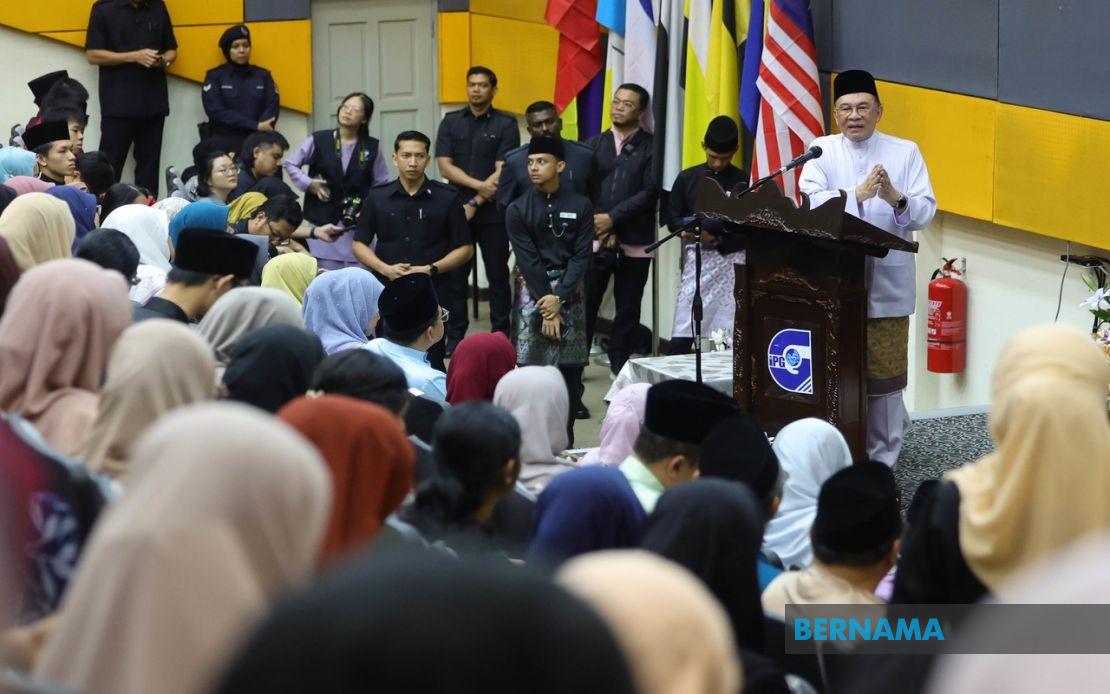
Prime Minister Datuk Seri Anwar Ibrahim has pinpointed the unwillingness of various segments within the establishment to embrace systemic change as the most significant barrier facing his government's reform initiatives, even more so than technological or expertise constraints. In remarks delivered at the Technical Education Campus of the Institute of Teacher Education in Bandar Enstek, the Premier highlighted that resistance emanates particularly from elite quarters who have vested interests in preserving longstanding corrupt practices and institutional weaknesses that benefit them.
Having steered the government for more than three years, Anwar noted that attempts to modernise the administration and dismantle corruption mechanisms consistently encounter pushback from those accustomed to exploitative systems. This observation underscores a fundamental tension within Malaysia's reform trajectory—while the machinery and know-how exist to drive transformation, the human element remains the critical bottleneck. The reluctance to surrender advantageous positions within a compromised status quo often outweighs the rational calculus in favour of systemic improvement.
The Prime Minister acknowledged that governance strengthening and anti-corruption measures frequently generate discomfort among stakeholder groups, making these initiatives unpopular in certain quarters. Nevertheless, he stressed that such reforms remain imperative for Malaysia's trajectory and must proceed regardless of the political cost. His reasoning rests on the conviction that no administrative framework reaches perfection, and continuous refinement represents both a moral and civilisational imperative.
Anwar's articulation of this challenge speaks to the paradox facing many developing economies attempting institutional renewal. Reform advocates often assume that demonstrating the logical superiority of transparent, accountable systems will persuade stakeholders to cooperate. Yet as the Premier's experience illustrates, those benefiting from opacity and inefficiency possess sufficient organisational power and institutional penetration to mount effective obstructionism. This resistance frequently takes sophisticated forms, including appeals to tradition, stability rhetoric, and claims that reform measures overreach.
Critically, Anwar identified a particular category of resistors—individuals whose external trappings suggest modernisation but whose institutional behaviour reflects attachment to pre-reform norms. These figures may adopt contemporary dress and lifestyle aesthetics while simultaneously defending practices rooted in patronage networks, selective accountability, and informal power structures. This phenomenon reveals that resistance to reform operates at psychological and interest-based levels, not merely as ideological conservatism.
The deeper implication of the Premier's remarks concerns the sequencing and sustainability of Malaysia's anti-corruption and governance agenda. For reforms to crystallise into permanent institutional change rather than temporary disruptions, they must shift from top-down directives to broader societal internalisation of transparency and accountability norms. This process necessarily generates friction as entrenched groups sense their privileges eroding.
Malaysia's experience resonates across the Southeast Asian region, where numerous nations grapple with similar reform bottlenecks. Countries including Indonesia, the Philippines, and Thailand have launched anti-corruption campaigns that have discovered, much as Anwar describes, that systemic resistance proves more intractable than anticipated. The presence of institutional muscle memory and informal power networks can blunt formal reforms, rendering them performative without substantive impact.
For Malaysian readers, Anwar's candid assessment suggests that visible progress on governance and corruption metrics should not be misinterpreted as indicating imminent systemic transformation. Rather, the coming years likely involve sustained contestation between reform champions and establishment defenders seeking to preserve advantage. The outcome depends partly on whether civil society, younger cohorts, and reformist bureaucrats can generate sufficient countervailing pressure to overcome organised obstruction.
The location of Anwar's remarks—a teacher education campus—carries symbolic weight. Educational institutions and the cohort they produce represent critical variables in reform sustainability. If emerging generations internalise transparency and accountability expectations as normative, they can eventually alter institutional culture from within. Conversely, if reform fatigue sets in or obstructionists convince younger cohorts that cynicism reflects realism, reform momentum could dissipate.
Anwar's framing also implicitly acknowledges that reform encounters not merely passive inertia but active antagonism. This distinction matters strategically. Passive resistance might yield to persuasion or demonstration of benefits. Active defence of corrupt or weak practices, however, requires counter-pressure through accountability mechanisms, transparent enforcement, and systematic removal of obstructive individuals from positions enabling interference.
Looking forward, the sustainability of Malaysia's reform trajectory hinges substantially on whether mechanisms can be institutionalised sufficiently to persist beyond individual political leadership. Anwar's tenure provides window opportunity, but permanent change demands transforming not just policies but the incentive structures and cultural expectations that currently sustain resistance. His acknowledgment of this challenge, while sobering, reflects the realistic assessment required for sustainable institutional reform.

