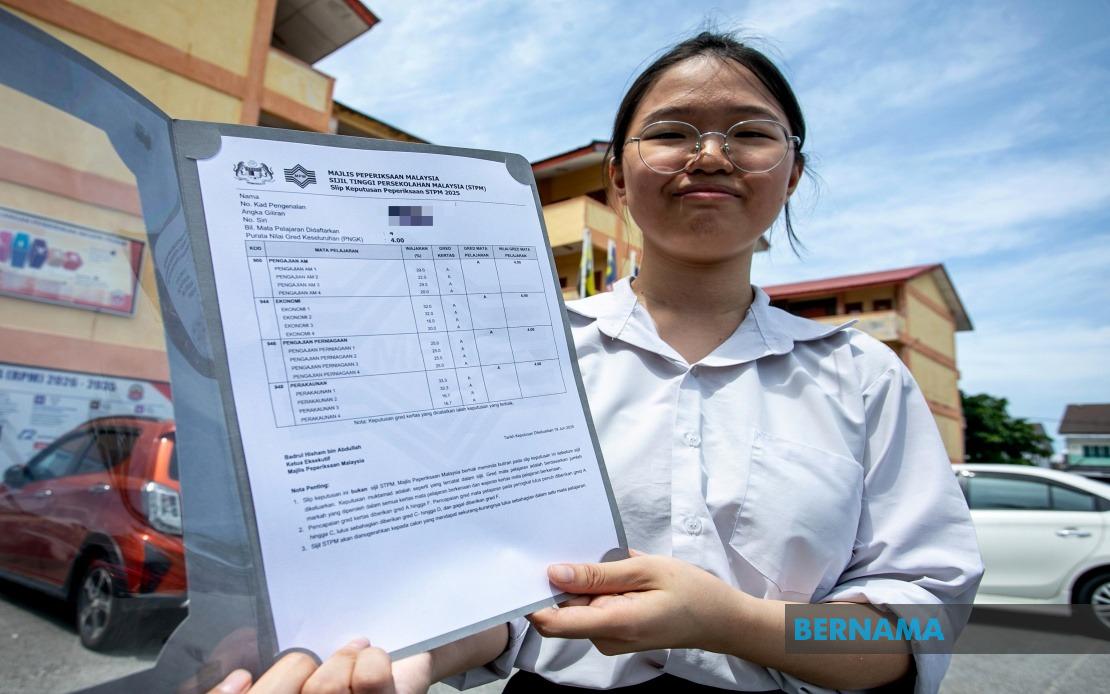
The 2025 STPM examination results have delivered a standout success story from Ipoh, where 20-year-old Yong Xin Yi from SMK Jalan Tasek secured four distinctions across General Studies, Principles of Accounting, and Economics. Her achievement, which places her among five students from her school to reach this academic milestone, underscores the measurable impact of disciplined time management in an examination system that remains highly competitive across Malaysia.
Xin Yi's approach to academic excellence revolved around a carefully structured timetable that carved out five dedicated hours for revision each evening, commencing at 5:00 pm and concluding at 10:00 pm. This consistent allocation of study time complemented her classroom presence, creating a dual-pronged strategy that emphasised both immediate learning and subsequent consolidation. The routine reflects an understanding that examination preparation is fundamentally a marathon rather than a sprint, requiring sustained effort rather than last-minute cramming.
What distinguishes her study methodology is the priority she placed on classroom engagement itself. Rather than viewing lessons as preliminary material to be genuinely understood only during home revision, Xin Yi treated teaching sessions as opportunities for deep comprehension. She deliberately cultivated the habit of concentrating fully during instruction, recognising that clear understanding from teachers reduced subsequent confusion and uncertainty. This perspective proved particularly valuable given the abstract nature of subjects like General Studies, which demand conceptual grasping beyond simple factual recall.
Homework completion formed another pillar of her academic strategy. Rather than dismissing assignments as bureaucratic requirements, Xin Yi leveraged them as instruments for mastery. Each exercise set by teachers became an occasion to test her grasp of recently covered material and identify knowledge gaps before examination conditions rendered correction impossible. This transformed what could have been routine administrative tasks into purposeful consolidation tools.
General Studies emerged as her most demanding subject, presenting challenges that extended beyond memorisation. The discipline requires students to develop sophisticated written expression skills while adhering to specific format requirements and understanding nuanced marking criteria. Recognising this particular difficulty, Xin Yi strategically allocated additional attention to the subject, refusing to allow weakness to accumulate. Her willingness to confront challenging material head-on rather than circumvent it proved instrumental in ultimately securing a distinction.
Her academic trajectory cannot be divorced from her family circumstances and parental support. As the only child of a clerk mother and phone salesman father, Xin Yi benefited from continuous parental encouragement throughout her secondary education. She articulates her achievement not as an individual triumph but as a collective family endeavour, viewing her examination success as validation of her parents' sacrifices and as a stepping stone toward broader family aspirations. This perspective mirrors values prevalent across Malaysian households where educational achievement carries weighty family significance.
Xin Yi's cumulative grade point average of 4.00 reflects consistent excellence rather than excellence concentrated in particular subjects. This consistency suggests that her study methodology proved universally applicable across the diverse demands of her subject portfolio. The breadth of her distinction grades indicates neither reliance upon rote learning nor narrow specialisation, but rather adaptable techniques capable of addressing different disciplinary requirements.
Looking forward, Xin Yi has resolved to pursue economics at Universiti Putra Malaysia, a decision rooted in careful assessment of her interests and market prospects. Her aspiration to become an economist aligns logically with her STPM results, where Economics ranked among her strongest performances. The choice reflects contemporary Malaysian student consciousness regarding career viability and sector growth potential, positioning her within an increasingly competitive professional landscape where economics graduates command significant labour market demand.
Her story carries implications for Malaysian secondary students contemplating their examination preparation strategies. The consistent daily routine she maintained demonstrates that spectacular results need not stem from exceptional genius but rather from methodical commitment executed over sustained periods. The combination of classroom attentiveness and systematic home revision provides a replicable framework that existing research on learning psychology increasingly validates.
Furthermore, her achievement within a broader context of five students from SMK Jalan Tasek reaching the four-distinction threshold suggests that institutional support structures matter considerably. The school's capacity to facilitate such concentrated success across multiple students indicates effective teaching quality, appropriate resource allocation, and perhaps an institutional culture that prioritises academic rigour. This dimension distinguishes her personal achievement from isolated excellence and positions it within a school-wide commitment to academic standards.
The contrast between examination success driven by genuine understanding versus rote memorisation manifests clearly in Xin Yi's educational philosophy. Her emphasis on classroom comprehension and conceptual mastery over mechanical revision exemplifies an approach increasingly advocated by education specialists concerned with deeper learning outcomes. In an examination system sometimes criticised for encouraging superficial knowledge acquisition, her methodology represents a countermodel emphasising substance over technique.
Xin Yi's articulated motivation—using her academic success to improve her family's circumstances and reward parental sacrifice—resonates with narratives common throughout Southeast Asia, where education functions as a primary pathway toward social mobility. Her trajectory from Ipoh schoolgirl to university-bound economist candidate embodies contemporary Malaysian aspirations and the tangible rewards that disciplined academic effort can generate. For students across the region confronting similar examination pressures, her story offers both inspiration and practical insight into the mechanics of sustainable academic achievement.

