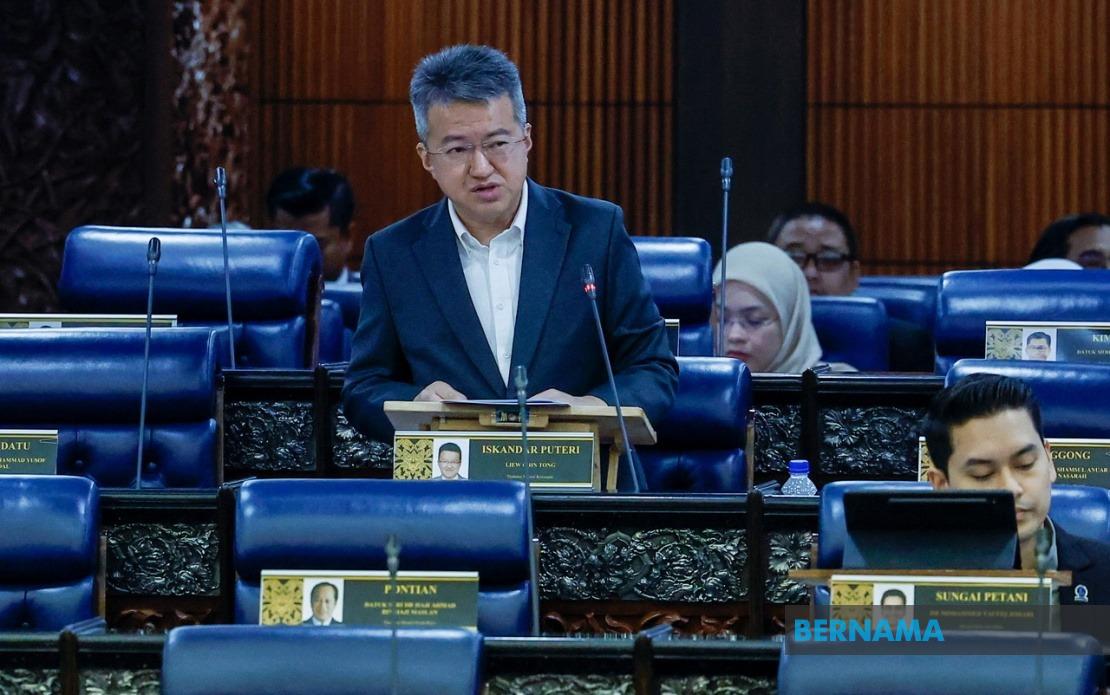
The federal government has moved to reassure Sabah that a substantial RM1.5 billion boost to the state's interim special grant will not result in a corresponding reduction to either the state's operating expenditure or its development allocation ceiling within the 2024 federal budget framework. Deputy Finance Minister Liew Chin Tong made this clarification during parliamentary proceedings, addressing concerns raised by lawmakers about how the grant increase would be administered and whether it might cannibalize other funding streams essential to Sabah's progress.
The special grant increase, which Prime Minister Datuk Seri Anwar Ibrahim announced in May, represents a significant gesture toward the resource-rich eastern Malaysian state. Liew's intervention in the Dewan Rakyat was particularly important given the historical sensitivities surrounding Sabah's fiscal arrangements with the federal government and questions about whether new commitments might squeeze existing budget lines that fund critical infrastructure and services.
Sabah's development allocation has actually strengthened this year, climbing from RM6.7 billion to RM6.9 billion, demonstrating the government's commitment to maintaining momentum across multiple sectoral investments. This expanded envelope supports an array of projects fundamental to the state's economic development and quality of life improvements. The Pan Borneo Highway remains a flagship initiative, representing one of Malaysia's largest infrastructure undertakings and critical to linking Sabah's remote regions with urban centers and facilitating trade corridors to Brunei and beyond.
Beyond the highway, development funding continues to flow toward rural accessibility infrastructure, with improvements to secondary and tertiary road networks that connect farming communities and small towns to markets. Rural electrification projects persist in bringing grid power to previously underserved areas, while simultaneous investments in water supply systems address one of the most basic development challenges facing dispersed populations across Sabah's interior.
Health infrastructure remains a priority within the development basket. The allocation supports construction and upgrading of hospitals, clinics, and related facilities that expand healthcare access across the state, where distances and terrain present enduring logistical challenges. Educational infrastructure also receives attention through funds dedicated to renovating dilapidated school buildings, addressing a longstanding backlog of facility improvements across both urban and remote areas. Law enforcement facilities, including police stations, benefit from similar upgrade programs.
A particularly noteworthy commitment concerns electricity subsidies. Although regulatory authority over electricity supply transferred to Sabah's state government in 2024, the federal government has pledged to continue bearing subsidy costs—a significant ongoing fiscal support. The 2026 electricity subsidy allocation is projected to reach RM880 million, representing a substantial financial transfer that cushions Sabah consumers from market rates while acknowledging the state's unique cost structure and development needs.
Water supply investments have accelerated markedly. The allocation for rural water schemes has jumped from RM103.5 million in 2025 to RM143 million in the current year, a substantial percentage increase reflecting the priority attached to universal access to clean water in a state where traditional water sources often prove inadequate or unreliable during dry seasons.
Cost-of-living support through direct cash assistance schemes amplifies the federal government's commitment to household welfare in Sabah. The Sumbangan Tunai Rahmah and Sumbangan Asas Rahmah programs together represent an estimated RM1.2 billion in assistance for Sabah, providing immediate income support to vulnerable populations amid inflationary pressures affecting the broader economy.
Regarding the special grant's mechanics, Liew emphasized that both the federal government and Sabah's state administration must adhere strictly to constitutional procedures outlined in Article 112D of the Federal Constitution. This mirrors the processes followed in 2022, 2023, and 2025, ensuring consistency and predictability. The constitutional framework governing these grants has become increasingly important given earlier court proceedings and evolving interpretations of federal-state fiscal relations.
Significantly, Liew acknowledged that the federal government remains engaged in an appeal concerning certain aspects of a Kota Kinabalu High Court ruling on special grants matters. Despite this litigation, he stressed that the government respects the foundational constitutional principle enshrining Sabah's entitlement to special grants under Article 112C, a provision rooted in Malaysia's federal compact and Sabah's historical position within the federation.
Looking forward, the federal government has signaled its commitment to negotiating a revised mechanism for determining future special grant amounts. These discussions with Sabah's state government seek to establish a sustainable, transparent framework aligned with Articles 112C and 112D, potentially replacing ad hoc arrangements with a more institutionalized approach. Such an agreement would provide both governments with clearer planning parameters and reduce friction arising from periodic disputes over grant calculations and entitlements.
For Malaysia's broader development agenda, Sabah's enhanced fiscal capacity carries implications for regional stability and economic integration. The state's development trajectory directly influences migration patterns, inter-state trade flows, and the overall competitiveness of Malaysian territories in regional markets. Infrastructure investments in rural electrification and road networks in Sabah contribute to the country's aim of reducing development disparities and ensuring that prosperity reaches beyond major urban centers.
The emphasis on maintaining both special grants and development allocations without trade-offs reflects a policy approach prioritizing complementary rather than competing spending streams. This distinction matters for stakeholders in Sabah and for other states watching how the federal government balances constitutional obligations with annual budgetary realities. The assurance that new grant payments will not displace existing development funding provides some clarity to state officials and communities planning their own interventions around federal investments.

