The federal government has earmarked RM44.5 million for comprehensive flood mitigation works in Petaling Jaya and Damansara, a substantial investment announced by Prime Minister Datuk Seri Anwar Ibrahim as part of an accelerated effort to combat recurring inundation problems in these high-risk zones. The funding represents a coordinated response between federal and Selangor state authorities, with both administrations having reached consensus on prioritising 30 distinct projects designed to reduce flood vulnerability in areas consistently experiencing seasonal or monsoon-related water management crises.
The Implementation Coordination Unit, housed within the Prime Minister's Department, will oversee the rollout of these mitigation works, ensuring that project timelines, resource allocation, and progress monitoring maintain consistent standards across both constituencies. This institutional framework reflects a deliberate strategy to centralise oversight of infrastructure spending and prevent the fragmentation that has historically plagued cross-boundary implementation efforts in the Klang Valley. By routing these initiatives through the ICU rather than delegating directly to state or local authorities, the administration signals its intention to maintain tight budgetary control and accountability at the highest levels of government.
Government spokesperson Datuk Seri Fahmi Fadzil elaborated on the supplementary allocations accompanying the main flood mitigation envelope, revealing that Petaling Jaya parliamentary constituency would receive an additional RM3 million designated for Projek Mesra Rakyat initiatives and grassroots community support, particularly targeting non-governmental organisations operating in the area. The Subang Jaya constituency received RM1.5 million under similar arrangements, underscoring the administration's commitment to distributing development funds across multiple constituencies within the broader Selangor corridor. These parallel funding streams reflect the government's dual approach of addressing infrastructure deficits while simultaneously strengthening social safety nets and community engagement mechanisms.
Coordination between the Selangor state ICU and the federal ICU unit will prove critical in ensuring that resources flow smoothly from central treasury accounts to implementation agencies on the ground. The involvement of two separate ICU bodies highlights the complexity of managing development projects across state and federal boundaries, particularly in heavily urbanised areas where land ownership, drainage responsibilities, and maintenance obligations often remain contested between different tiers of government. Without clear administrative lines and delineated accountability frameworks, flood mitigation efforts can become mired in jurisdictional disputes, causing costly delays and duplicative spending.
The identification of Petaling Jaya and Damansara as priority zones reflects accumulated evidence regarding their vulnerability to inundation. Both areas have endured significant flooding episodes in recent years, disrupting commerce, damaging property, and disrupting daily life for thousands of residents and businesses. The selection of 30 discrete projects across these constituencies suggests that planners have conducted detailed hydrological assessments to pinpoint specific chokepoints, undersized drainage infrastructure, and topographical depressions where water accumulates during heavy rainfall. This granular, evidence-based approach contrasts with earlier ad-hoc responses that often treated flooding as an inevitable seasonal nuisance rather than an engineering problem susceptible to systematic solutions.
For Malaysian property owners and businesses in these constituencies, the investment carries significant implications. Flood mitigation infrastructure can enhance asset values, reduce insurance premiums, and increase the attractiveness of previously water-logged areas for retail, residential, and commercial development. The RM44.5 million represents a substantial injection of capital that should translate into visible physical improvements—widened drainage channels, upgraded pump stations, retention ponds, or elevated roadways—within the coming fiscal years. Residents and investors monitoring this initiative will be watching closely to assess whether timelines slip and whether implemented works actually translate into measurable reductions in water levels during future weather events.
The announcement also carries broader significance for Southeast Asian urban governance, where many cities across Thailand, Vietnam, Indonesia, and the Philippines grapple with comparable flooding challenges. Malaysia's approach, relying on centralised coordination through the Prime Minister's office rather than dispersing authority across numerous local bodies, offers one institutional model for managing complex infrastructure investments. The relative wealth of federal resources available in Malaysia may not be replicable in less-developed regional neighbours, yet the administrative emphasis on unified oversight and accountability demonstrates how institutional design can improve project delivery outcomes.
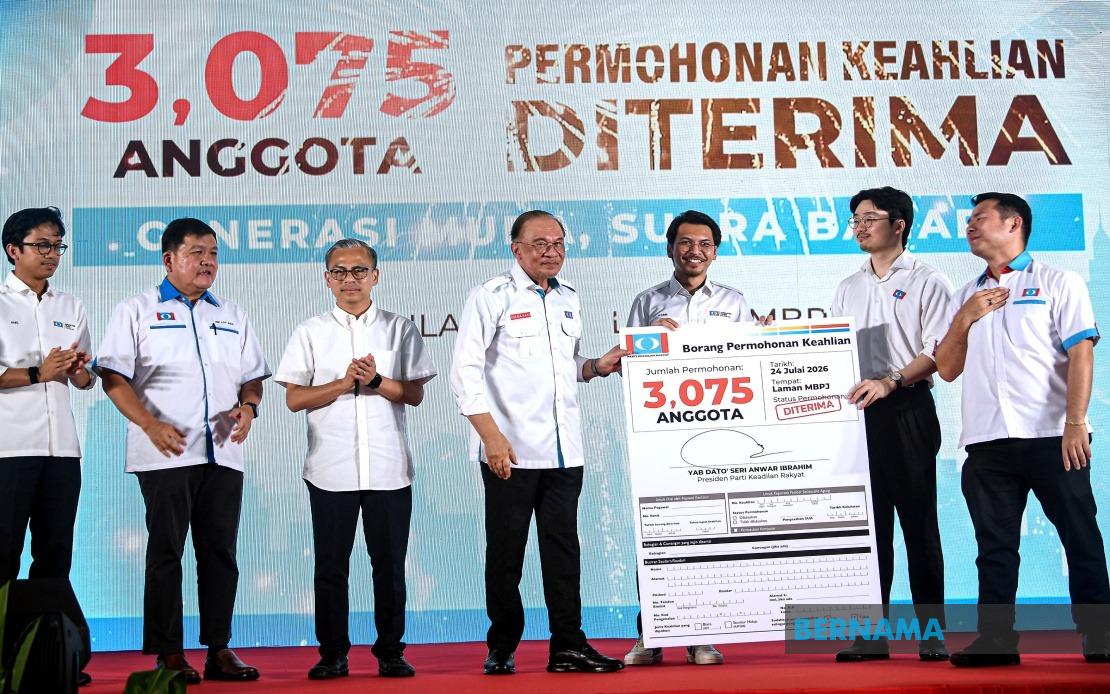
Beyond flood mitigation, the Prime Minister's office seized the occasion to reinforce its political outreach to younger demographics. The Generasi Muda Suara Baharu Programme, hosted at Petaling Jaya Smart Centre, served as the venue for announcing the flood mitigation allocations while simultaneously facilitating recruitment of 3,075 new Parti Keadilan Rakyat members, predominantly drawn from Generation Z cohorts through Angkatan Muda Keadilan structures. This bundling of infrastructure announcements with youth mobilisation demonstrates how Malaysian political actors integrate governance functions with party-building imperatives, using development spending announcements as platforms for broader political engagement.
Fahmi characterised the extraordinary turnout and membership recruitment surge as vindication of PKR's continued traction among younger voters, describing it as a foundation for expanded outreach efforts. The party plans to launch a nationwide Jelajah AMK Gen Z programme, framed explicitly as a party-building initiative rather than preparation for imminent electoral contests, though the distinction between regular political activity and campaign mobilisation remains somewhat nebulous in Malaysian political practice. The framing reflects sensitivity to accusations that development announcements sometimes blur the boundary between governance and partisan advantage, though sceptics might note that announcing flood mitigation investments in the presence of thousands of young party members creates powerful visual narratives benefiting the ruling coalition.
The timing of this announcement, arriving as Malaysia approaches potential elections within the coming eighteen months, situates the flood mitigation initiative within a broader electoral calculus. While the government presents the spending as straightforward infrastructure investment addressing long-standing local problems, opposition observers may characterise it as strategic resource deployment in constituencies where electoral margins remain competitive. The legitimacy and effectiveness of the flood mitigation works themselves will ultimately depend on timely implementation and measurable outcomes, factors that will become apparent during the next major rainfall event or over the course of the following monsoon season.
The RM44.5 million allocation, while substantial, requires context within the broader landscape of Malaysian development spending. Annual federal budgets routinely allocate many billions towards infrastructure, and the flood mitigation envelope, though significant for Petaling Jaya and Damansara specifically, represents a relatively targeted intervention rather than a comprehensive overhaul of national drainage systems. For residents in these constituencies, however, the investment signals that their flooding concerns have registered with the highest levels of government and that resources are flowing toward solutions. Whether those resources translate into effective, durable infrastructure improvements will ultimately determine whether this initiative enhances the government's credibility on development delivery or merely adds another chapter to the lengthy history of unfulfilled promises surrounding Malaysian infrastructure projects.

