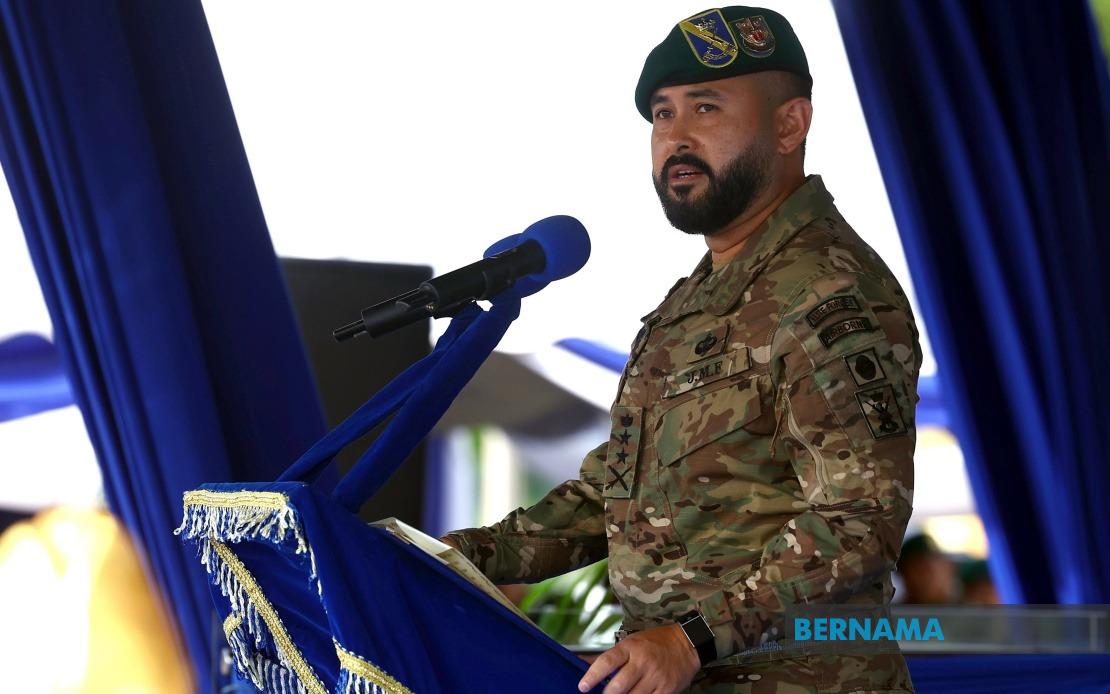
The Regent of Johor, Tunku Mahkota Ismail, has issued a stern directive that all stakeholders involved in developing the Regimen Gerak Khas (RGK) must respect decisions already sanctioned by His Majesty Sultan Ibrahim, King of Malaysia, and refrain from modifying them to serve narrow interests. Speaking at the unit's 61st anniversary parade in Mersing on August 20, the Regent emphasised that every planning initiative and modernisation effort concerning the RGK requires royal approval in the King's capacity as Colonel Commandant, and must be executed with absolute integrity and commitment to national security.
The Regent's remarks carry particular weight given the RGK's strategic importance as Malaysia's premier special forces unit, responsible for confronting the nation's most serious security threats. By invoking the Malay proverb about entrusting a fence only to have it destroyed, Tunku Mahkota Ismail signalled frustration with what appears to be internal resistance or self-interested attempts to reshape previously approved developmental trajectories. The message appeared directed at ensuring that once royal consensus is reached, implementation proceeds without dilution or deviation driven by bureaucratic or personal agendas.
Crucially, the Regent coupled this warning with a broader critique of governance standards within the Ministry of Defence and Malaysia's Armed Forces establishment. He acknowledged awareness of specific individuals influencing senior Defence Ministry positions and pledged forthcoming engagement to address what he characterised as a "cancer" within the military hierarchy. This language suggests systemic dysfunction beyond mere administrative inefficiency, potentially implicating corruption, nepotism, or violations of meritocratic principles that could compromise operational effectiveness and national security.
The timing of these remarks coincides with growing international recognition that Southeast Asia's security environment has become markedly more volatile and complex. The Indo-Pacific region faces intensifying geopolitical competition, while developments in the South China Sea and strategic manoeuvring among major powers create unpredictable operational demands. Against this backdrop, the Regent argued persuasively that Malaysia cannot afford complacency regarding the RGK's capabilities. Rather, serious investment in equipment, weaponry, mobility, advanced technology systems and operational assets must proceed urgently, calibrated to contemporary and emerging security scenarios.
Central to the Regent's message is an unambiguous rejection of procurement and development practices driven by anything other than rigorous capability assessment and operational necessity. He stressed that all acquisition decisions under Malaysia's 13th Malaysia Plan must prioritise the RGK's actual requirements, incorporating cutting-edge technology, cost-effectiveness, operational suitability and long-term strategic fit. This framework implicitly critiques past or ongoing procurement decisions that may have prioritised cost minimisation over capability, supplier relationships over performance standards, or political considerations over defence necessity.
The Regent extended his governance critique to human resource management, insisting that personnel welfare and career advancement must operate transparently and exclusively on merit-based grounds. He condemned any culture of favouritism, preferential treatment or non-transparent decision-making regarding individual career trajectories, arguing convincingly that such practices corrode organisational cohesion and compromise operational readiness. For an elite special forces unit where trust and mutual reliance directly determine life-or-death outcomes, such standards are not merely bureaucratic nicety but operational necessity.
For Malaysian readers and regional observers, the Regent's intervention reflects a broader tension within Southeast Asian defence establishments between modernisation imperatives and institutional reform requirements. Malaysia faces the challenge of upgrading its special forces capabilities while simultaneously addressing governance deficits that could undermine that very modernisation. The RGK's effectiveness depends not only on superior equipment but on organisational integrity, leadership credibility and personnel confidence in advancement systems.
The implications extend beyond the RGK itself, signalling royal and high-level institutional concern about corruption or misconduct within defence governance broadly. When senior royalty directly references decision-making authority over Defence Ministry personnel, it indicates awareness of systemic issues requiring intervention at the highest political levels. This engagement may presage broader governance reforms or disciplinary actions addressing what the Regent identified as internal dysfunction.
Moreover, the Regent's emphasis on regional security complexity underscores why Malaysia cannot tolerate organisational dysfunction within its premier tactical asset. As geopolitical tensions in the Indo-Pacific intensify and South China Sea strategic competition deepens, operational excellence becomes increasingly critical to national security. Personnel welfare, equipment standards, and transparent meritocratic advancement directly support rather than distract from operational readiness.
The Regent concluded by reiterating the fundamental responsibility of RGK personnel to maintain exceptional standards of skill, physical and mental resilience, integrity and unwavering loyalty to King and country. This framing positions the RGK not as a conventional military unit but as the "tip of the spear" confronting existential national security challenges. The parallel emphasis on governance standards and operational excellence suggests recognition that elite military capability requires both superior equipment and superior institutional culture.

