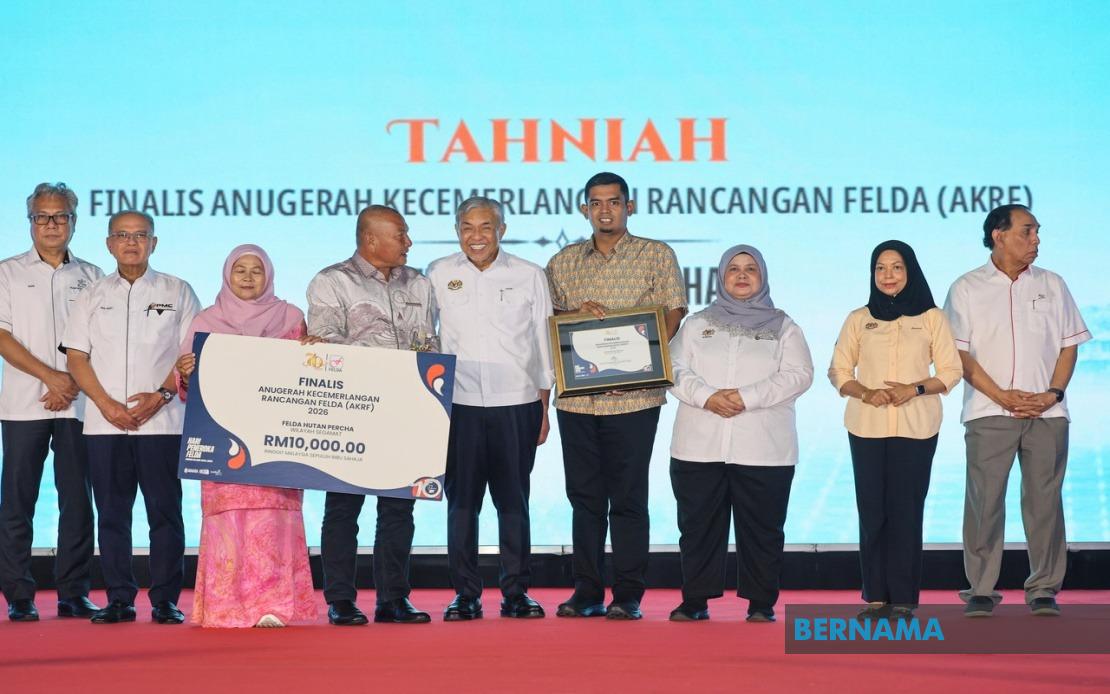
The Deputy Prime Minister has articulated a transformative vision for Malaysia's rural sector, arguing that confining development efforts within national boundaries no longer serves the country's economic aspirations. Speaking at the World Rural Development Day 2026 celebration in Maran, Datuk Seri Dr Ahmad Zahid Hamidi—who also holds the Rural and Regional Development portfolio—positioned rural entrepreneurship as integral to Malaysia's regional competitiveness, particularly as ASEAN integration deepens and global markets become increasingly accessible to developing economies.
Ahmad Zahid's remarks signal a strategic pivot in how Kuala Lumpur approaches rural economic policy. Rather than treating rural communities as recipients of government support programmes confined to domestic consumption and local supply chains, the administration now views these entrepreneurs as potential exporters and regional players. This reorientation reflects broader Southeast Asian economic trends, where smaller enterprises increasingly find opportunities through e-commerce platforms, bilateral trade agreements, and cross-border investment corridors. For Malaysian rural businesses, the implications are substantial: access to ASEAN's 650 million consumers and participation in global halal trade networks worth hundreds of billions of dollars annually.
The National Rural Economy Agenda, which Ahmad Zahid identified as the overarching blueprint for the next phase of development, represents an attempt to coordinate fragmented rural initiatives under a coherent strategic framework. This consolidation addresses a longstanding weakness in rural policy implementation across Southeast Asia, where multiple agencies often operate with competing priorities and insufficient coordination. By centralising objectives around competitive, market-ready rural enterprises rather than subsistence-oriented development, the ministry aims to create ecosystems where innovation and scalability become standard rather than exceptional.
Three years of programmatic intervention have yielded measurable results that extend beyond traditional infrastructure metrics. The government's flagship initiatives—RisSMart and IkonDesa—have directly supported over 7,000 new rural entrepreneurs, generating approximately 15,000 employment opportunities and sales exceeding RM1.77 billion. These figures, while substantial, represent merely the foundation of what a comprehensive rural transformation could achieve. For regional observers, the data suggests that targeted entrepreneurship support, when combined with market access mechanisms, can accelerate rural income growth far more effectively than infrastructure investment alone, though both remain essential.
Parallel progress in human capital development demonstrates the administration's commitment to breaking generational poverty cycles through education. Nearly 500 Orang Asli students securing university admission marks a significant milestone, though the numbers underscore how much work remains to close educational disparities between rural and urban communities. This educational emphasis proves critical for rural development sustainability; entrepreneurial success increasingly depends on digital literacy, financial management skills, and market research capabilities that formal education provides. For Southeast Asian governments grappling with similar challenges, Malaysia's approach offers a template for integrating marginalised populations into knowledge-based rural economies.
Infrastructure investment during the 12th Malaysia Plan addressed connectivity gaps that had historically constrained rural enterprise. The upgrade of nearly 5,000 kilometres of rural roads, electrification of over 7,000 homes, and clean water provision to more than 10,000 households represent foundational improvements that enable economic activity. These investments also reflect recognition that rural development competitiveness depends on basic service availability; entrepreneurs operating without reliable electricity or transport links face structural disadvantages regardless of their entrepreneurial capability. However, infrastructure alone remains insufficient—the government's emphasis on simultaneous market access initiatives acknowledges this reality.
The construction and renovation of nearly 10,000 rural homes, benefiting approximately 40,000 residents, addresses another critical development constraint. Housing security correlates strongly with educational outcomes, health indicators, and entrepreneurial engagement; families living in inadequate shelter dedicate resources to survival rather than investment in productive activities. This holistic approach—combining housing, infrastructure, and economic opportunity—reflects understanding that rural development encompasses interconnected social and economic dimensions rather than isolated sectoral interventions.
Malaysia's formal observance of World Rural Development Day, which the United Nations designated in September 2024 with July 6 as the annual date, positions the country alongside global peers in acknowledging rural communities' contributions to national prosperity. The commemoration marks the establishment of the Centre on Integrated Rural Development for Asia and the Pacific, an institution that has influenced rural policy across the region for decades. By elevating World Rural Development Day to official observance status, Malaysia signals commitment to the development agenda while joining a growing coalition of nations recognising that rural transformation determines broader economic sustainability.
The international dimension of Ahmad Zahid's remarks reflects Malaysia's strategic positioning within ASEAN and global value chains. Rural entrepreneurs accessing regional markets benefit from preferential trade arrangements, harmonised standards, and investment frameworks that regional integration has created. The emphasis on halal economy participation particularly suits Malaysia's competitive advantages and religious composition, offering a differentiated market segment with growing global demand. For rural enterprises, halal certification and participation in Islamic finance networks open pathways unavailable to competitors lacking these capabilities.
This vision also acknowledges Southeast Asia's demographic realities. Rural populations remain substantial across the region, and their economic marginalisation perpetuates inequality, drives urban migration, and constrains regional consumption growth. Countries succeeding in rural transformation—including Thailand and Vietnam—have achieved faster poverty reduction and more balanced development than those concentrating investment in urban centres. Malaysia's strategic emphasis on rural entrepreneurship and market access aligns with these successful precedents while recognising that the contemporary global economy offers rural enterprises unprecedented opportunities for scaling and profitability.
Implementation challenges, however, remain substantial. Rural entrepreneurs require not merely market access but also technical support, financial services, quality assurance mechanisms, and digital infrastructure to compete internationally. Supply chain complexity, regulatory compliance, and logistics costs create barriers that supportive policies must address systematically. The success of RisSMart and IkonDesa in generating sales and employment demonstrates feasibility, yet scaling these successes across Malaysia's diverse rural regions demands sustained investment, institutional capacity, and coordination across government levels.
The emphasis on expanding beyond borders represents a fundamental reorientation from rural development as poverty alleviation towards rural development as economic growth generation. This shift carries profound implications for policy priorities, resource allocation, and performance measurement. Rural communities increasingly contribute to national economic competitiveness rather than receiving residual government attention; this reframing should translate into commensurate resource commitments and political priority.
Moving forward, the success of Ahmad Zahid's vision depends on translating rhetorical commitment into institutional action. Rural entrepreneurs require sustained market access support, investment in digital and financial infrastructure, and integration into regional and global value chains. For Malaysia and Southeast Asia more broadly, the stakes extend beyond rural prosperity to encompass regional competitiveness, equitable development, and social stability.

