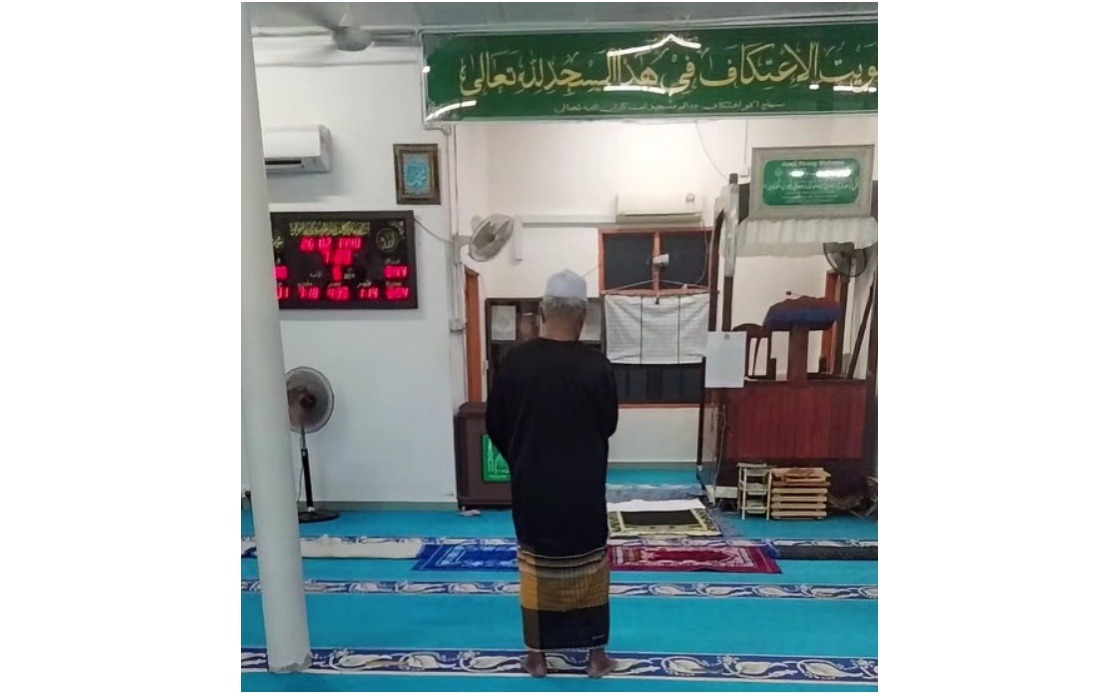
A short video circulating across social media platforms has thrust Masjid Tanjung Resang into unexpected public scrutiny, revealing the quiet struggles facing rural religious institutions as communities shrink and residents migrate to urban centres. The 15-second clip, which spread through Facebook and WhatsApp networks, captured a solitary worshipper in the mosque and prompted commentators to question the facility's management and vitality. Yet local leaders contend the snapshot misrepresents the broader reality of a mosque that continues to serve its community despite the headwinds of depopulation affecting rural Malaysia.
Mersing Member of Parliament Muhammad Islahuddin Abas, himself a village resident, acknowledged that the mosque's attendance challenges reflect deeper demographic currents coursing through Peninsular Malaysia. Many houses dot the Tanjung Resang landscape, but the people who once filled them have dispersed, seeking employment opportunities in cities or relocating permanently to other regions. This pattern of rural-to-urban migration has become endemic across Malaysia, leaving infrastructures like mosques designed for larger congregations to adapt to diminished populations. The exodus represents not a failure of local management but rather the gravitational pull of Malaysia's economic geography, which concentrates jobs and services in metropolitan areas.
Despite these structural challenges, Muhammad Islahuddin emphasised that the mosque's leadership has sustained a consistent programming schedule centred on religious education and community engagement. Weekly activities including religious lectures, Quranic recitation sessions known as Yasin gatherings, and scholarly talks continue as regular fixtures on the mosque's calendar. This continuity demonstrates that mosque officials are committed to maintaining spiritual life in the village even as the congregation's numerical base erodes. The leadership's determination to preserve religious activities underscores a principle central to Malaysian Islamic practice: that houses of worship remain vital community anchors regardless of demographic fluctuations.
The viral video's emergence surprised Muhammad Islahuddin, who received a screenshot of the clip from a friend in Kuala Lumpur via WhatsApp. The fact that the video circulated across state lines and reached him through personal networks highlights how digital communication can amplify localised issues into broader public conversations. The Mersing MP's initial shock at seeing his own constituency mosque become an unexpected social media talking point illustrates the unpredictable nature of viral content and its capacity to place scrutiny on institutions that ordinarily operate outside public consciousness. However, he characterised the incident more constructively as an unintended benefit, noting that the attention, despite its negative framing, had introduced the mosque to people well beyond its immediate geographic sphere.
A significant challenge the mosque faces is its physical isolation from main thoroughfares. Located off principal roads, Masjid Tanjung Resang has remained largely invisible to people passing through the Mersing district, including many local residents unfamiliar with its existence. This geographic obscurity has compounded the challenge of building a robust congregation, as potential worshippers may be unaware the mosque exists at all. Muhammad Islahuddin observed that the viral video, inadvertently, has begun remedying this anonymity by bringing the mosque's name and circumstances to widespread attention. Public awareness, even when born from misunderstanding, can paradoxically serve institutional interests by establishing baseline recognition in communities that had previously overlooked the facility entirely.
Beyond its religious function, the mosque has cultivated a role as a focal point for the broader Tanjung Resang community and visiting populations. Muhammad Islahuddin characterised the facility as welcoming to people of all backgrounds, including non-Muslims, and noted its strategic importance as a rest stop and resource hub for hikers ascending Gunung Arong, a nearby mountain destination. This multifaceted purpose—serving simultaneously as a place of worship, a community gathering space, and a waystation for recreational visitors—reflects how rural mosques in Malaysia increasingly function as multipurpose community infrastructure rather than exclusively religious venues. The provision of amenities for hikers demonstrates an adaptive approach to institutional relevance in regions where tourism and outdoor recreation intersect with traditional religious life.
Mosque chairman Abdul Syamil Abdul Fadzil reported that he had been contacted by a representative from the Johor Islamic Religious Affairs Department (JAINJ) following the video's circulation. Rather than viewing the inquiry as an indictment, Abdul Syamil framed it as an opportunity to clarify the mosque's actual operational status. He explained that the individual visible in the viral footage was performing a voluntary prayer, not constituting an indication of inadequate congregational participation or management dysfunction. This distinction matters considerably: voluntary prayers represent personal devotional practice rather than communal worship, and the video's failure to capture the broader context of the mosque's activities skewed interpretation of a moment that, viewed in isolation, appeared anomalous.
The department's awareness of the Tanjung Resang mosque's circumstances suggests that state-level Islamic governance structures maintain operational knowledge of rural religious institutions and understand the demographic pressures they face. JAINJ's response to the viral video indicates a measured approach focused on fact-finding rather than punitive investigation, reflecting an institutional recognition that attendance fluctuations in rural mosques often stem from structural economic and demographic factors beyond the control of local leaders. This administrative perspective provides important context for understanding how government bodies approach challenges confronting rural Islamic infrastructure across Johor and broader Malaysia.
Abdul Syamil firmly rejected the characterisation implied by the viral video, asserting that the snapshot fundamentally misrepresented the mosque's actual operational reality. Religious activities, he stated, continue to be organised regularly, maintaining the institutional continuity essential to a functioning place of worship. The chairman's insistence on this point reflects the distress that such misrepresentation can cause to communities already grappling with the stresses of demographic decline. For rural communities, viral videos can amplify existing challenges by lending false legitimacy to impressions of institutional failure or abandonment. The mosque's response demonstrates the importance of local leaders actively defending their institutions' reputations against incomplete or misleading digital narratives.
The Tanjung Resang situation illuminates broader tensions within Malaysian religious life as rural communities experience sustained population loss. Mosques represent significant capital investments and remain central to village identity and spiritual infrastructure, yet their viability increasingly depends on whether communities can maintain sufficient congregations to sustain programming and justify ongoing operational expenses. Unlike urban mosques that can draw worshippers from surrounding populations, rural facilities operate with relatively fixed congregational bases. The migration of younger people seeking employment in cities exacerbates this challenge, as age-out effects gradually reduce congregational capacity unless communities develop strategies for attracting external participation or adapting institutional purpose.
The response from both Muhammad Islahuddin and Abdul Syamil suggests that rural mosque leaders across Malaysia would benefit from more proactive communication strategies designed to counteract misrepresentations circulated through social media. The viral video phenomenon has created a new vulnerability for institutions that may lack the digital communication infrastructure or expertise to rapidly respond to negative narratives. Establishing mechanisms for explaining rural institutional challenges to broader publics, highlighting community roles beyond formal worship, and building networks of supporters capable of amplifying accurate information could help other rural mosques navigate similar crises. The Tanjung Resang episode offers a case study in how transparency and community engagement can mitigate damage from misleading digital content.
Looking forward, the Tanjung Resang mosque's experience suggests that rural religious institutions must increasingly view demographic change not as a threat to be passively endured but as a condition requiring active adaptation. Expanding the mosque's functions to serve hikers, tourists, and broader district residents represents one strategy; developing stronger media presence and digital communication capabilities represents another. For Malaysian policymakers, the situation underscores the need for sustained support for rural religious infrastructure even as populations decline, recognising that such facilities represent essential community assets whose value transcends their congregational size. The attention generated by the viral video, despite its origins in misunderstanding, has inadvertently created an opportunity for Masjid Tanjung Resang and institutions like it to articulate their evolving roles within communities experiencing profound demographic transformation.

