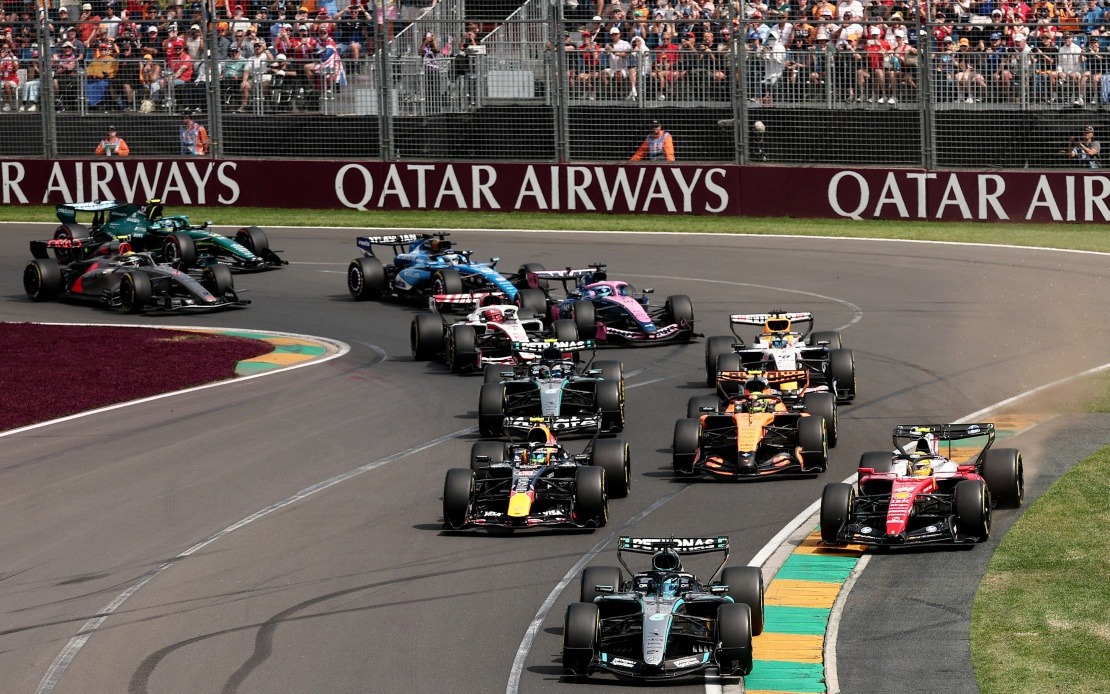
George Russell's championship campaign suffered another setback at Spa-Francorchamps when he retired from Sunday's Belgian Grand Prix, prompting an expletive-laden radio outburst that captures the mounting frustration within the Mercedes camp this season. The driver's anger over a battery deployment malfunction that compromised his performance underscores a pattern of reliability issues threatening to derail what remains of his title fight. With only the Hungarian Grand Prix remaining before the summer break, Russell now trails his teenage teammate Kimi Antonelli by a substantial 50 points after the Italian's sixth victory from ten rounds contested so far.
The technical fault that triggered Russell's frustration originated during the opening lap when his Mercedes experienced an engine glitch that exposed him to pursuing competitors. This initial problem cascaded into a collision with teammate Lewis Hamilton, ultimately ending his race and dashing any realistic hopes of challenging Antonelli's commanding position. Russell's radio transmission, though not broadcast during the live television coverage, revealed the depth of his exasperation as he questioned why his car had lost battery capacity along the Mulsanne-equivalent straight, describing the situation as fundamentally unacceptable and expressing despair about the weekend's overall execution.
The roots of Russell's Spa performance crisis extended beyond the race itself. During qualifying, a deployment anomaly within his power unit left him stranded half a second adrift of Antonelli's benchmark pace. Initially, the Mercedes engineering department suspected Russell's driving technique might explain the discrepancy, attributing the problem to his particular approach through the critical corners. However, this theory quickly collapsed under scrutiny as the engineers themselves acknowledged the fault lay elsewhere, pointing instead to something more systemic within the hybrid power unit architecture. The fact that a professional outfit cannot quickly isolate and explain such a significant performance deficit speaks volumes about the complexity of contemporary Formula 1 power unit management and the challenges Mercedes currently faces.
Russell's emotional state has visibly deteriorated as the season progresses. He acknowledged to his team that mechanical failures and technical setbacks have left him feeling emotionally numb to disappointment, suggesting a weary resignation has set in after months of technical tribulations. His plea that Mercedes engineers discover a solution before Budapest reveals both the urgency of the situation and his dwindling confidence that meaningful improvements will materialise in the limited time remaining. The language Russell employed—raw, unfiltered, and captured in an off-air radio moment—exposes the psychological toll when a competitive driver faces repeated equipment failures beyond his control. For Malaysian and Southeast Asian Formula 1 enthusiasts, Russell's struggle illustrates how technical reliability remains as decisive as driver talent in determining championship outcomes.
Mercedes team principal Toto Wolff's measured response to Russell's outburst acknowledged the emotional dimension whilst simultaneously defending the team's commitment and competence. Wolff characterised Russell's frustration as a natural reaction to difficult circumstances, noting that even elite-level competitors experience challenging periods requiring psychological resilience and team support. Wolff's assertion that he has known Russell for considerable time and understands his character suggests an attempt to contextualise the driver's behaviour as temporary venting rather than fundamental dissatisfaction. The team principal's emphasis that Mercedes remains fully supportive of Russell attempts to project stability despite mounting internal pressures, though his need to provide such assurance hints at the real tension simmering beneath the surface.
Wolff's technical analysis of the power unit issue provides insight into the Byzantine complexity underpinning modern Formula 1 propulsion systems. The Mercedes team principal explained that harvesting and deploying electrical energy represents one of contemporary racing's most challenging engineering disciplines, requiring seamless integration between driver inputs and sophisticated management algorithms. He identified that Russell's power unit exhibited a specific deficiency in energy deployment available at turn 18, the chicane where top teams extract decisive advantages through superior acceleration. Wolff acknowledged this problem accounted for approximately half the qualifying gap separating Russell from Antonelli, suggesting other factors—possibly setup, driving style variations, or circuit conditions—explained the remaining performance differential.
The fortuitous timing of identifying this fault at Spa rather than Budapest holds implications for Mercedes' season trajectory. The high-speed, energy-demanding nature of the Belgian circuit exposed the deployment issue clearly, whereas Budapest's moderate-speed configuration might have masked the problem or made diagnosis significantly more complex. In this context, Wolff's characterisation of the Spa discovery as fortunate, even while acknowledging it provided no immediate relief for Russell, reflects the pragmatic perspective of an experienced team principal focused on future rounds. For Malaysian audiences following the championship, this technical discussion illustrates how contemporary Formula 1 transcends simple driver competition, becoming instead an intricate battle between engineering departments attempting to extract maximum performance from densely regulated technological systems.
Russell's championship situation has transformed dramatically from the season's opening rounds. The existence of a 50-point deficit with several races remaining essentially closes the mathematical door on his title aspirations unless Antonelli experiences a catastrophic collapse or extended mechanical failures. The Italian teenager's six victories from ten races—an extraordinary strike rate suggesting dominant car performance or exceptional driver talent or both—indicate Mercedes possesses the pace necessary to win, yet Russell's inability to consistently translate that machinery into results has become increasingly problematic. Whether Russell's mechanical failures represent bad luck, diminished performance under pressure, or fundamental car setup inadequacies remains subject to interpretation.
The depth of Mercedes' reliability challenges this season carries broader implications for the team's competitive standing. Whereas previous years established Mercedes as Formula 1's benchmark organisation for engineering excellence and operational reliability, this season's persistent power unit issues suggest the new technical regulations may have created unforeseen complexities that have exposed gaps in the German manufacturer's development process. Multiple reliability failures affecting one driver disproportionately raises questions about whether these problems represent team-wide weaknesses or driver-specific setup issues. For regional observers, Mercedes' struggles this season underscore how even the sport's historically dominant organisations cannot guarantee sustained excellence when regulations fundamentally reshape competitive parameters.
Russell's prospects heading into Hungary depend largely on whether Mercedes' engineers can rapidly implement solutions to the energy deployment problem and other related issues that have plagued his weekend at Spa. The final pre-summer race carries heightened significance as the last opportunity to build momentum and psychological confidence before the sport's midseasonal pause. A strong result in Budapest might revitalise Russell's mentality and provide evidence that Mercedes has addressed its technical difficulties. Conversely, another mechanical failure or underperformance relative to Antonelli would solidify the championship's outcome and potentially reshape perceptions of where responsibility lies for Mercedes' season trajectory. For Malaysian Formula 1 followers, Russell's redemption arc or continued decline over the remaining campaign will provide instructive lessons about how championship contests turn on the convergence of mechanical reliability, driver psychology, team support, and fortune.

