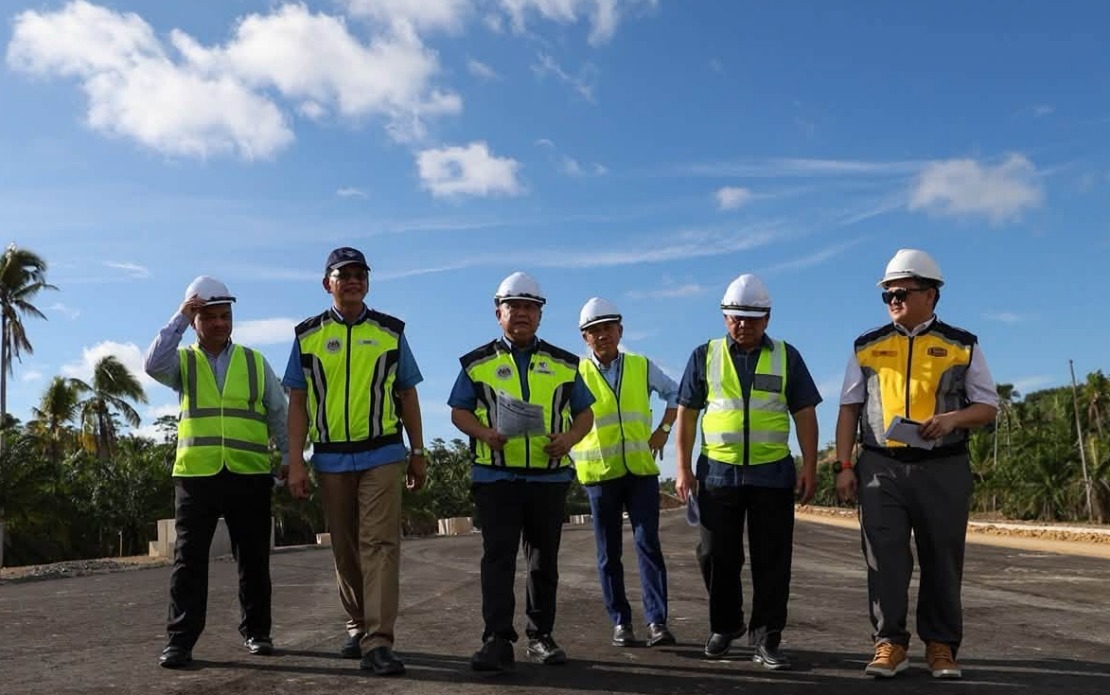
The contractor managing the critical Sabah Pan Borneo Highway Work Package 11 has formally presented a recovery strategy to counter schedule slippage that has accumulated since project commencement. Works Minister Datuk Seri Alexander Nanta Linggi confirmed that the remedial measures target completion within the contractual window ending September 29, 2026, despite the section currently running behind its original timeline.
The 7.3-kilometre Rampayan Laut-Sarang alignment segment, valued at RM167.48 million, had reached 61.76 per cent physical completion as of late June. However, this progress lagged approximately 4.35 per cent behind the baseline schedule, translating to a 32-day shortfall that authorities now seek to narrow. The recovery plan represents a coordinated effort between the Works Ministry, Sabah Public Works Department, project consultants, and the contractor to realign execution with milestones.
The recovery strategy is deliberately calibrated to reduce accumulated delays to merely 14 days by August 2026, effectively clawing back the majority of lost time before the final completion target. This phased approach acknowledges current constraints while establishing realistic interim checkpoints for performance verification. The Ministry's commitment to close oversight demonstrates awareness that infrastructure delays in Sabah carry broader regional implications for connectivity and economic development.
Utility coordination has emerged as the primary impediment to maintaining schedule velocity. Challenges in relocating existing infrastructure involving Sabah Electricity Sdn Bhd, the Sabah State Water Department, and Celcom Timur Sabah Sdn Bhd have created bottlenecks that restricted on-site construction progress. These utility-related complications are not unique to this project but reflect systemic coordination issues common across major infrastructure undertakings in Malaysia, where multiple service providers often operate with insufficient integration of planning timelines.
Land acquisition difficulties compound the schedule pressures, introducing legal and administrative dimensions beyond purely technical construction variables. Such impediments highlight why infrastructure megaprojects require elevated stakeholder coordination at planning stages. The Minister's emphasis on proactive, integrated problem-solving suggests recognition that siloed approaches to utility relocation and land matters simply cannot deliver the acceleration necessary for major highway segments.
Beyond the immediate completion objective, the Rampayan Laut-Sarang alignment carries substantial strategic value for northern Sabah. Once operational, the route will deliver a safer and materially more efficient alternative for travellers heading toward Simpang Mengayau and Kudat, potentially reducing journey distances by up to 30 kilometres. This geometric advantage translates into time savings of 30 to 60 minutes, fundamentally altering travel economics and accessibility patterns across the region.
The infrastructure completion will unlock capacity within the Tourism Belt and the Northern Sabah Coastal Tourism Master Plan, a development corridor that remains significantly underpenetrated relative to its resource and natural heritage potential. Improved connectivity typically catalyses broader economic activation through reduced logistics costs, enhanced market access, and expanded service provision to previously peripheral communities. This alignment therefore represents more than incremental capacity expansion; it functions as an enabler of regional economic restructuring.
The projected employment and investment stimulus from improved infrastructure connectivity aligns with established economic development theory emphasizing transportation networks as foundational to opportunity creation. For northern Sabah communities, the highway completion promises indirect benefits through multiplier effects across tourism, trade, and service sectors. However, realising these benefits depends critically on executing the recovery plan successfully, converting schedule commitments into tangible completion within the stated 2026 timeframe.
Minister Nanta's framing of the project transcends technical delivery metrics by explicitly linking infrastructure quality, safety, and integrity to community wellbeing. This positioning acknowledges that major public works carry legitimacy dimensions extending beyond contractual compliance. For Sabah residents, the highway represents an investment in provincial connectivity that influences long-term livelihood prospects and regional positioning within broader Malaysian economic geography.
The recovery plan submission marks a crucial inflection point where coordination theory becomes operational reality. Success requires sustained discipline from utility providers, streamlined land acquisition procedures, and contractor resource deployment sufficient to absorb the identified delays. Conversely, failure to execute the recovery plan threatens not merely a single project deadline but broader confidence in infrastructure delivery capability across Sabah and the wider Pan-Borneo initiative.
The work package represents one component of the Pan-Borneo Highway, a multi-year initiative spanning multiple states with complex coordination requirements across Sabah, Sarawak, and federal agencies. Experience with Work Package 11 delays and recovery strategies offers broader lessons for optimising implementation of remaining corridor segments and future megaprojects across Malaysian Borneo. Enhanced utility coordination protocols and more integrated land acquisition planning could substantially mitigate similar delays in parallel projects.
Stakeholder alignment on the September 2026 completion date reflects consensus that current delays remain manageable if recovery measures receive consistent resourcing and institutional support. The involvement of multiple government entities—Works Ministry, state public works departments, and project consultants—indicates official recognition that single-agency approaches cannot resolve utility coordination and land acquisition complexities that fundamentally constrain construction pace.

