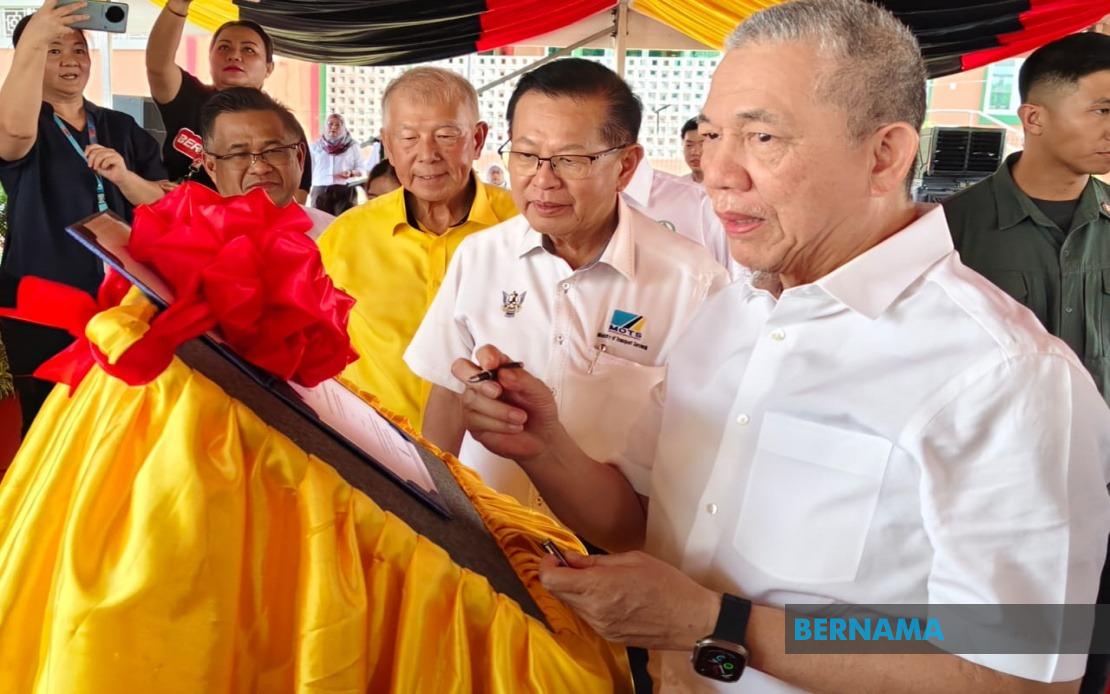
Deputy Prime Minister Datuk Seri Fadillah Yusof has announced that Sarawak will receive 52 infrastructure projects under the Cakna MADANI Programme this year, representing a RM9.46 million commitment to combat the twin challenges of coastal and riverbank erosion while strengthening defences against seasonal flooding that regularly threatens communities across the state.
The programme's progress reflects varying stages of implementation across the state. Twelve initiatives have been completed, providing immediate relief to vulnerable areas, while 13 additional projects are actively under construction. A substantial portion—27 projects—remain in the pre-implementation phase, suggesting a pipeline of work designed to address erosion and flood hazards systematically over the coming years. Fadillah, who doubles as Energy Transition and Water Transformation Minister, made the announcement during a site visit in Miri, where he inspected ongoing mitigation efforts firsthand.
The deputy prime minister highlighted a specific project in Miri as exemplary of the programme's scope. The Riverbank Stabilisation Project at the Tab Cinaq Cemetery in Miri District, budgeted at RM134,682, represents targeted intervention in areas where erosion directly jeopardizes community infrastructure and burial grounds. Construction commenced in May and is scheduled for completion by November, involving the installation of a 50-metre retaining wall. This engineering solution addresses multiple objectives simultaneously: stabilizing the deteriorating riverbank, halting active erosion processes, and protecting both the cemetery and surrounding residential and commercial infrastructure from further degradation.
Sarawak's vulnerability to environmental hazards extends well beyond these 52 smaller-scale Cakna MADANI initiatives. The state faces formidable long-term flooding and erosion challenges that demand substantially larger investments in comprehensive infrastructure. To this end, 29 major flood mitigation projects have secured approval across Sarawak with a combined budget of RM3.834 billion—a figure that underscores the scale and urgency of hydrological management in the state.
The breakdown of these 29 larger projects reveals a balance between consolidating existing efforts and launching new interventions. Eighteen projects represent continuations of ongoing work, collectively budgeted at RM3.567 billion and reflecting multi-year commitments to long-term water management. Meanwhile, 11 new projects, costing RM267 million, expand the portfolio of protective measures. These initiatives encompass the formal Flood Mitigation Plan (RTB), High Priority Flood Mitigation (TBBT) schemes, specialized coastal erosion mitigation works, and river conservation efforts. Together, they form an integrated approach to managing water-related risks across Sarawak's diverse geography.
Among the continuation projects, the RTB Sungai Miri exemplifies the long-duration commitments required for meaningful flood management. This project, valued at RM31 million, commenced construction in October 2023 and has achieved 58.11 per cent physical progress. Completion is not anticipated until November 2026—a timeline that reflects both the complexity of large-scale infrastructure work and the deliberate pace required when modifying riverine systems to enhance flood resilience.
For Malaysian and Southeast Asian observers, Sarawak's investment strategy carries broader significance. The state's commitment to flood and erosion mitigation signals recognition that climate variability and urbanization have amplified hydrological risks across the region. Sarawak's experience—marked by recurring seasonal flooding and accelerating erosion in certain districts—mirrors challenges faced by other Southeast Asian jurisdictions, particularly those with extensive coastlines and river systems vulnerable to monsoon rains and tidal influences.
The integration of smaller community-level projects like the Tab Cinaq stabilisation work with massive state-wide programmes demonstrates differentiated policy response. Cakna MADANI addresses acute, localized threats where erosion or flooding directly endangers specific communities and essential infrastructure. The larger RTB and TBBT frameworks, by contrast, tackle systemic hydrological management across entire river basins and coastal zones. This layered approach acknowledges that environmental hazards operate at multiple scales and require simultaneously targeted and comprehensive responses.
Sarawak's capital expenditure on flood and erosion mitigation—approaching RM3.9 billion when combining all approved projects—positions the state among Malaysia's most substantial investors in climate adaptation infrastructure. For policymakers across Southeast Asia grappling with similar environmental pressures, Sarawak's model illustrates how sustained, multi-billion-ringgit commitments translate environmental risk reduction into tangible protection for population centers and economic assets. The visibility afforded by high-profile ministerial site visits, as demonstrated by Fadillah's Miri inspection, also reinforces political accountability for project delivery and outcomes, a consideration increasingly important as public expectations for infrastructure quality and timely completion intensify across the region.

