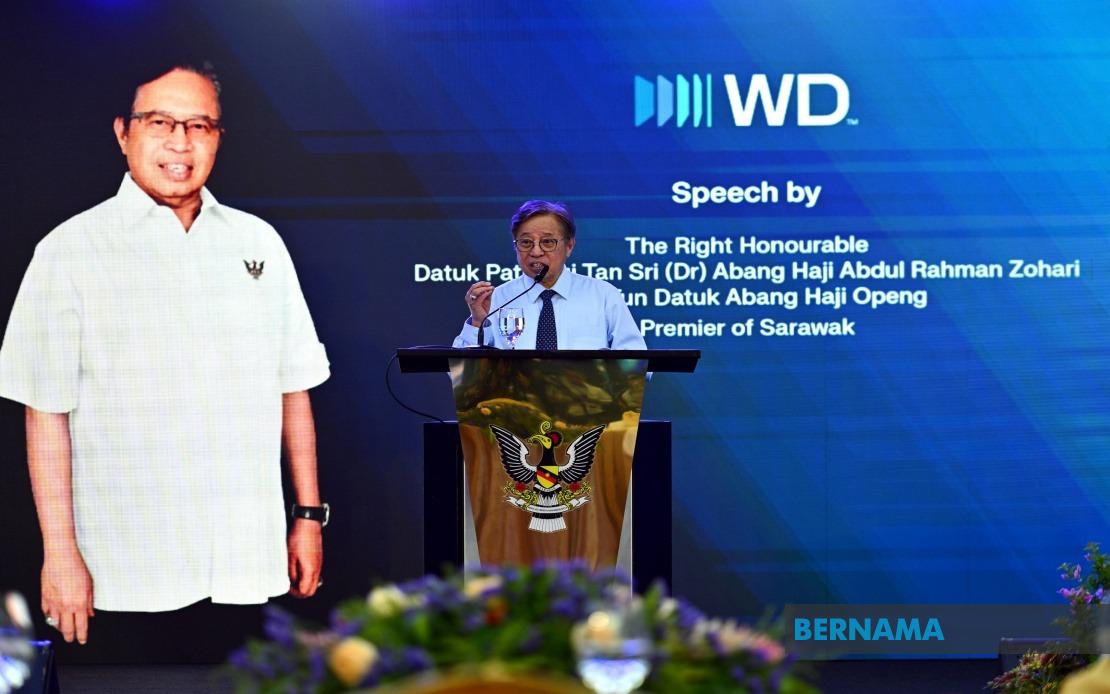
Sarawak's leadership has adopted a pragmatic stance toward potential increases to its constitutional special grant, signalling openness to higher allocations while remaining cognisant of federal budgetary constraints. Premier Tan Sri Abang Johari Tun Openg expressed this measured optimism when commenting on negotiations with Kuala Lumpur, noting that any expansion of Sarawak's entitlements should align with the Federal Government's actual capacity to deliver such improvements. His remarks reflect a delicate balance between advocating for the state's interests under the Malaysia Agreement 1963 and maintaining a workable relationship with Prime Minister Datuk Seri Anwar Ibrahim's administration.
The special grant in question operates under Article 112D of the Federal Constitution, a mechanism that has long been a significant component of Sarawak's fiscal relationship with the centre. During a recent in-state meeting with Anwar in Bintulu, the matter surfaced in general conversation, though neither side has yet engaged in substantive negotiations on specific figures or implementation timelines. Abang Johari's characterisation of these discussions as preliminary reflects the nascent stage of what could develop into formal negotiations, particularly as Sarawak continues to strengthen its political positioning within Malaysia's federal framework.
The Premier's conditional support carries particular weight given Sarawak's historical assertion of autonomy and distinct constitutional standing. The state, as a signatory to MA63, has long maintained that certain powers and financial arrangements warrant differential treatment compared to peninsular states. By framing his response around federal financial capacity rather than an absolute entitlement, Abang Johari has positioned Sarawak as a reasonable interlocutor—a stance that may enhance his leverage in future discussions whilst avoiding the appearance of intransigence that could sour his administration's ties with Putrajaya.
Meanwhile, Prime Minister Anwar's recent parliamentary statement that special grant negotiations remain active underscores the federal government's acknowledgement of this constitutional obligation. The timing of these discussions occurs within a broader context of Malaysia's fiscal management, where the government balances infrastructural development, social spending, and deficit reduction. For Sarawak, any increment would represent recognition of evolving economic needs and the state's growing strategic importance to national development objectives.
The Premier's comments were delivered during his attendance at the New Horizon for Western Digital Sarawak programme, an occasion that highlighted the state's emergence as a hub for advanced technology manufacturing. Western Digital's decades-long partnership with Sarawak, spanning approximately three decades, demonstrates how the region has positioned itself as an attractive location for high-value industrial investment. This context matters significantly for the special grant discussion, as Sarawak's economic trajectory—increasingly oriented toward technology and data storage rather than conventional resource extraction—arguably strengthens its case for enhanced federal support.
Abang Johari articulated a forward-looking vision in which data storage and artificial intelligence infrastructure represent critical pillars of Sarawak's economic future. The state's abundant renewable energy capacity and substantial water resources provide natural competitive advantages for data centres and related facilities, which are notoriously energy-intensive operations. Glass substrate technology, the next-generation recording medium that Western Digital is developing in Sarawak, exemplifies how the state is diversifying beyond traditional sectors and positioning itself for long-term prosperity in the digital economy.
The Premier's assertion that data will eventually surpass petroleum in value carries implications extending beyond Sarawak's borders. This perspective aligns with global economic trends and suggests that Malaysian policymakers increasingly recognise the necessity of transitioning away from hydrocarbon dependency. For a state that has historically relied heavily on petroleum revenue, the deliberate pivot toward technology-driven industries represents a strategic recalibration that should resonate positively with federal planners concerned about Malaysia's long-term competitiveness in an increasingly digital world.
Sarawak's advantages in attracting technology investors stem from more than natural endowments. The state government's evident commitment to establishing a conducive investment climate, coupled with political stability under consistent leadership, has fostered confidence among multinational corporations seeking reliable long-term operational bases. Western Digital's willingness to expand its Sarawak footprint through glass substrate development reflects this institutional confidence and demonstrates tangible returns from the state's development strategy.
The broader implications for federal-state relations merit examination. Sarawak's measured approach to the special grant question—accepting rather than demanding, understanding rather than confrontational—establishes a template for constructive negotiation that could benefit both the state and the federal government. By anchoring its request in economic rationality and demonstrating how increased federal investment translates into national competitive advantage, Abang Johari has reframed what could otherwise appear as a parochial demand into a matter of systemic economic interest.
For Malaysian observers tracking the evolution of centre-state relations in the post-GE15 political environment, these developments warrant attention. The manner in which Kuala Lumpur responds to Sarawak's special grant aspirations will signal whether the federal government genuinely prioritises regional development and constitutional recognition of state interests, or whether fiscal pressures ultimately supersede commitments to differential arrangements. Similarly, the degree to which Sarawak successfully leverages its technology sector expansion as justification for enhanced federal support may establish precedents for how other states approach resource allocation discussions with Putrajaya in coming years.

