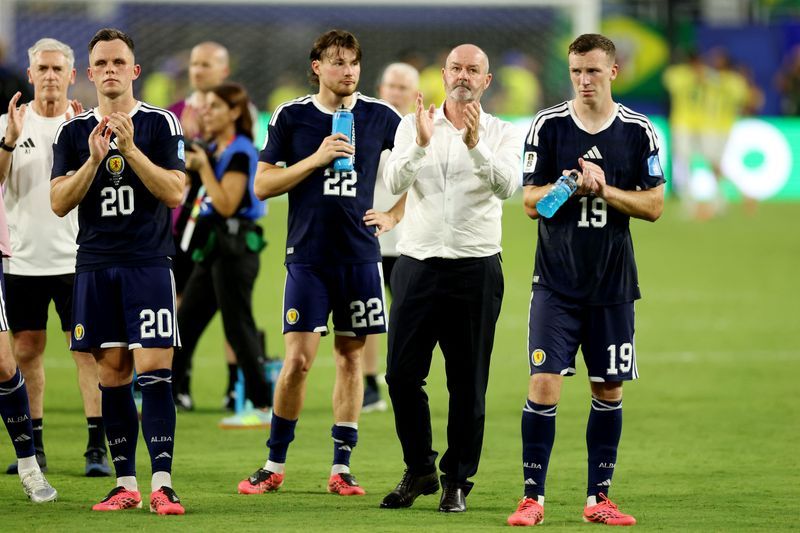
Scotland's return to the World Cup stage after a 28-year absence appears destined to end in disappointment, with manager Steve Clarke conceding that his team's heavily one-sided 3-0 defeat to Brazil on Wednesday has likely sealed their premature departure from the tournament. Despite still possessing a mathematical path to the knockout rounds as one of eight third-placed teams advancing across the 12 groups, Clarke's pessimistic assessment reflects the gulf in class that emerged at the Miami venue. With three points accumulated so far, Scotland currently sits with the sixth-best record among potential third-place finishers, but Clarke's candid analysis suggests that margin will quickly evaporate once the remaining group matches conclude.
The Scotland manager pulled no punches in dissecting what went wrong against Brazil, attributing most of the damage to his own players' shortcomings rather than superior opposition brilliance. Clarke acknowledged that Brazil's clinical finishing and attacking prowess exploited defensive vulnerabilities that Scotland gifted them throughout the match. He was particularly critical of how his defence made Brazil's task straightforward, essentially presenting the South American powerhouses with opportunities they were always likely to convert. This acknowledgment demonstrates Clarke's no-nonsense approach to accountability—rather than finding refuge in excuses about Brazil's quality, he pointed directly at his team's preventable errors.
While acknowledging Brazil's destructive capacity in the attacking third, Clarke emphasised that Scotland contributed significantly to their own downfall by making poor decisions under pressure. He noted that the Seleção capitalised on the first and second goals through errors initiated by the Scots themselves, with the third goal similarly stemming from lapses in concentration or positioning. However, Clarke also credited goalkeeper Angus Gunn for producing several important saves that could have worsened the scoreline, suggesting Brazil created more chances than they ultimately converted. On the flip side, Scotland's attacking contribution proved negligible, with the manager conceding they created just one or two presentable opportunities but never fashioned a clear-cut opening.
Despite the bitter nature of the loss, Clarke maintained a measured tone regarding his players' overall commitment and character. He explicitly stated he was not angry with the squad that had engineered Scotland's qualification—a qualification that represented a significant achievement given the country's decades of World Cup absence. Instead, Clarke framed his disappointment through the lens of unfulfilled potential, suggesting the players possess capabilities they failed to demonstrate against Brazil. This distinction matters for the wider Scottish football community, signalling that Clarke's criticism is constructive rather than personal, focused on performance management rather than dressing room conflict.
The Scotland manager's comments reveal deeper anxieties about the current state of Scottish football development and competitiveness at the elite level. Having witnessed both Morocco and Brazil up close during this tournament, Clarke identified concerning disparities in physicality, power, and technical proficiency that Scottish players currently cannot match. These observations struck at the heart of structural problems within Scottish football, prompting Clarke to argue that the national system must fundamentally improve its approach to developing young talent capable of competing on the world stage. This critique extends beyond a single tournament or campaign, suggesting systemic investments in youth development, coaching standards, and technical infrastructure are required.
Clark's analysis implies that Scotland's player development pipeline is producing athletes who can achieve qualification successes but lack the individual quality to compete meaningfully once elite opponents are encountered. The contrast between the achievement of reaching a World Cup after 28 years and the inability to stay competitive once there highlights a critical gap in Scottish football. Countries like Morocco and Brazil, which Scotland faced in their group, demonstrate how consistent investment in youth systems translates to the kind of physical attributes, technical proficiency, and tactical intelligence required at the highest level. Clarke's implicit message to Scottish football authorities is that qualifying is no longer sufficient—the system must evolve to ensure competitive performances once qualification is achieved.
Throughout his post-match commentary, Clarke repeatedly emphasised respect for the Tartan Army, the famously passionate Scottish supporters who travelled to the United States for the tournament. He acknowledged their contribution to the atmosphere and their role as ambassadors for Scotland on the global stage. Yet Clarke delivered a subtle but important reminder: the fans' presence in America, and the country's participation in the tournament itself, existed solely because the current squad had qualified. This point carried particular weight given Scotland's previous World Cup absence since France 1998, a quarter-century gap that made this qualification a genuine accomplishment.
Clark's framing of the relationship between players and supporters served another purpose—contextualising the achievement of qualification within Scotland's football culture. For decades, Scottish supporters have watched World Cups without their country represented, confined to watching from home as other nations competed. This tournament represented an opportunity to reclaim that participation, and Clarke ensured that the narrative did not become purely negative. While the performance against Brazil disappointed, Clarke insisted the players deserved recognition for delivering the prerequisite qualification that enabled the entire nation to participate. This balanced perspective acknowledged both the ultimate failure to progress further and the genuine accomplishment that preceded it.
The implications of Scotland's apparent exit extend beyond the immediate tournament. With multiple group matches still pending across the competition, other third-place finishers with three points will compete for the eight available knockout spots. Clarke's assessment that Scotland will be overtaken by at least two other teams suggests a relatively pessimistic view of potential positive results elsewhere in the competition benefiting the Scots. This perspective reflects the mathematical reality that several groups remain incomplete, and various combinations of results could still alter the third-place equation. Nevertheless, Clarke's pragmatic stance suggests he has already mentally moved past the tournament, focusing instead on the broader implications for Scottish football development.
For Malaysia and Southeast Asian observers of international football, Scotland's predicament offers instructive lessons about the distance between qualification achievement and competitive performance at World Cups. Teams across the region harbouring World Cup ambitions should note that simply reaching tournaments requires sustained investment and performance, but remaining competitive once there demands something additional—a development infrastructure that produces technically proficient, physically imposing players capable of matching elite opponents. Scotland's experience demonstrates that decades of World Cup absence can be reversed through effective qualification campaigns, yet suggests that building sustainable competitiveness requires deeper structural reforms than tactical adjustments alone can address.
Looking forward, Clarke faces significant questions about the future direction of Scottish football and his own role within it. The immediate task involves assessing whether remaining group matches offer any realistic path to progression, though Clarke's demeanour suggests acceptance of the likely outcome. Beyond the tournament, the conversation in Scottish football will inevitably turn to whether the systems producing players have adequately equipped them for success at the world's premier competition. Clarke's honest diagnosis of structural weaknesses provides a foundation for that discussion, suggesting that comprehensive reform rather than marginal improvement is required if Scotland hopes to transform future World Cup participations into genuinely competitive campaigns rather than brief, disappointing returns to the global stage.

