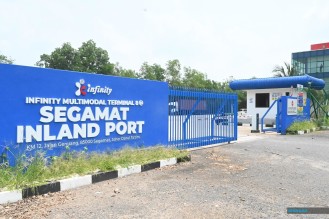
Segamat Inland Port (SIP), dormant for over a decade, is charting an ambitious recovery trajectory with a target to process more than 6,000 twenty-foot equivalent units (TEUs) of containerised and bulk cargo before December. The facility, which resumed full operations in late June under operator Infinity Logistics & Transport, has already managed approximately 1,000 TEUs during its first month of activity, signalling renewed interest in rail-based logistics for the broader corridor spanning northern Johor, southern Pahang, southern Negeri Sembilan and Melaka.
Samuel Ho, manager of the reactivated facility, attributes the port's resurgence to a fundamental shift in transport philosophy. Malaysia's Road to Rail initiative, developed collaboratively with national railway operator Keretapi Tanah Melayu Bhd, has positioned inland rail ports as critical infrastructure for economic development beyond traditional coastal gateways. The reactivation represents more than a business decision—it reflects a strategic pivot rooted in both economic efficiency and public safety considerations. Rail freight inherently offers superior safety profiles compared to road transport, eliminating exposure to vehicle accidents and mitigating delays created by persistent road congestion in Malaysia's increasingly strained highway corridors.
The environmental and operational mathematics underlying the freight shift are compelling. A single cargo train journey displaces approximately eighty container truck movements, dramatically reducing diesel consumption while lowering the carbon footprint of regional supply chains. For a country managing escalating urban congestion and air quality concerns, this displacement represents meaningful progress toward sustainable logistics. The transition also addresses a historical constraint that had plagued SIP's original iteration: single-track railway operations that forced freight schedules to yield priority to passenger services, rendering the facility operationally impractical.
Completion of double-tracking infrastructure extending to Johor has fundamentally altered SIP's operational flexibility. Where the facility previously managed approximately one cargo receiving or dispatch cycle weekly, it now accommodates up to four such operations per week—a fourfold increase that reflects genuine transformation rather than marginal improvement. This expanded capacity draws directly from major port hubs including Port Klang, Port of Tanjung Pelepas, and Johor Port in Pasir Gudang, creating a robust trunk route for containerised trade that previously depended entirely on trucking networks.
The port's economic footprint extends beyond container metrics. Operating across 20.23 hectares in its initial development phase, SIP has already generated employment for over 200 local residents, with projections suggesting substantial job creation will accelerate as the facility progresses through its planned three-phase expansion. Employment opportunities span security, logistics operations, and warehouse management—sectors critical to northern Johor's economic diversification. Ho envisions the port functioning as an economic magnet, attracting manufacturing and distribution enterprises to surrounding industrial areas by offering direct rail connectivity to major trade corridors. Districts including Batu Pahat and Kluang stand positioned to benefit from this infrastructure-led development strategy.
Academic partnerships underscore the facility's broader significance. Collaboration with Universiti Tun Hussein Onn Malaysia (UTHM) includes fieldwork exposure and research initiatives, positioning SIP as both operational facility and educational platform. This approach ensures knowledge transfer regarding rail-based inland port management while building regional expertise in logistics innovation—a capability increasingly valuable as Southeast Asian trade networks evolve.
Transport Minister Anthony Loke Siew Fook, who officially launched the reactivated facility in June 2026, emphasised SIP's catalytic potential for northern Johor's economic trajectory. His remarks highlighted the port's role in strengthening the nation's integrated logistics ecosystem while enhancing supply chain efficiency at a time when Malaysia faces mounting pressure to optimise transport infrastructure investments. The minister's vision aligned with Ho's operational strategy: positioning inland rail ports as correctives to road-dependent logistics that have become increasingly congested and economically inefficient.
Projected traffic displacement illustrates the scale of the intervention. SIP operations are expected to reduce approximately 18,000 monthly lorry movements—encompassing both trailers and container trucks—from Malaysian roads. This reduction translates directly into improved road safety, diminished congestion on critical commercial corridors, and optimised utilisation of rail assets that previously underperformed. For regions where truck traffic dominates regional highways, this rebalancing offers genuine relief.
The port's trajectory also reflects broader Southeast Asian logistics trends. Regional supply chains increasingly demand inland connectivity and rail-based options as congestion at coastal ports intensifies and road transport becomes less economically viable. Malaysia's positioning as a regional trade hub depends partly on maintaining competitive logistics costs; inland rail ports represent a mechanism for preserving that advantage. SIP's success or failure will thus influence whether comparable facilities across the region receive comparable investment and policy support.
From a Malaysian perspective, the facility embodies the practical challenge of revitalising underutilised infrastructure. SIP's original 1997 establishment yielded limited adoption, illustrating how inadequate rail networks and operational constraints can undermine even well-intentioned infrastructure. The double-tracking completion and reactivation demonstrate that persistent constraints can be addressed through sustained investment and policy alignment. This lesson extends beyond SIP to broader questions about Malaysia's rail freight potential, particularly as the nation seeks to reduce logistics costs and environmental impacts.
The 6,000 TEU target for 2026, while ambitious given the June restart, remains achievable based on early throughput patterns and the pent-up demand from northern Johor industries seeking efficient rail alternatives. Success will depend on sustaining customer relationships, maintaining operational reliability, and leveraging the port's improved scheduling flexibility. Achievement would validate the Rail to Road initiative's foundational logic and potentially accelerate approval for comparable inland port developments elsewhere across Peninsular Malaysia.

