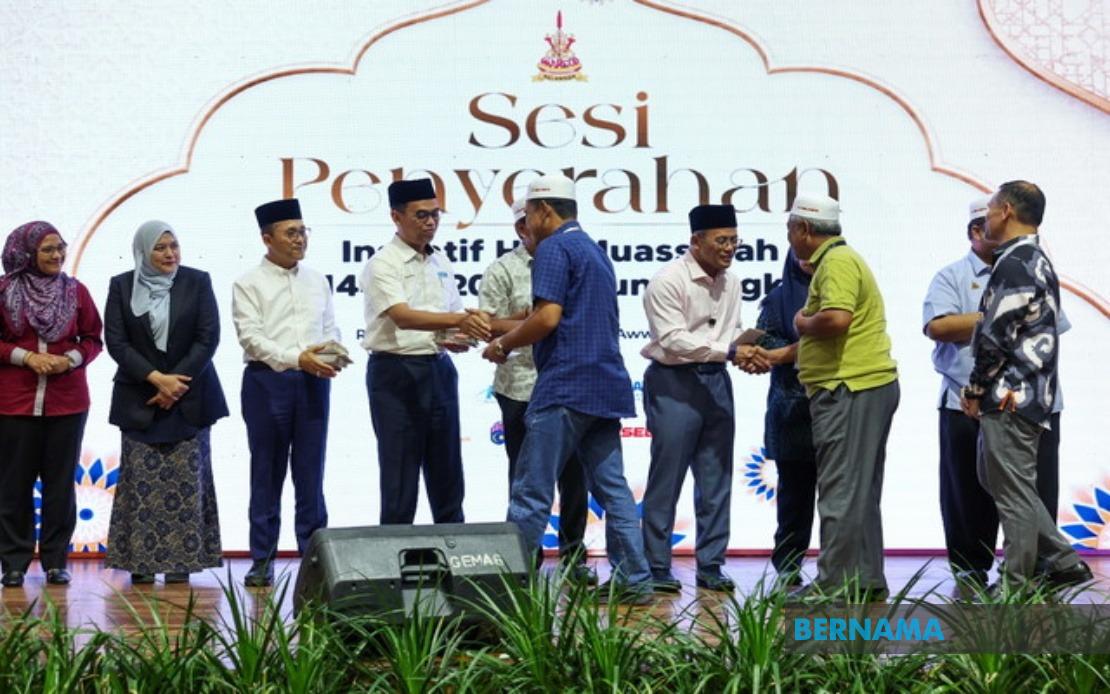
Selangor's state government is on track to complete distribution of its Muassasah Haj Incentive Programme by September, having already channelled assistance to 4,800 of the scheme's 6,000 intended beneficiaries. Menteri Besar Datuk Seri Amirudin Shari outlined the disbursement progress during a contribution presentation ceremony in Puchong, where he reiterated the administration's commitment to supporting Muslim pilgrims preparing for the annual Islamic pilgrimage.
The initiative, funded through the Selangor Menteri Besar Incorporated Foundation (Yayasan MBI) with an allocation of RM9 million, represents a significant welfare undertaking for the state. Each recipient receives RM1,500 to defray the substantial costs associated with Haj preparation, spanning religious equipment, prescribed medications, appropriate clothing, and other essential items for the journey to Makkah. This financial backing acknowledges the economic burden placed on individual families when undertaking the pilgrimage, one of Islam's five pillars.
The remaining cohort of slightly over 1,000 recipients is currently undergoing identification and contact procedures to facilitate final disbursement. State officials expressed confidence that administrative delays would not impede the September deadline, indicating that verification processes and tracking of eligible recipients were proceeding methodically. The Dengkil state constituency ceremony, attended by 259 recipients and featuring Deputy Housing and Local Government Minister Datuk Aiman Athirah Sabu, formed part of a broader outreach programme spanning constituencies throughout Selangor.
The programme's design reflects evolving policy considerations within Malaysia's most economically developed state. By targeting religious observance and pilgrimage participation, Selangor's government signals recognition that financial constraints frequently prevent eligible Muslims from fulfilling this religious obligation. The RM1,500 assistance, while modest relative to total Haj expenses ranging from RM10,000 to RM15,000, meaningfully reduces the barrier to participation for lower-income households and pensioners.
Looking ahead, state leadership has articulated ambitions to expand the scheme's generosity. Amirudin indicated that increasing the per-recipient allocation to RM2,000 represents a medium-term objective, potentially achievable by 2027 or 2028 depending on fiscal performance and budgetary circumstances. This phased approach acknowledges the tension between expanding welfare coverage and maintaining fiscal discipline—a consideration particularly pertinent to state governments managing competing demands across education, healthcare, and infrastructure sectors.
The conditional framing of future enhancement reveals pragmatic governance thinking. Rather than committing to unaffordable pledges, Selangor's administration grounds expansion plans in realistic assessments of revenue capacity and potential economic headwinds. The statement that "we cannot promise everything because we may suddenly face financial constraints" reflects learning from global economic volatility, including supply chain disruptions, inflation pressures, and commodity price fluctuations affecting state revenue streams.
For Malaysian pilgrims and their families, the scheme addresses a genuine hardship point in the Haj journey. Airfare, accommodation, visa processing, and mandatory health screenings consume substantial household resources. Religious equipment including ihram garments, prayer mats, and guided spiritual texts, while individually inexpensive, accumulate quickly. Medications—particularly for elderly pilgrims managing chronic conditions—represent an unexpected expense many inadequately budget for. Selangor's targeted assistance acknowledges these concrete needs rather than operating through purely symbolic gestures.
The programme's scale and execution offer lessons for other Malaysian states. With 6,000 beneficiaries across Selangor's constituent areas, the initiative reaches a demographically significant population segment whilst remaining administratively manageable. The geographic distribution across constituencies suggests sensitivity to equitable coverage, avoiding concentration of benefits in urban or politically favourable regions. Other state governments facing similar religious welfare obligations might examine Selangor's framework as a model, adapting allocation levels and recipient numbers to local fiscal capacities.
The timing of this announcement, during the Islamic calendar period preceding the 2026 Haj season, reflects strategic communication intent. By publicising disbursement progress and articulating future enhancement goals, Selangor's government reinforces messaging around religious commitment and welfare consciousness ahead of periodic electoral considerations. The visible participation of federal legislators including a deputy minister amplifies the announcement's reach whilst signalling cross-level government cooperation on Islamic affairs.
From a Southeast Asian perspective, Selangor's approach distinguishes Malaysian Islamic governance from neighbouring approaches. While Brunei and Indonesia maintain state-supported Haj facilitation systems, Malaysia's decentralised federalism allows states considerable latitude in designing supplementary assistance. This permits policy experimentation and adaptation to local economic conditions—an advantage when national-level resources prove insufficient for comprehensive support.
The programme's success hinges on effective implementation infrastructure. Verification systems must accurately identify eligible residents, process applications efficiently, and maintain records preventing duplication whilst ensuring no deserving applicant falls through administrative gaps. The mention of "identifying and contacting" remaining recipients suggests potential challenges in reaching all beneficiaries, possibly reflecting residential mobility, communication difficulties, or documentation gaps among lower-income populations.
Moving beyond immediate disbursement mechanics, the Muassasah Haj Incentive Programme reflects broader Selangor policy positioning within Malaysia's religious governance landscape. By coupling financial assistance with ceremonial presentation events highlighting recipient stories and administrative efficiency, the state constructs narratives around effective governance and religious stewardship. These narratives hold particular salience in Selangor, where electoral competition between competing political coalitions frequently hinges on credible claims regarding social welfare delivery and religious sensitivity.
As Malaysia navigates post-pandemic economic recovery and inflation management, state-level religious assistance schemes take on heightened significance for vulnerable households. The Selangor initiative, though modest in per-capita terms, represents tangible state recognition that religious observance and economic participation need not remain mutually exclusive for lower-income citizens. The commitment to subsequent enhancements, conditional as it may be, signals that religious welfare considerations will persist within the state's policy calculus as financial circumstances permit.

