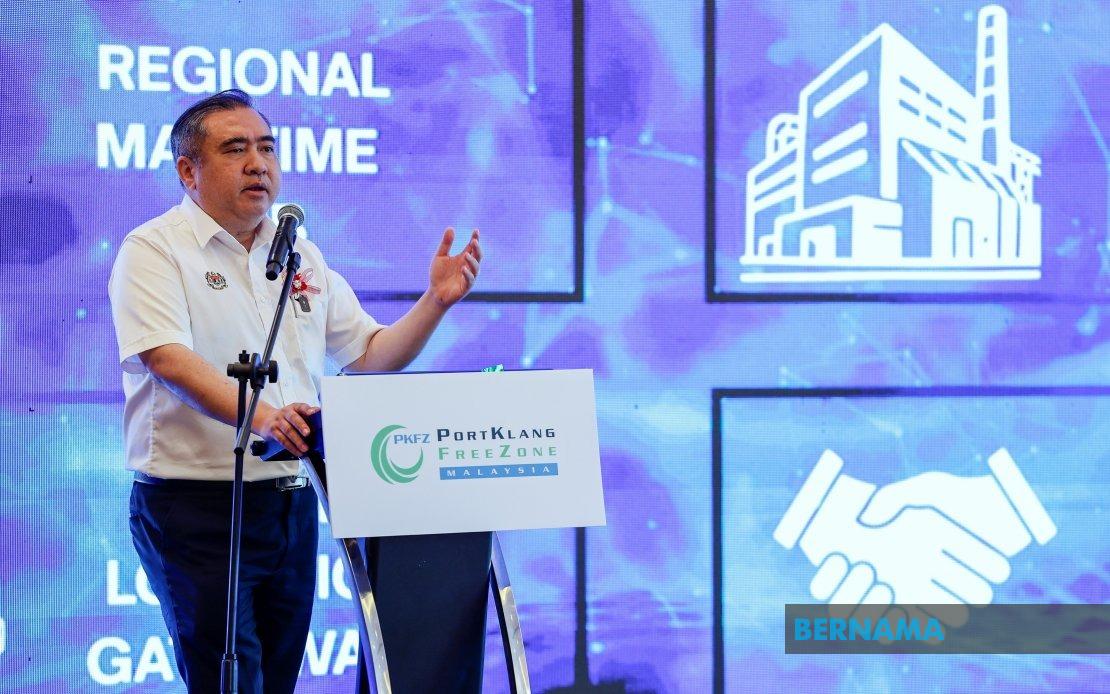
The Selangor State Government is pressing ahead with efforts to clear property ownership complications that have held back development of the Port Klang Third Terminal on Carey Island, signalling progress on one of Malaysia's most strategically important infrastructure undertakings. Transport Minister Anthony Loke confirmed that resolving the land question represents the immediate priority before construction can commence, with the process now being coordinated between state authorities, federal agencies, and private developers operating under a concession framework.
Loke's remarks came during a series of industrial facility openings at Port Klang Free Zone, where multiple manufacturing ventures representing RM566 million in fresh investment were unveiled. The minister indicated that authorities remain hopeful about initiating construction activities within the current calendar year, provided the property matter reaches satisfactory conclusion. The undertaking will follow a Build-Operate-Transfer arrangement, a structure that allows private operators to recoup investment over a specified period before surrendering control to the government.
The significance of Port Klang's third container terminal extends beyond mere port expansion. As Malaysia's primary maritime gateway handling over 13 million twenty-foot equivalent units annually, capacity constraints increasingly threaten the nation's competitiveness in regional trade. The new facility would substantially augment handling capacity while positioning Malaysia more favourably against neighbouring hubs like Singapore and regional competitors emerging throughout the ASEAN region. Prime Minister Datuk Seri Anwar Ibrahim had previously directed all responsible agencies to accelerate implementation, underscoring the project's centrality to national economic strategy.
The land assembly challenge involves multiple stakeholder interests across approximately 1,699.68 hectares earmarked for development on Pulau Carey within Kuala Langat district. According to Selangor Menteri Besar Datuk Seri Amirudin Shari's earlier disclosure, the footprint comprises 1,011.71 hectares of submerged seabed territory administered through the Selangor State Development Corporation, alongside 687.96 hectares of terrestrial coastal acreage controlled by Yayasan Selangor. Harmonising these divergent ownership structures and securing necessary approvals represents a complex institutional undertaking that accounts for the extended timeline required before enabling works can commence.
The Build-Operate-Transfer model selected for the project offers practical advantages in addressing Malaysia's capital constraints while maintaining public sector oversight of this critical infrastructure asset. Private operators assume construction risk and technical responsibility throughout the operational period, typically spanning 25 to 35 years depending on negotiated terms. This approach has proven effective across major Southeast Asian port developments, enabling rapid implementation whilst safeguarding state control and revenue opportunities upon concession expiry.
Beyond port modernisation, the initiative carries implications for Malaysia's broader logistics ecosystem and manufacturing competitiveness. Container dwell times and port charges directly influence investment location decisions for regional distributors and manufacturers contemplating facility sites throughout Southeast Asia. A fully operational third terminal would materially improve service standards and operational flexibility, potentially attracting additional supply chain investment to Malaysia compared to competitors operating under congestion constraints.
Simultaneously, Loke emphasised workforce development initiatives addressing skills shortages within the maritime and logistics industries. A memorandum of understanding between Port Klang Free Zone and the Armed Forces Ex-Servicemen's Affairs Corporation, witnessed by Deputy Prime Minister Datuk Seri Dr Ahmad Zahid Hamidi, establishes a recruitment pathway for retired military personnel into specialised positions. This arrangement reflects a broader government programme launched in March to facilitate heavy vehicle driving license acquisition among defence force retirees, directly addressing chronic shortages of qualified operators in the haulage sector.
The skills initiative demonstrates integrated thinking about infrastructure expansion, as enhanced port capacity requires corresponding logistical support networks. Driver availability has constrained growth across Malaysia's road freight industry, with some operators reporting recruitment difficulties that necessitate competitive compensation packages. Channelling trained military personnel into commercial transportation operations represents a pragmatic solution capitalising on existing technical proficiency and disciplinary standards whilst providing meaningful livelihood transition support for retiring service members.
The convergence of these developments—land settlement advancement, construction framework confirmation, and workforce preparation—suggests substantive momentum building around the third terminal initiative. Nevertheless, port infrastructure projects involving multiple government entities and private concessionaires routinely experience schedule adjustments reflecting unforeseen complications in land acquisition, environmental permitting, or financing negotiations. The stated aspiration to commence construction during 2025 should be evaluated against typical timelines for comparable regional undertakings, which frequently encounter delays extending implementation schedules by 12 to 24 months beyond initial projections.
For Malaysian business interests and international trading partners, successful third terminal realisation would materially enhance regional logistics efficiency and reinforce Malaysia's positioning as Southeast Asia's premier container gateway. The project also signals continued government commitment to infrastructure modernisation despite fiscal pressures affecting other development initiatives. Transport and logistics operators dependent upon Port Klang capacity should monitor progress announcements regarding land settlement completion, as these will provide genuine indicators of whether the accelerated timeline proves achievable or requires adjustment.
Looking ahead, stakeholder attention should focus on formal announcements regarding land acquisition completion and concession tender details, which will demonstrate whether property complications can be resolved within the targeted timeframe. International port operators and maritime service providers may also view the third terminal opportunity as potential participation avenue, particularly given the government's emphasis on attracting private sector expertise alongside local capability. The initiative ultimately represents a crucial testing ground for Malaysia's capacity to execute complex infrastructure undertakings in a competitive regional environment where port efficiency directly translates into economic advantage.

