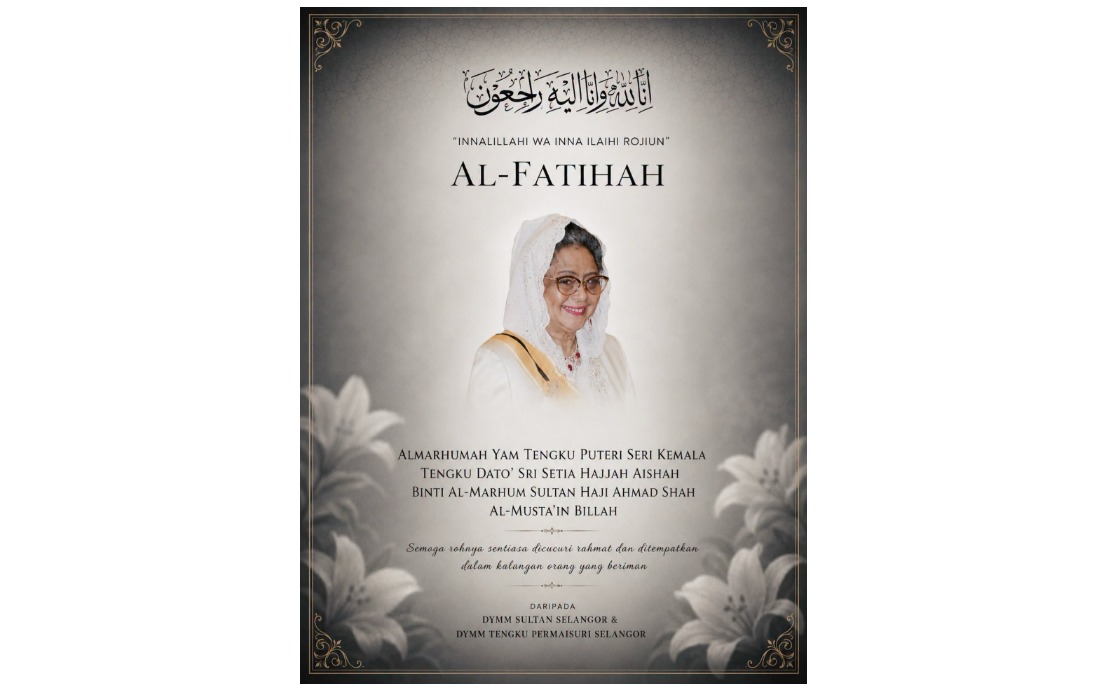
The Malaysian royal establishment has extended formal condolences following the death of a prominent member of the Pahang royal family. Sultan Sharafuddin Idris Shah of Selangor and his consort, Tengku Permaisuri Norashikin, have conveyed their sympathy to Al-Sultan Abdullah Ri'ayatuddin Al-Mustafa Billah Shah, the Sultan of Pahang, in the wake of his elder sister's passing.
Tengku Datuk Seri Aishah, formally known as Tengku Puteri Seri Kemala Tengku Datuk Seri Aishah Almarhum Sultan Ahmad Shah, died on Tuesday evening at a private hospital in Kuala Lumpur. She was 83 years old at the time of her death. The Selangor Royal Office released an official statement confirming that the Sultan and Tengku Permaisuri had dispatched their condolences through appropriate diplomatic channels.
In their message of sympathy, the Selangor royal couple emphasised their profound sadness at the loss and offered prayers for the deceased. The formal statement released by the palace indicated that both the Sultan and Tengku Permaisuri hoped that Tengku Datuk Seri Aishah's soul would receive divine mercy and find peace among the righteous. The traditional Islamic phrase Al-Fatihah was recited in honour of her memory, reflecting the solemn religious observances that accompany royal deaths in Malaysia.
Tengku Datuk Seri Aishah held considerable significance within the Pahang royal household as the elder sister of the reigning Sultan. Her life spanned nearly eight decades, witnessing the post-independence evolution of Malaysia's constitutional monarchy system. Family connections between the various Malay royal houses are traditionally maintained through formal courtesy and ceremonial protocols, particularly during moments of family transition such as death.
Following her passing at 9.15 pm on Tuesday, arrangements began immediately for her funeral and burial in accordance with royal protocol and Islamic custom. The deceased was transported to the Pahang Royal Mausoleum located in Pekan, the royal capital of Pahang state. Her final rites were to be conducted with full royal honours, reflecting her status as a member of one of Malaysia's most prominent ruling families.
The funeral proceedings adhered strictly to established royal customs and religious requirements. As a senior member of the Pahang royal lineage, Tengku Datuk Seri Aishah was accorded ceremonial respect befitting her rank and family position. The Pekan mausoleum, which houses numerous members of the Pahang royal dynasty, would serve as her resting place in accordance with family tradition.
Inter-royal condolences of this nature represent an important aspect of Malaysia's constitutional monarchy framework, where the various state rulers maintain formal relationships through established protocols. The public expression of sympathy from the Selangor Sultan underscores the bonds that unite Malaysia's royal households across state boundaries. Such gestures carry both ceremonial and symbolic weight, demonstrating respect for family loss within the broader context of the nation's royal institution.
The Selangor royal family, one of the most prominent in the federation, frequently engages in such formal expressions of solidarity with counterparts in other states. The timing and content of the condolence message reflected standard diplomatic practice within Malaysia's unique constitutional framework, where state rulers maintain cordial relations despite their individual administrative responsibilities.
Tengku Datuk Seri Aishah's death marks the passing of another generation within Malaysia's royal elite, individuals who witnessed the nation's transformation from colonial administration to independent statehood and modern development. Her remaining decades as a senior family member were spent largely away from public scrutiny, though her status guaranteed her a position of respect within Pahang's royal structure.
The condolences extended by Sultan Sharafuddin and Tengku Permaisuri Norashikin exemplify the mutual respect and ceremonial courtesies that characterise relationships among Malaysia's nine hereditary rulers. Such formal acknowledgements of significant family events serve to reinforce the institutional continuity of the royal system, which remains central to Malaysian constitutional arrangements and national identity.

