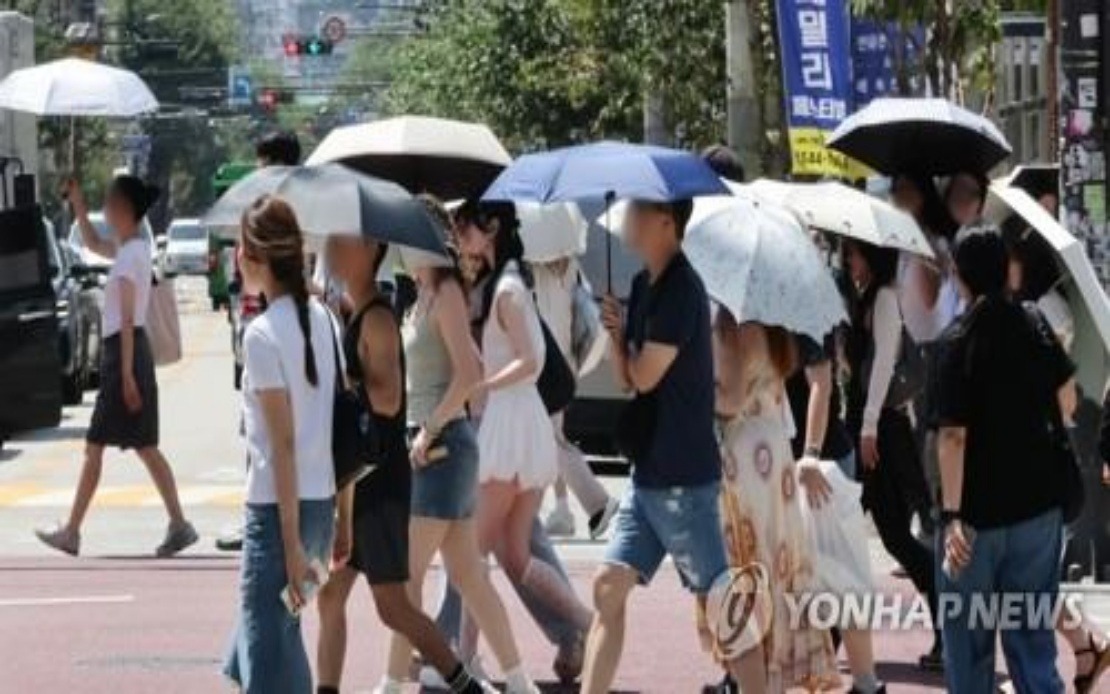
South Korea has been engulfed by a punishing heat wave that pushed temperatures above 40 degrees Celsius across Seoul and several other population centres on Friday, marking a concerning escalation in the country's battle against extreme weather. The Korea Meteorological Administration recorded 40.2°C at an automatic weather station in Seoul's Nowon ward at 3.28 pm, a threshold not breached in the capital since August 1, 2018, when the city experienced 41.8°C. The significance of this temperature spike extends beyond mere numerical records; it reflects a broader pattern of intensifying heat that is affecting daily life, public health, and infrastructure across one of East Asia's most densely populated regions.
The heat's reach extended well beyond Seoul's boundaries, transforming the broader Korean peninsula into a danger zone for heat-related illnesses and strain on cooling systems. Hanam's Deokpung district, positioned southeast of the capital, registered 40.7°C at 2.32 pm, while Gwangyang, situated approximately 300 kilometres to the south, recorded 40.2°C at 2.37 pm. Additional hotspots emerged in Yeongweol County in Gangwon Province and Yeoju in Gyeonggi Province, both reaching 39.8°C. This geographic spread demonstrates that the extreme heat is not confined to urban heat islands but rather represents a nationwide phenomenon affecting rural and urban areas alike, with important implications for agricultural production and water resources across the country.
What distinguishes this particular heat episode is not just the peak temperatures but the duration and intensity of thermal stress being imposed on the population. The Korea Meteorological Administration reported that the nation has experienced an average of 14.8 heat wave days—defined as periods when daytime highs reach 33°C or above—between June 1 and Thursday. This figure represents the fourth highest count for the identical period since the nationwide weather observation network expanded in 1973, placing the current situation in historical context as an extreme but not unprecedented event. More alarming, however, are the tropical nights, defined as periods when minimum temperatures fail to drop below 25°C, which have reached a record 13 days. These nights offer no respite to residents and industrial facilities alike, preventing natural cooling and maintaining thermal stress throughout the twenty-four-hour cycle.
The sustained nature of these tropical nights carries particular significance for public health and energy infrastructure. When nighttime temperatures remain above 25°C without relief, vulnerable populations including the elderly, infants, and those with pre-existing health conditions face compounded physiological stress. The inability for indoor spaces to cool naturally through ventilation during evening hours forces continued reliance on air conditioning, straining electrical grids during peak demand periods and raising concerns about brownouts in a nation with aging power infrastructure. For Malaysia and other Southeast Asian neighbours, the South Korean experience serves as a cautionary example of how climate change is shifting temperature baselines upward, potentially creating new normal operating conditions that existing infrastructure and public health systems were never designed to accommodate.
In response to the crisis, South Korea's weather authorities took measured steps to adjust their alert systems as they monitored the trajectory of the heat wave. The Korea Meteorological Administration announced Friday evening that it would downgrade the serious heat wave warnings previously issued for Seoul and the eastern and southwestern portions of the country to ordinary warnings beginning at 6 pm. The capital had been operating under the highest-tier heat alert since Tuesday, reflecting the sustained nature of dangerous conditions. This downgrade represents a cautious optimism that the most acute phase may be passing, though the adjustment reflects the difference between serious and ordinary warnings rather than an elimination of heat-related risks altogether.
The criteria for these warning classifications reveal the scientific sophistication underlying South Korea's heat response system. According to Korea Meteorological Administration guidelines, a serious heat wave warning is triggered when apparent temperatures—a measure that combines actual temperature, humidity, and wind—are projected to reach 38°C or higher, or when daily maximum temperatures exceed 39°C or above, specifically in regions where the highest perceived temperature already registers at 35°C or higher. These conditions must persist for two or more consecutive days to trigger the top-tier alert. The framework demonstrates recognition that raw temperature readings alone cannot capture the full physiological burden imposed by heat, particularly when humidity levels elevate the apparent temperature substantially above the actual mercury reading.
The forecast provided by weather authorities offers modest improvement but hardly suggests a return to normal conditions. Saturday's predictions call for morning lows ranging between 21°C and 26°C nationwide, with daytime highs expected between 26°C and 35°C. While these numbers represent a decrease from the 40°C readings, daytime highs approaching 35°C still place much of the country within the definition of a heat wave day, meaning that even as conditions ease, the burden of extreme heat will persist throughout the weekend and beyond. The gradual nature of this forecasted improvement contrasts sharply with the sudden intensity of the heat surge and suggests that meteorological patterns are shifting only incrementally rather than transforming entirely.
For Malaysia and the broader Southeast Asian region, South Korea's experience carries important lessons about preparedness and adaptation to changing climate patterns. While tropical nations have long experience managing heat, the combination of factors present in South Korea—the unprecedented duration of heat stress, the record tropical nights, and the historical rarity of the event—suggests that even heat-accustomed populations face challenges when climate patterns shift beyond historical norms. The Korean peninsula, typically cooler than Southeast Asia, is now experiencing conditions that rival or exceed temperatures common to equatorial regions, yet its population and infrastructure developed under different thermal assumptions. This experience underscores that climate change presents not simply a matter of slightly warmer temperatures but rather a fundamental reshaping of the thermal environment in which societies must operate.
The broader policy and preparedness implications extend across multiple sectors. Public health authorities must grapple with potential surges in heat-related emergency visits, mortality among vulnerable populations, and long-term health consequences of repeated extreme heat exposure. Energy infrastructure planners must design systems capable of handling sustained peak cooling demand without risk of failure. Urban planners are increasingly turning attention to heat mitigation strategies such as expanded green spaces, reflective building materials, and modified urban geometry to reduce heat island effects. For emerging economies in Southeast Asia watching developments in more developed neighbours, the South Korean heat wave represents a real-world stress test of how modern, wealthy nations manage extreme weather, providing valuable data about what preparations prove effective and which vulnerabilities remain despite substantial resources. The experience also highlights the importance of international cooperation on climate adaptation, as extreme heat respects no borders and affects the stability of regional supply chains, particularly in electronics and manufacturing sectors where South Korea plays a crucial role in global production networks affecting Malaysia and other trading partners.

