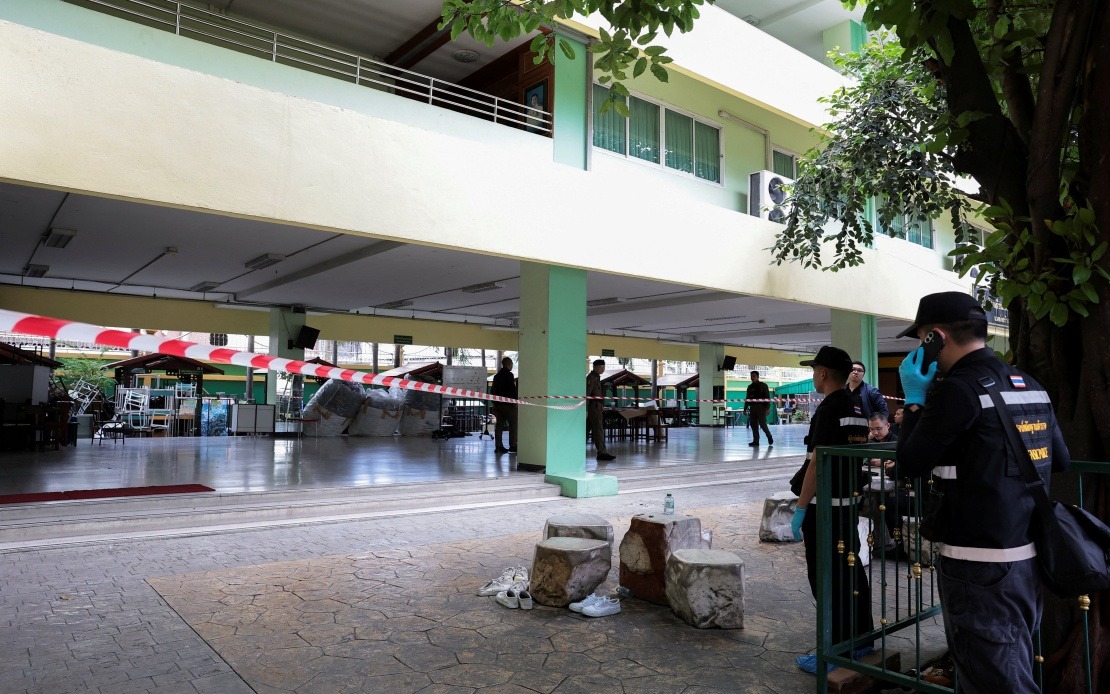
A devastating shooting at Debsirin Nonthaburi School in Bang Kruai district has claimed seven lives and left at least fifteen people hospitalized, marking yet another tragedy in a troubling pattern of firearms violence across Thailand. The incident unfolded on Friday morning around 10 am when a student at the school opened fire on staff and fellow pupils, resulting in the deaths of three teachers, three students, and the suspect himself. The casualty toll underscores the sudden and severe nature of the attack, which saw emergency responders scramble to contain the situation and evacuate survivors.
According to Lieutenant General Trairong Piwpan, the Royal Thai Police deputy inspector-general and spokesperson, investigators quickly established that the weapon was a 9mm handgun with 34 rounds of ammunition kept outside its magazine. The firearm did not belong to the shooter himself but to his grandfather, raising critical questions about firearm storage practices and family supervision within homes. This detail carries particular significance for Southeast Asian nations grappling with similar risks, where enforcement of safe gun handling standards and parental responsibility remains inconsistent.
The immediate aftermath saw authorities execute an emergency evacuation protocol, relocating teachers and students to the nearby Chanrat Wittaya School while parents and guardians rushed to retrieve their children from the scene. The swift institutional response prevented further casualties, though the psychological impact on survivors and the wider school community will extend far beyond Friday. In recognition of the trauma involved, Thailand's national police chief directed Police General Hospital to deploy psychologists to provide mental health support and counselling to affected individuals, acknowledging that recovery from such incidents requires comprehensive care beyond physical medical attention.
Prime Minister Anutin Charnvirakul, who serves concurrently as interior minister, appeared at the scene to express official condolences and pledged immediate government assistance to the injured. His statement linking the shooting directly to the government's hardline stance on firearm permits reflects a broader policy response aimed at tightening weapons regulations. By explicitly connecting the incident to the administration's decision to halt the renewal of carrying and possession permits, Anutin sought to frame the tragedy as vindication for stricter gun control measures, a position that carries weight in a nation where civilian access to firearms already remains heavily restricted compared to Western countries.
The shooting represents the second major school violence incident in Thailand within six months, intensifying public anxiety and policy scrutiny. In February, an eighteen-year-old gunman opened fire at a school in Hat Yai, Songkhla province, killing the school director and wounding multiple others before law enforcement apprehended him. The recurring nature of these incidents within such a compressed timeframe suggests systemic vulnerabilities that extend beyond individual perpetrators, encompassing questions about mental health screening, early intervention protocols, and community awareness programs that might identify warning signs before violence erupts.
For Malaysian policymakers and security experts monitoring regional developments, the Nonthaburi incident carries instructive lessons. While Malaysia maintains similarly strict civilian firearms regulations, the transnational character of security challenges means that destabilizing violence in neighboring Thailand can have ripple effects across the region. The involvement of a family member's firearm in this attack parallels concerns raised in Malaysian security circles about household weapons being accessed by unauthorized individuals, particularly youth struggling with psychological distress.
The broader context reveals a troubling intersection of youth mental health crises and inadequate early intervention systems across Southeast Asia. Thailand's education sector, like Malaysia's, operates within resource constraints that limit school-based counselling and psychological support services. When students experience acute psychological disturbance, the absence of robust detection and intervention mechanisms creates dangerous gaps that can culminate in tragic incidents. The shooter in this case was a student at the school, meaning he had presumably interacted with teachers and administrators who may have lacked formal training to recognize severe behavioral deterioration or access pathways to mental health services.
The apparent ease with which the shooter accessed his grandfather's firearm illuminates regulatory compliance challenges in household firearm storage. Even in jurisdictions with strict licensing requirements, enforcement of proper storage protocols—including secure locking mechanisms, ammunition separation, and family education—remains inconsistently implemented. This vulnerability exists across multiple Southeast Asian nations where police capacity for regulatory oversight is stretched across competing priorities. Thai authorities will likely use this incident to initiate stricter inspections of licensed firearm owners' home storage practices, a measure that Malaysian law enforcement might review in its own operational procedures.
The government's response strategy, centered on halting permit renewals and tightening access restrictions, reflects a prevention-through-limitation approach rather than intervention-based strategies. While reducing civilian firearm prevalence logically decreases supply-side risks, this approach does not address demand-side factors driving individuals toward violence. Mental health system strengthening, school-based threat assessment programs, and community early warning mechanisms represent complementary policy levers that Thailand's government may need to activate alongside restrictive licensing measures.
For the international community and particularly for ASEAN member states, the Nonthaburi school shooting underscores the necessity of cross-border intelligence sharing regarding individuals with documented violent ideation or psychological crisis markers. If the shooter had previously received mental health intervention or displayed flagged behavior patterns, regional cooperation mechanisms might have enabled preventive intervention. Malaysia and other ASEAN nations should explore deepening policy coordination on school security, mental health referral systems, and threat assessment protocols that transcend national boundaries while respecting sovereignty and privacy protections.
The incident's timing during Thailand's broader political and social challenges—including economic hardship, youth unemployment, and intergenerational tension—suggests that individual acts of violence may correlate with ambient social stress conditions. When young people face limited economic prospects, experience social marginalization, or struggle with untreated psychological conditions against a backdrop of general societal anxiety, the probability of extreme reactive violence increases. This structural dimension requires policy responses extending beyond law enforcement into education reform, youth employment programs, and mental health system expansion that remain underfunded across Southeast Asia.
As Thailand's authorities investigate the shooter's motives and background, regional security analysts will scrutinize whether ideological radicalization, personal grievance, or acute psychiatric crisis primarily drove the violence. The answer will inform whether similar risks exist in neighboring countries and what preventive strategies would prove most effective. Meanwhile, the seven victims—three teachers and three students plus the shooter—represent a profound human cost that education systems across Southeast Asia must confront as they reassess safety protocols, mental health provisions, and emergency preparedness standards in schools.

